

Trending Moment, Immediate Thesis
Bayern Munich are back at the center of Europe’s debate, dissected for what they are right now and speculated upon for what they might become next. Tactically speaking, there is a single pivot point that explains both conversations: Harry Kane’s 9.5 role has rewired Bayern’s 3-2-5 structure. It changes who receives between the lines, who pins the last line, where the half-space advantage is created, and, crucially, how Bayern defend transitions when possession turns. In our view, that is the real reason Europe is reranking Bayern—up or down—depending on whether you believe this system is fully optimized or fatally imbalanced.
“Kane’s 9.5 role doesn’t just add goals; it redraws Bayern’s passing map and forces a new logic on their rest-defense.”
This isn’t transfer gossip or table watching; it’s about how one striker, operating as a hybrid creator-finisher, shifts the geometry of a superclub. The implications reach from the right half-space to the Champions League’s sharpest counterattacks, and from Munich’s training ground patterns to the scouting boards of every rival trying to puncture the Bavarian machine.
The Shape: A 3-2-5 That Breathes Around a 9.5
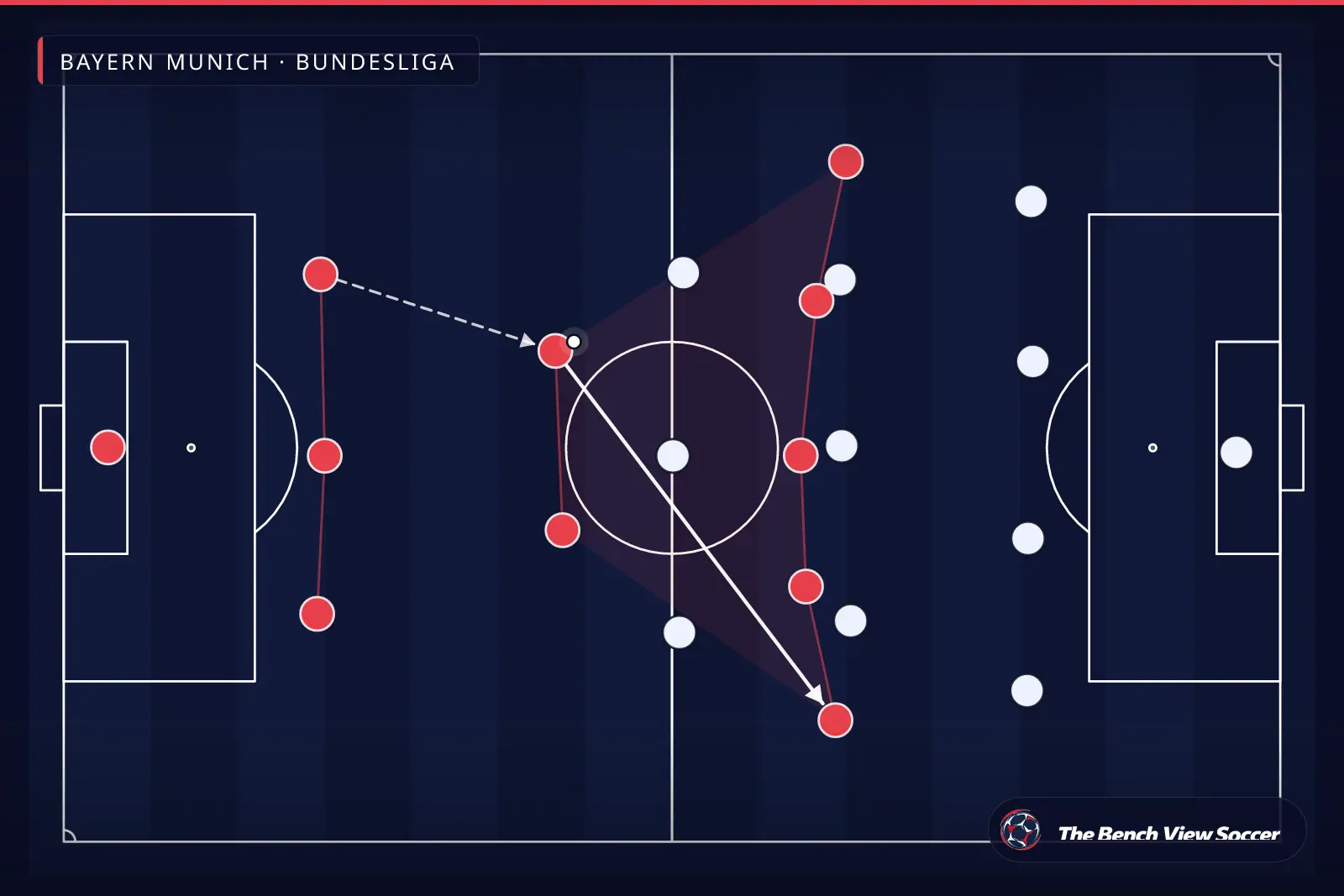
Strip the names and you’ll still recognize the skeleton: Bayern build in a 3-2-5. One fullback inverts, the other often holds width or steps as an auxiliary eight, the wingers stretch the touchlines, and two eights jockey for the half-spaces. The twist is that Kane is not a static nine. He oscillates across the front, drops into the pocket, and plays as a connective hub. This recodes the lanes of progression:
- The initial line is often a back three, formed either by the fullback’s inversion or a midfielder dropping between center-backs.
- The double pivot (Kimmich + partner) forms the second line of rest-control, looking for diagonals into the interior lanes.
- The front five stagger: left winger wide, left eight (often an interior technician) in the left half-space, Kane hovering between the right half-space and central pocket, right eight (e.g., Musiala) making third-man runs, and the right winger pinning the far-side fullback.
When all five slots are occupied with the right timing, Bayern achieve positional superiority: an extra man around the ball in the most valuable corridors. The problem for opponents isn’t just that Kane can finish; it’s that his back-to-goal play converts sterile possession into dynamic advantage in a single, disguised touch.
Kane the 9.5: The Pass Before the Pass, and the Shot After It
The 9.5 label matters. Kane doesn’t merely check short; he checks with purpose to unlock the third man. Consider the role sequence:
1) Kane drops from the blindside of the center-back into the right half-space pocket.
2) The nearest eight (often Musiala) starts high, then runs beyond the receiving line as Kane arrives.
3) Winger holds width to elongate the fullback, creating a diagonal channel.
4) Ball arrives at Kane; with one touch he either lays off to the pivot who has stepped through the line (third-man bounce) or spins into a give-and-go, opening the channel for a through ball.
This is neither a pure false nine nor a conventional target man. It’s a timekeeper. The benefit is twofold: Bayern retain a finisher in the box because the weak-side eight or far-side winger crashes the area on cue, and they manufacture an extra central connector without sacrificing their wide threat. Kane’s signature contributions—angled layoffs, disguised reverse passes, and late penalty-box entries—produce a passing map that looks like a hinge: the attack swings through him.
Right-Side Bias, Left-Side Release
Bayern’s right lane is their ignition point. When the right-back stays a little deeper or inverts, he pulls a marker and frees the right half-space. Two classic sequences show the template:
- 28’ vs Manchester United (2023–24 UCL group, Allianz): The move that led to the first goal began with a right-side punch through the half-space. Even if the final finish owed something to a goalkeeping error, the build-up was pure Bayern-under-Kane: drop, bounce, third-man runner breaking the line.
- 9’ at Borussia Dortmund (Nov 2023, Bundesliga): Kane’s early angled movement dragged the near center-back one step higher, the right eight ran inside-out, and the box run reappeared like clockwork. Result: an early knockout punch in a match Bayern controlled through timing more than territory.
On the left, the fullback’s inversion is the release valve. When the left-back steps in alongside the pivot, Bayern produce a box midfield in possession (fullback + pivot with the eights). That box allows circulation without risk and primes the switch that finds the weak-side winger 1v1.
- 63’ vs Arsenal (Apr 2024, UCL): The winning sequence at the Allianz materialized from a left-side overload that turned into a whiplash delivery to the far-post runner. That cross found Joshua Kimmich darting beyond a flat-footed back line—an under-discussed effect of Bayern’s far-side timing. Even when Kane is deeper, the box guarantees a point of control for the big switch.
Pressing Triggers and the Hidden Cost of a 9.5
In possession, the 9.5 is a cheat code. Out of possession, it changes the first line of pressure. Instead of pinning the opposition’s six with his body shape like a traditional nine, Kane often stands a half-step off, ready to spring on a back pass. The pressing picture looks like this:
- Trigger 1: Opponent’s back pass from fullback to center-back—right winger jumps, right eight presses the pivot’s near shoulder, Kane angles the lane to the far center-back with his cover shadow.
- Trigger 2: Heavy touch by opposition six—Kane pounces head-on, eights squeeze from the blindside, and a fullback steps into midfield to compact the zone.
- Trigger 3: Switch under pressure—Bayern’s far-side winger starts early, baiting the receiver into a touchline trap.
That first line needs impeccable coordination. If Kane is two beats deep from an attacking action, the angle on the six disappears and Bayern slide into a softer mid-block. When that happens, their rest-defense is tested, because in a 3-2 rest shape the wide channels can be exposed if both eights had pushed into the last line.
- 18’ at Leverkusen (Feb 2024, Bundesliga): Xabi Alonso’s side punished exactly this space with a switch-to-advance pattern that found a wing-back high and free, forcing Bayern’s near center-back to defend the width without cover. The goal wasn’t about individual mistakes; it was the systemic tax you pay when the nine is also your auxiliary ten.
Half-Spaces: Where Bayern Win or Lose Champions League Ties
The half-spaces matter twice over for Bayern. First, they are the route to get Kane facing forward. Second, they are the area opponents attack when Bayern’s eights are ahead of the ball.
On the ball: Bayern engineer 2v1s by stacking the half-space with an eight inside and Kane just outside the cover shadow. The nearest winger stays wide to stretch the fullback. When the ball arrives to the eight, Kane is the pressure escape: a cushioned layoff, a spin, and the third man goes. This is how Bayern create clean entries without sprinting a runner directly through a crowded middle block.
Off the ball: When transitions bite, it’s typically because both eights are beyond the opposition midfield line and the double pivot is outnumbered. If the inverted fullback has moved high to sustain pressure, the back three becomes a stretched two-and-a-half. That’s when elite sides drop the ball into the right or left half-space behind Bayern’s jumping fullback and race the near center-back to the corner of the box. The quick cut-back is the danger zone.
Solving the Rest-Defense Equation
There are three levers Bayern can pull without changing personnel:
- Stagger the eights: one high, one mid, never both beyond Kane at the same time in settled possession. That ensures a re-press screen.
- Invert selectively: if the left-back inverts, the right-back stays deeper to widen the base, creating a 3+2 with true width in the first line.
- Time the counter-press: the instant Kane drops, the nearest eight must rotate behind him to protect against a vertical poke through midfield. It’s choreography—think spinning gears, not linear lanes.
When those levers are hit, Bayern look untouchable. When they’re mistimed, elite opponents don’t need three chances; one transition can flip a knockout tie.
Why This Looks Different From Previous Bayern Eras
Every great Bayern side had a structural signature:
- Heynckes 2013 (4-2-3-1): Wide wingers, double pivot security, relentless box entries from the 10. The nine ran the line, not the rhythm.
- Guardiola 2014–16 (positional play): 3-1 and 2-3 starts, hyper-controlled rest-defense, inverted fullbacks as midfielders, false-fullbacks and fixation on half-spaces, but with a nine often tasked to pin rather than create.
- Flick 2020 (vertical wave): A high line married to furious counter-pressing; wide overloads and ruthless cut-backs. The nine finished the move more often than he initiated it.
- Nagelsmann/Tuchel bridge (hybridization): Box midfield, fullback inversion, inside wingers, and higher variance between pinning and dropping nines.
What we see now is the cleanest synthesis of the last decade’s experiments: Guardiola’s love of central progression, Flick’s appetite for immediacy, and a nine whose passing vision allows both to co-exist. The price is the balancing act in rest-defense. Earlier Bayern sides solved it by role clarity: the nine pinned, the tens created, the pivots guarded. Today, Kane collapses the creator-finisher divide, and the pivots’ burden increases accordingly.
Case Studies: Five Sequences That Explain the Whole
1) 28’ vs Manchester United (Allianz, UCL 2023–24): The Right-Half-Space Trigger
Setup: Right-back stays in the half-lane, right eight starts high, right winger chalk-on-boots. Ball cycles left-to-right to draw the press across.
Action: Kane steps into the pocket just as the right eight checks away. The pass is fizzed into Kane’s back foot; he bounces it diagonally to the pivot, who has stepped past the line; the third-man release hits the eight sprinting inside the fullback.
Outcome: Chaos in the box, rebound falls kindly, the opener follows. The lesson: Kane’s layoff is the hinge on which a dead attack turns.
2) 9’ at Borussia Dortmund (Nov 2023, Bundesliga): The Early Box Run
Setup: Bayern compress the right side from kickoff, then feint a switch. The right winger holds, Kane drops and pulls the center-back into no-man’s land.
Action: Musiala (as the right eight) runs beyond, Kane’s touch sets the angle.
Outcome: An early strike that alters the match state. The lesson: Bayern’s best tool to silence a hostile stadium is the timed underlap into a Kane-shaped wall pass.
3) 18’ at Bayer Leverkusen (Feb 2024, Bundesliga): The Rest-Defense Tax
Setup: Bayern in a 3-2-5, left-back high, both eights advanced to second-post positions.
Action: Turnover in the left half-space. Leverkusen switch diagonally to the far wing-back, who receives without pressure, forcing a scrambling retreat.
Outcome: A clean finish at the end of a wide-to-inside transition. The lesson: if the box midfield loses its rear guard, Bayern’s width in the first line collapses and the back three gets stretched.
4) 63’ vs Arsenal (Apr 2024, UCL): The Weak-Side Knockout
Setup: Prolonged left-side pressure with the fullback inverted to form the box. Arsenal’s block shifts and compresses, the far fullback gets caught in two minds.
Action: Timing window opens; a fast switch followed by a whip cross to a delayed runner.
Outcome: The decisive header. The lesson: the box isn’t just for control; it sets the trap that springs the cross to a late-arriving finisher.
5) 72’ at Borussia Dortmund (Nov 2023, Bundesliga): Kane the Finisher
Setup: Bayern in control, Dortmund chasing. Kane has spent an hour as the link; the defense now leans toward his passing lanes.
Action: The ball arrives centrally; this time, no layoff. Kane turns, steps into the blindside gap he’s conditioned the defense to expose, and finishes clinically.
Outcome: The game is over. The lesson: the 9.5 keeps the shot-quality switch in his pocket for the final third of matches.
The Why: Systemic Factors Behind Bayern’s Pattern
Why did Bayern go this way? Three systemic reasons explain the evolution:
- Talent distribution: Their squad has creators who like to carry (e.g., Musiala) and fullbacks comfortable inside (e.g., Guerreiro-style profiles). A nine who connects completes the triangle.
- European reality: Champions League opponents deny the obvious through-balls and punish sloppy rest-defense. A 9.5 can recycle pressure without losing centrality, preventing the sterile horseshoe.
- Legacy learning: After years of toggling between a pinning nine and a false nine, Bayern have chosen the middle path. It gives them control without blunting their finishing.
What Europe Must Solve: The Three Problems Kane Creates
Opponents see three related problems, all born of Kane’s duality:
1) Who marks him between the lines? If a center-back jumps, the channel opens. If the six steps, the pivot line thins.
2) How do you defend the third man without overcommitting? Tracking the eight kills your compactness; staying put grants Bayern a free turn.
3) How do you transition without triggering Bayern’s re-press? If you pass central, Kane sits on the lane; if you go wide, the touchline trap looms.
The best answers so far combine three ideas: screen Kane with a zonal six who refuses to follow, press the pivots from the blindside with wingers, and first-time every regain into the far half-space before Bayern re-forms the box. This is why Leverkusen and Real Madrid types feel like bad matchups: their first touches under pressure are passes, not traps.
If You’re Bayern: The Next 10%
There are four obvious optimizations Bayern can chase without buying anyone or reinventing the wheel:
- Pre-activate the far-side winger: cue him to arrive at the back post as soon as Kane drops. The extra body restores box threat while Kane creates.
- Rotate the pivot behind the ball on every Kane drop: automate the safety valve so the re-press is guaranteed.
- Vary the right-back role: alternate invert/depth holds to widen the rest shape on possession losses. It’s insurance against the diagonal switch.
- Drill a two-touch rule for the eight in traffic: one to control under contact, one to bounce. It sustains tempo and preserves spacing.
Do those things and Bayern don’t just look controllable; they look inevitable.
Historical Context: The 9.5 in Superclub Systems
It’s worth stepping back. The 9.5 is not new, but its deployment inside a committed 3-2-5 is the fresh twist. Think Wayne Rooney’s connective work alongside Van Persie, Karim Benzema’s linking role in Madrid’s varied shapes, or Roberto Firmino’s setting of Liverpool’s pressing and buildup. Bayern’s version is more possession-centric than Liverpool’s and more box-dominant than prime Guardiola-Barça. It sits in the sweet spot modern knockout football rewards: control until the trap opens, then five men hit the area.
What makes Bayern interesting is that they can still look like an old-school 4-2-3-1 in the blink of an eye: Kane steps up, the right eight becomes a 10, and the winger collapses inside. Their fluidity is not a gimmick; it’s a structural affordance of the 3-2-5, where one player’s lane shift cascades into a formation change.
What This Means for the Season, the Player, the Club
- Season outlook: In our view, Bayern’s league ceiling remains defined by their ability to automate the rest-defense behind Kane’s drops. Domestic opponents can be overcome by talent and repetition; Europe will punish single errors. The good news is that the 3-2-5/9.5 blend is a tie-control machine when the spacing is right. Expect Bayern to look more comfortable protecting narrow leads than in recent seasons, because Kane’s central presence allows them to keep the ball in areas that smother counters.
- Player trajectory: Kane’s role at Bayern is legacy-defining. The 9.5 tag is a feature, not a compromise; it showcases the full spectrum of his game without marginalizing his finishing. As long as Bayern keep cramming the box with weak-side runs, he doesn’t sacrifice goal volume to provide platform play.
- Club identity: Bayern are moving toward a European identity built on half-space dominance rather than pure wing play. It won’t look like 2013, and it shouldn’t. The league has caught up athletically; control is the new aggression.
A Tactical Thought Experiment: If Anyone Came for Kane
We won’t wade into rumor mill waters. Tactically speaking, if any elite club ever angled for Kane, the hook wouldn’t be “more goals”—it would be the 9.5 effect: instant chemistry with box-crashing eights, wingers who arrive rather than depart, and pivots who relish forward-facing touches. Bayern know this, which is why their current blueprint is designed to make his profile indispensable, not optional. The smartest response to outside interest is always to make the role irreplaceable.
A Counterargument Worth Hearing
Some argue Bayern would score more and suffer less defensively with a pure vertical nine who sprints the last line, letting a dedicated 10 orchestrate play. The logic is clear: keep the nine pinning, reduce midfield rotations, and stabilize rest-defense. There’s truth here—especially against disciplined low blocks where an extra runner instead of an extra passer can improve shot volume.
But in our view, that trades away the very quality that makes Bayern unpredictable in Europe: the capacity to win the middle before striking the box. Against elite blocks, sterile circulation is the real enemy; the 9.5 keeps the circulation dangerous. The antidote to transition risk isn’t eliminating the 9.5—it’s nailing the re-press choreography behind him.
How to Beat This Bayern
Coaches plotting an upset need to accept that you won’t block every half-space entry. You have to choose the poison and time your antidote:
- Allow the first bounce into Kane but deny the third man: build a pressing cage that collapses after the layoff, not before it. The counter lives in the vacuum Kane leaves if you win the duel immediately after his touch.
- Attack the far-side fullback with pre-programmed diagonals: as soon as Bayern invert on the left, your right winger should be cheating to the touchline, ready to receive the switch in stride.
- Force Kane into square touches: body-shape your six to show him lateral options, never vertical. Lateral touches let your block recover and rob Bayern of their timing advantage.
Even then, you will need high-execution moments: first-time passing, ice-cold finishing, and a goalkeeper brave enough to stand on crosses without punching everything. The margins are thin because Bayern’s structure is designed to starve chaos.
What Bayern Should Fear—and Welcome
Fear the games where the wingers don’t arrive at the back post. Kane’s deeper role becomes a liability if the box is underpopulated. Fear, too, the matches with a referee who permits aggressive contact on the bounce; if rivals can foul the hinge without sanction, Bayern’s timing fizzles.
Welcome the matches that force prolonged possession. This Bayern can suffocate opponents’ lungs by keeping the ball in the half-spaces for minutes on end. Welcome, also, the sides that press recklessly with a back four—Kane’s angled layoffs will shred those rotations and hand Bayern repeated 2v1s on the wings.
The Detail That Changes Everything: Timing, Not Formation
It is seductive to fixate on formations. The 3-2-5 describes the picture; it doesn’t describe the speed of paint drying. Bayern’s success hinges on when Kane drops, not simply that he drops; on when the right eight runs, not simply that he runs; on whether the pivot has stepped behind the ball a half-second before the vertical pass, not after. The best coaches don’t teach positions; they teach time. Bayern are closest to being unplayable when their time signatures are tight.
Verdict
In our view, Bayern Munich’s present and near future turn on a single truth: Harry Kane’s 9.5 role has rewired their 3-2-5 so profoundly that you cannot separate his pass-map from their chance-map. It is the blueprint that makes them European favorites on their best nights and vulnerable to diagonals on their worst. That’s the bargain. It is a good one.
If Bayern keep the eights staggered, the fullbacks complementary, and the re-press automated the instant Kane checks, they will not merely dominate possession—they will decide where and when the game can hurt them. When you can choose the danger, you usually win. That’s why, despite all the noise, the quietest and most decisive change in European football might be a striker who learned to be the pass before the pass—and never forgot how to finish the move.
The Bench View app
Don’t just read football — train it
Everything you read here, turned into training you can follow step by step.
Physical training at home
AI daily sessions adapted to your level and position. No equipment needed.
Tactical training courses
Step-by-step courses on positioning, pressing, build-up and decision making.
- 7 days free
- No commitment
- Cancel anytime
Free account: 2 physical sessions + the first tactical course. PRO: 7-day free trial — cancel before day 8 and you pay nothing.
More Analysis
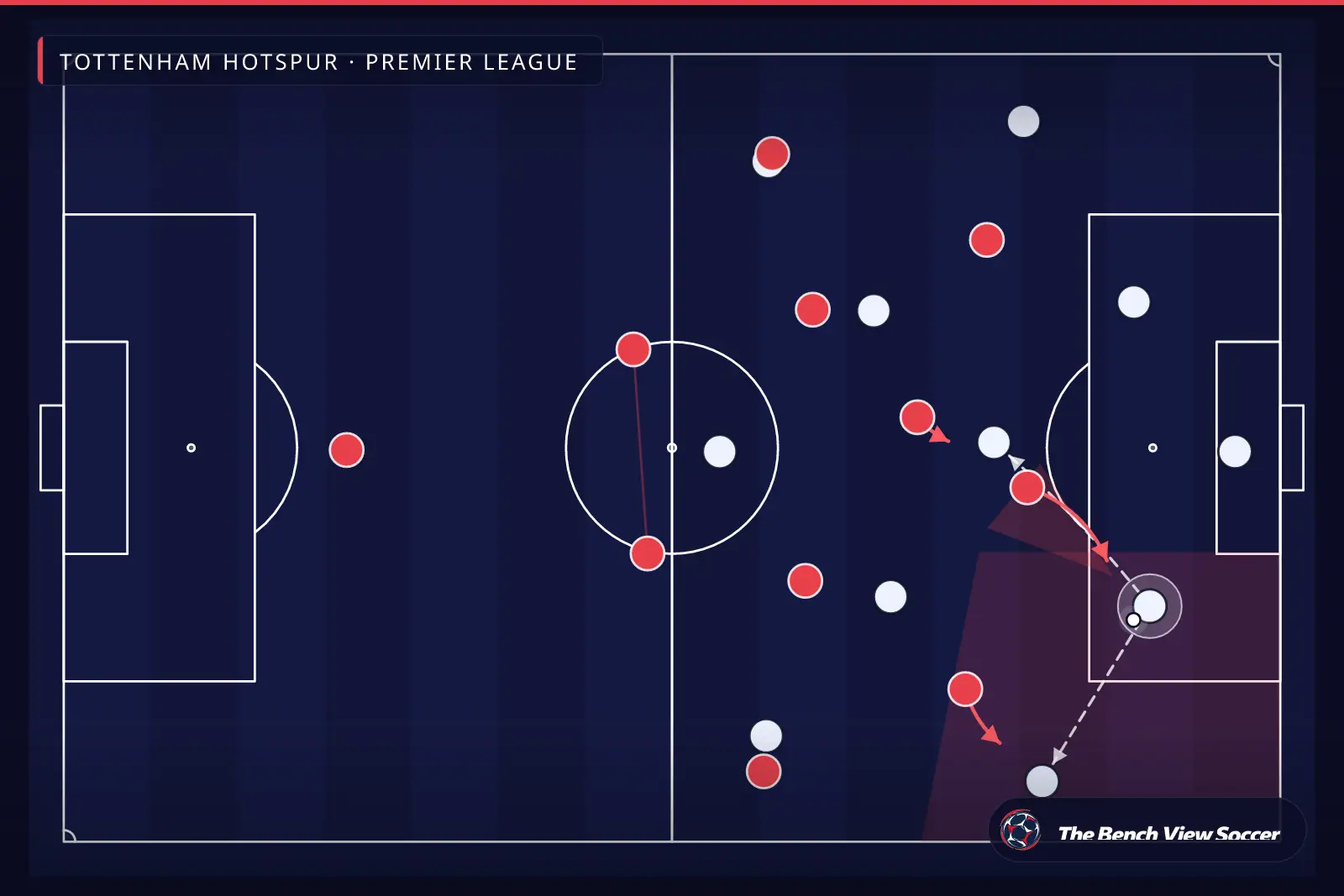
Tottenham Hotspur: How World Cup 2026 Is Warping Their Press
August 27, 2026
Chelsea's 3-2-5 Rest-Defense Is the Real Champions League Edge
August 27, 2026
Aston Villa's Box Midfield Is the Premier League's Real Edge
August 26, 2026
Chelsea's Box Midfield Is Fueling Chaos at the Cottage — Why
August 24, 2026