Introduction
Manchester City under Pep Guardiola treat set-pieces (corners and free-kicks) like mini-attacks rather than “dead-ball moments.” For fans who mostly learn tactics through open play—passing triangles, pressing, counter-attacks—City’s set-piece work is a great entry point into how elite teams plan small details to create big advantages. The key idea is simple: City do not just “aim for the tallest guy.” They build routines to engineer mismatches—situations where a City player gets a favourable duel against an opponent who is smaller, slower, or distracted. They also manipulate the opponent’s marking system, whether it is man-marking (each defender tracks a specific attacker) or zonal marking (defenders guard spaces). In the Premier League and UEFA Champions League, where opponents study City intensely, these small advantages matter. This article breaks down what City commonly do at set-pieces, why it works, and how you can watch for the cues—blocks, decoy runs, second balls, and back-post overloads—without needing advanced coaching language.
How It Works
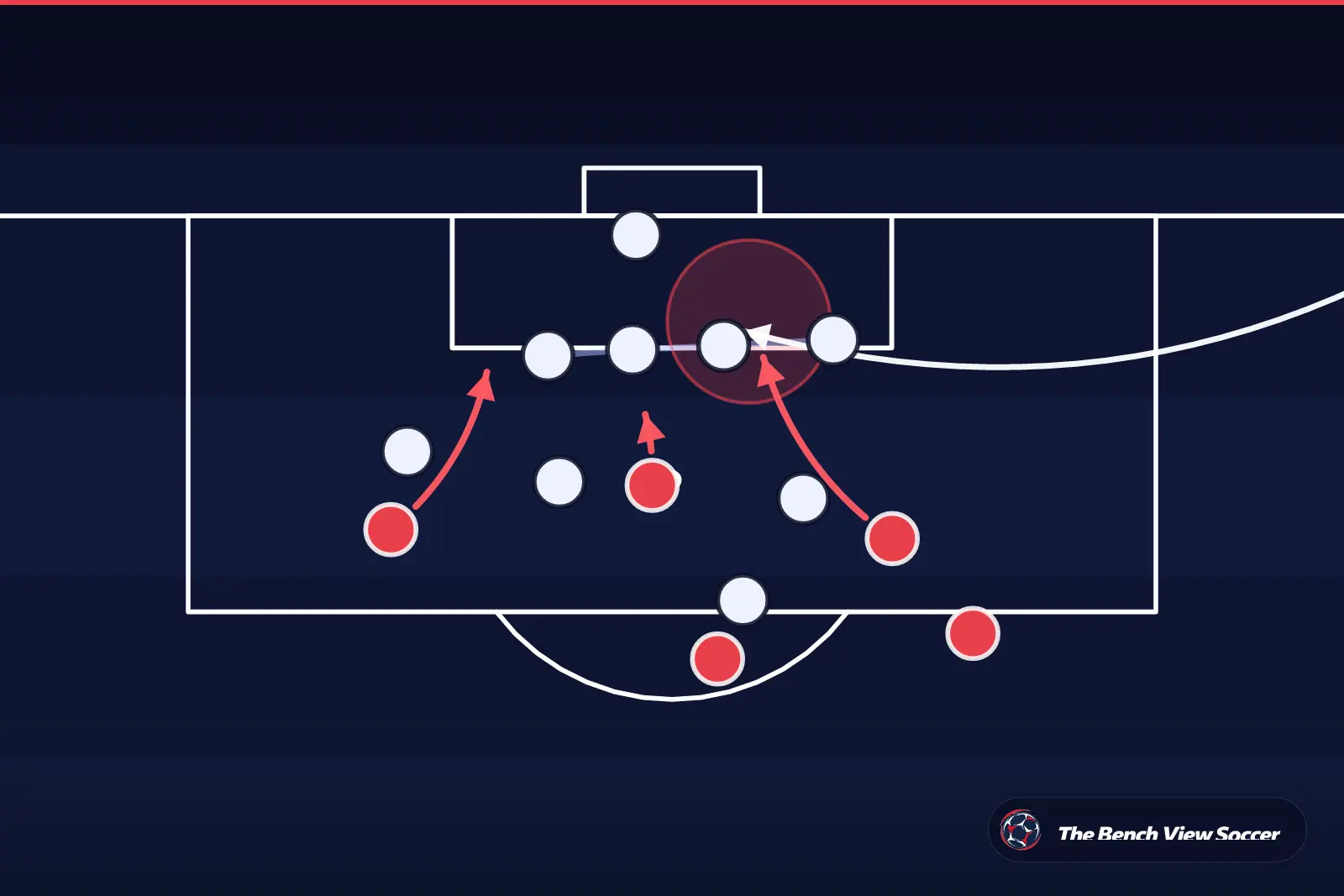
City’s set-piece routines revolve around three repeatable mechanisms: space creation, matchup targeting, and second-phase control. First, space creation: City often start with multiple players bunched together around the penalty spot or edge of the six-yard box. This “cluster” forces defenders to make a choice—stay tight and risk being blocked by teammates, or leave space and risk losing contact. As the ball is delivered, City players separate with timed runs: one darts near post, one attacks the central corridor, one fades to the back post. The key is timing; the run begins late so the defender cannot get set. Second, matchup targeting: City identify weaker markers and pull them into uncomfortable duels. For example, a strong header like Rúben Dias or a powerful jumper like Erling Haaland (when on the pitch) can be positioned against a full-back or a smaller midfielder if the opponent uses man-marking. City achieve this through pre-kick movement—swapping positions, screening (standing in the defender’s path without blatant fouling), and dragging a dominant defender away with a decoy run. If the opponent uses zonal marking, City attack the seams between zones: the gaps between two defenders guarding different spaces. Third, second-phase control: City are excellent when the first header is not a shot. They place players like Kevin De Bruyne, Bernardo Silva, Phil Foden, or İlkay Gündoğan-type profiles (midfielders comfortable receiving under pressure) around the edge of the box. When the clearance drops, City immediately recycle the ball for a second cross or a cutback. This is where mismatches reappear: defenders step out late, lose runners, and City attack a disorganised line. The routine is not only about the first contact; it is about winning the next two actions after the delivery.
Match Examples
A useful way to learn City’s set-piece ideas is to watch specific games and pause at the moment before the kick is taken. In the 2022–23 UEFA Champions League semi-final second leg, Manchester City vs Real Madrid at the Etihad (Guardiola vs Carlo Ancelotti), City repeatedly use crowded starting positions on corners to force Madrid’s markers to negotiate traffic. Even when the first ball does not become a direct shot, City keep Madrid pinned by recovering loose clearances and sending the ball back into the box quickly, which creates new mismatches as defenders turn to face their own goal. In the 2023–24 Premier League season, Manchester City vs Arsenal at the Etihad shows another theme: the value of the second phase. Arsenal under Mikel Arteta defend set-pieces with strong organisation, but City’s edge comes from how they keep the ball alive around the box and re-enter from better angles. Watch how City leave technically secure players outside the box to collect clearances, then switch the point of attack, which forces Arsenal’s zonal line to shuffle and can isolate a far-post defender. Go back to the 2021–22 Premier League, Manchester City vs Manchester United at the Etihad (Guardiola vs Ralf Rangnick). Even when set-pieces do not directly produce goals, City use them to sustain pressure: they lock United in, win second balls, and re-attack before United can push out. That sustained pressure is itself a “mismatch,” because it turns a 50-50 corner into a sequence where City get repeated advantages—fresh deliveries against defenders who are constantly resetting and losing their references.
Related Concepts & Skills
Training Implications
For coaches and players—especially in India where structured set-piece time is often limited—City’s principles can be trained with simple, repeatable exercises. Start with a 15-minute “corner module” twice a week. Step 1: assign roles, not just positions. Pick one primary aerial target (best header), one near-post runner, one back-post runner, one screener, and two edge-of-box recyclers. Keep these roles consistent for a month so timing improves. Step 2: rehearse the cluster-and-separate routine without a ball first. Use cones to mark the penalty spot, near post, and back post. On the coach’s whistle, the group begins from a tight cluster, then breaks into three lanes. The rule: runs start late (on the whistle), and runners must not collide—this teaches controlled separation. Step 3: add a server and train delivery zones. Ask the taker to hit three specific targets: (a) front zone between six-yard box and near post, (b) penalty spot, (c) back-post corridor. Track success rate out of 10 deliveries per zone. Rotate takers so the team is not dependent on one player. Step 4: train the second phase like open play. After the first contact (header or clearance), play continues for 8 seconds. The edge-of-box players must (i) secure the loose ball, (ii) make one quick pass, then (iii) deliver again or find a cutback. This creates the habit City rely on: winning the next action. Step 5: teach defenders to understand the same patterns. Run a defensive session where the back line practises communication—calling “zone,” “switch,” and “runner”—and learns to pass markers on when attackers swap positions. This reduces the chaos that City aim to create and makes your team better on both sides of the ball.
The Bench View app
Don’t just read football — train it
Everything you read here, turned into training you can follow step by step.
Physical training at home
AI daily sessions adapted to your level and position. No equipment needed.
Tactical training courses
Step-by-step courses on positioning, pressing, build-up and decision making.
- 7 days free
- No commitment
- Cancel anytime
Free account: 2 physical sessions + the first tactical course. PRO: 7-day free trial — cancel before day 8 and you pay nothing.