

Erling Haaland’s Trending Moment — and the Tactical Truth Behind It
The headlines are loud: Erling Haaland’s international flame dimmed while the World Cup 2026’s brightest stage roared around him. The noise ranges from frustration to fury, but the football truth, tactically speaking, is quieter and more precise. Haaland did not suddenly become a lesser forward. Norway, in our analysis, stripped away the two structural conditions that let his greatness repeat: real width and a consistent cutback game. Remove those, and even the most devastating finisher begins to look ordinary.
In our view, that is the core of the story. This isn’t about character or desire; it’s about geometry and repeatability. Haaland’s entire elite-level threat profile is built on a machine that delivers low, lateral service to the penalty spot and six-yard line at tempo. At this tournament, Norway drifted into a muddle of half-crosses, half-spaces without penetration, and too few third-man runs. The result wasn’t a mystery; it was a model.
Key analytical claim: Haaland’s “quiet” World Cup was a system failure — Norway abandoned five-lane spacing and the cutback economy that turns his off-ball runs into elite chances.
How City Builds Haaland — And Why Norway Didn’t
To understand the gap, start with the club template that supercharges Haaland. At Manchester City, the attack is designed to place him on the final line with three things calibrated in his favor: five-lane occupation, wingers pinning fullbacks to the byline, and repeat cutbacks from the underlap channel. None of this is romantic; it’s ruthless, programmable football that multiplies a striker’s expected value per touch.
The Five-Lane Geometry That Protects the No.9
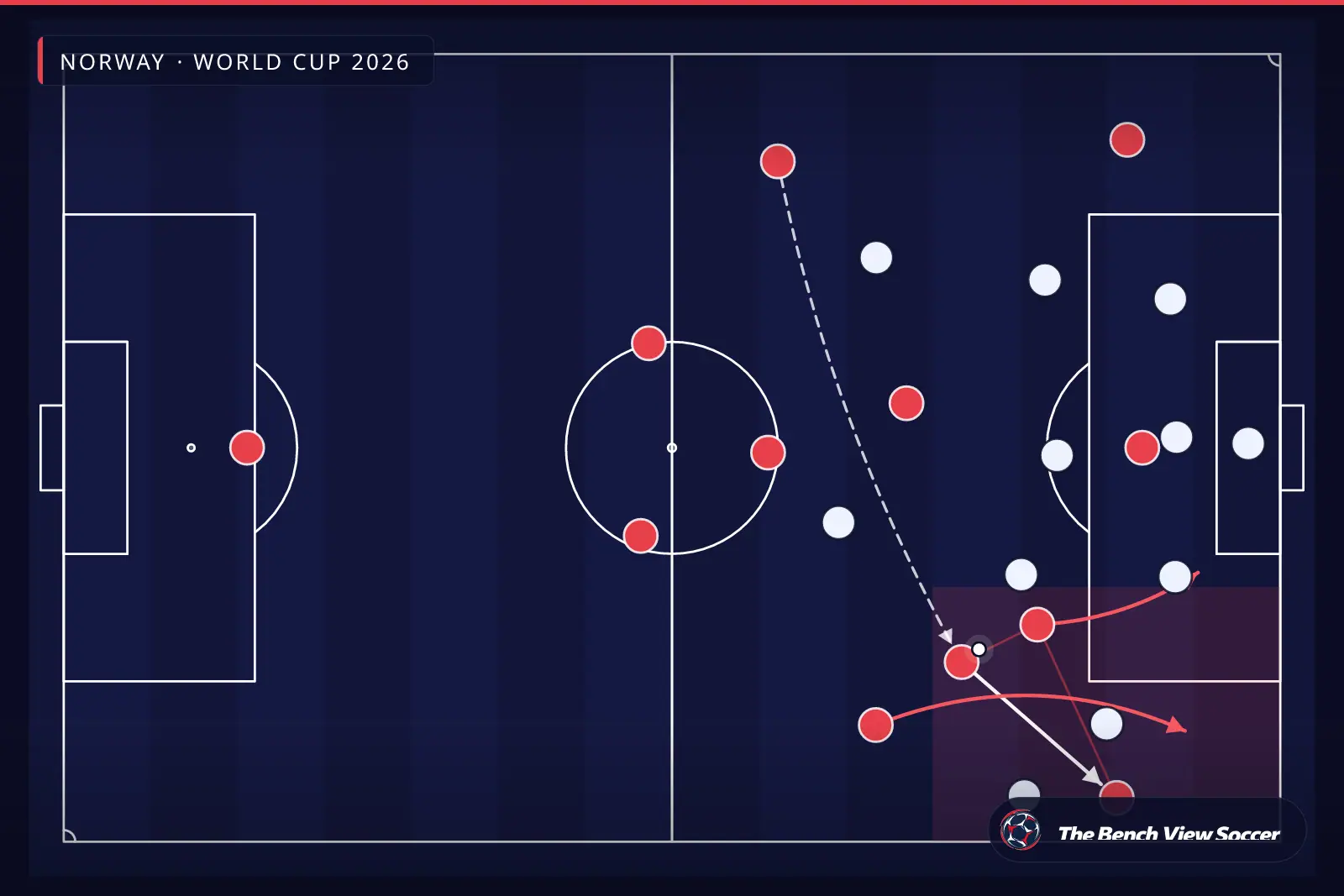
Haaland’s best environment uses all five vertical lanes — left wing, left half-space, central lane, right half-space, right wing — at once. That spacing prevents center-backs from stepping out because any vacancy is punished by a third-man runner. It also means Haaland rarely needs to drop to connect; the ball arrives around him with defenders already stretched. At City, those lanes are guarded by positional rules: the winger stays wide, the near-side fullback underlaps, and an attacking midfielder times the box arrival to the cutback zone.
Norway, by contrast, tended to compress into three or four lanes in possession. The right winger often narrowed to combine with Martin Ødegaard in the right half-space, while the fullback overlapped into the same channel. Good players occupied the same square of grass, which created pretty triangles with nowhere to go. Without a wide pin to fix the opposition fullback, Haaland’s channel (that diagonal dart across the near center-back) had no depth to exploit. The nine’s run became decorative rather than decisive.
Cutbacks vs. Hoisted Hope
Haaland’s finishing superpower is not just velocity and precision — it’s how well his run curve syncs with low-driven deliveries across the six-yard box. These are the cutbacks and flat crosses from the byline or just inside the area that force defenders to face their own goal. Haaland times his step pattern to arrive slightly late at the penalty spot or slash across the near post. The repeatability matters: cutbacks massively raise the quality of a chance without requiring the striker to beat three men.
In this tournament window, Norway defaulted too often to lofted or floated deliveries from 22–30 meters, especially when possession slowed on the right. Those balls create duels, not goals. They allow defenders to square up to the flight, reset their feet, and attack the aerial. Haaland will score headers — he’s ferocious — but that is not the most efficient version of him. The best version is the one meeting a knee-high rocket across the corridor of uncertainty. Norway’s delivery profile shifted away from that corridor, and with it Haaland’s danger evaporated.
Third-Man Releases and the Near-Post Promise
So much of Haaland’s club productivity is about the third-man run: a pass that bypasses an obvious receiver to find the runner who escaped attention. City rehearse it endlessly. Right half-space to underlapping fullback, low ball to the spot. Left wing to interior eight arriving late, square ball into stride. The rhythm is king; the timing is the threat. Norway’s sequences frequently stalled at the penultimate action, with the right-sided overload inviting pressure but lacking the pre-planned release. When the ball finally swung wide, it came with backspin, not whip. Haaland was already in the net, hands raised, asking for the pass that never came.
Think of the recurring, match-after-match sequence that told the tale: a right-half-space entry invites the opposing six to slide; the Norway winger tucks inside to combine; the fullback goes beyond but receives a floating switch instead of a slip to the byline; the cross arcs to the back post, where Haaland, now marked 2v1, must generate all the value himself. Tactical talent turned into tactical tax.
The Ødegaard Question — Elite Conductor, Unused Crescendo
Martin Ødegaard is an elite right half-space conductor. His body shape, disguise, and glide off the first touch are Champions League-level. Tactically, the pairing with Haaland should be terrifying. Yet when Norway stall, it’s often because the structure around Ødegaard misreads what his passing actually demands.
Right Half-Space Maestro, Missing Runner
Ødegaard thrives with a fixed wide reference outside him and a vertical runner beyond the near center-back. That creates a triangle he can knife through with outside-of-the-boot passes or disguised slips. In too many Norway possessions, the “runner beyond” is late or absent, the winger vacates touchline to receive at feet, and the fullback overlaps into the same corridor Ødegaard occupies. The half-space gets crowded; the pass map waves but cannot penetrate. Haaland is left making decoy runs he should be finishing.
The correction is simple and structural, not personnel-dependent: keep the winger on the paint. Force the fullback to choose: defend the underlap or respect the byline. That binary opens Ødegaard’s best ball — the blindside slip to the underlap — which in turn opens Haaland’s best movement — the late burst to the spot or the near-post kiss. These are not miracles. They’re rules.
The Sørloth Trade-Off
When Alexander Sørloth partners Haaland, Norway gain wall-play and pressing volume. But the trade-off is spacing. Two strikers can pin both center-backs, but if the wide players narrow as well, the byline disappears. That compounds the cutback drought. The partnership can work if and only if the double nine is backed by double tens who split and stretch, and true width that refuses to drift. Otherwise, you create a four-man straight line on the last shoulder with no one tasked to bend runs into the underlap channel.
In our view, the cleanest version of Norway with both strikers is a 3-2-4-1 in possession (out of a 4-4-2 without the ball), where Sørloth can drop to the right half-space as a temporary 10, Ødegaard stays higher as the opposite 10, and both wingbacks pin the bylines. That keeps five lanes live and restores the cutback lanes — the only lanes that truly multiply Haaland’s threat across 90 minutes.
Pressing and Rest Defense: The Invisible Half of Striker Output
Haaland’s shot volume at City is an attacking product of defensive control. It sounds paradoxical, but it isn’t. City’s rest defense — the structure behind the ball when attacking — is built to smother the counter at source. That means sustained possessions, repeat entries, and more cutbacks per half. When Norway’s counterpress breaks or the distance between midfield and defense stretches, each attack becomes a one-off expedition. If you only enter the box cleanly three times a half, you must score from a half-chance. That’s variance football.
At this tournament, Norway’s press felt caught between ideas. Haaland started triggers on back passes, but the line behind him did not always lock onto outlets. The result was energetic sprints with no capture. That drains a striker and shortens attacks. If you wonder why a nine gets two touches in the area across 30 minutes, look first to whether the ball is being won back within six seconds of a broken move. The best strikers are beneficiaries of a team’s ability to keep the game pinned at 35 meters, not magicians conjuring big chances from kick-offs.
Historical Echoes: Big 9s Starved by National Teams
This pattern isn’t new. Robert Lewandowski has often seen his Poland self look a shade smaller than his Bayern/Barça self, not because he changed but because the surrounding structure did. Zlatan Ibrahimović scored spectacular international goals for Sweden but regularly played in games where the byline vanished and his touches turned to wrestling matches at the back post. Early-cycle England under Gareth Southgate sometimes asked Harry Kane to be both conductor and finisher, which occasionally collapsed the penalty-box presence entirely. Romelu Lukaku in Qatar 2022 lived the other side of the variance coin: he found the right zones repeatedly but could not finish — the structure was right; the outcomes were wrong.
Haaland’s current moment smells most like Lewandowski’s international dips: a world-class finisher reliant on very specific service chains that national-team structures rarely replicate under tournament pressure. When the five-lane picture holds and the cutback meter hums, the nine looks inevitable. When it doesn’t, the nine turns into a fight for first contact, second balls, and re-centered possessions — the opposite of his gift.
Cause and Effect: Why It Broke at This Tournament
So why did Norway default away from the very model that amplifies Haaland? Tactically, three effects fed each other.
First, game state. Early deficits or tense, even states push fullbacks to be cautious. Cautious fullbacks cut the underlap. Without the underlap, the winger either receives on the touchline against two or comes inside for numbers. When the winger comes inside, the byline vanishes. Repeat until the clock kills you.
Second, the midfield selection balance. Norway often chose security next to Ødegaard: a ball-winner/deeper distributor who stays behind the play. That is defendable in international football, but if both eights are not committing beyond the line in alternating bursts, nobody is arriving to that classic cutback zone (the penalty spot and the D). Haaland can be the final touch, not the layoff and the finisher. If he must check to connect, his box gravity evaporates — and so does Norway’s scalability.
Third, delivery technique under pressure. Even when Norway found the flank, the cross profile shifted high and hopeful. Tournament nerves do this. Players loft the ball to “give it a chance.” But high floats give defenders perfect timing. The missing ingredient is the coached habit of driving the ball at knee height through the six-yard channel. That is a technique choice more than an opponent problem.
Add officiating and chaos — the odd stoppage or marginal call that tilts rhythm — and the structure can unravel for five-minute runs that feel like whole halves. We are not adjudicating controversy; we are noting how easily a possession model tilted toward side-to-side can fall into aerial contests it never wanted. That is where Haaland disappears: not because he hides, but because the service disappears.
The Fix: Three Structural Tweaks That Change Everything
The good news for Norway is that this is fixable without ripping up the player pool. In our analysis, three structural tweaks would restore Haaland’s club-like productivity in international colors.
1) Hard-Rule the Width
Write it in ink: the near-side winger stays on the paint until the ball crosses the 18. No exceptions. That pins the fullback and keeps the lane open for the underlap. On the right, that means Ødegaard has a constant out-to-in triangle — winger wide, fullback underlap, Haaland on the shoulder. On the left, it gives the far-side crash a predictable cue. This one rule will generate two or three extra cutback chances per half. That is the difference between “quiet” and “decisive.”
2) Double 10s, Not Double Eights
Norway’s best talent profile begs for a 3-2-4-1 in possession: two central defenders split, a single pivot joins the ball-side center-back to form the “2,” and ahead of them Ødegaard and a left-sided creator form the “4” line with the wingers. Sørloth can be the flexible piece — either start wider-right as a pseudo-10 to run the inside channel or rotate with the right winger to attack the byline from deeper positions. The key instruction: one 10 arrives late to the D every time the ball goes wide. If that runner is religiously present, Haaland doesn’t need to do two jobs.
3) Rehearse the Two-Tempo Cross
Build a set-piece-level habit for live play: a low driven cross across the six, followed by the slightly delayed cutback to the spot. Two tempos, same picture. The near-post drive invites the first Haaland run, the delayed cutback catches the defense leaning. Rotate which 10 fires which tempo. If the fullback is comfortable playing the drive at pace, the winger must know that the cutback is next. Turn this into a pattern your players could run in darkness.
These aren’t theoretical. They are coaching interventions seen across elite club football that travel well to tournament environments because they reduce thinking under pressure.
Pressing Reboot: Where the Goals Really Begin
Every conversation about Haaland’s touches must pass through one gate: how fast can Norway restart an attack after losing the ball? A striker’s volume is tied to the team’s ability to trap on the first pass out. Put simply: you won’t feed your nine cutbacks if you chase your own turnovers to the halfway line. The out-of-possession shape needs a small recalibration: tighter distances between the front three and midfield line, a firm trigger on back-passes toward the weak foot of the opponent’s center-back, and the nearest fullback stepping in-field to seal the first inside lane. Win those, and you will see Haaland’s numbers bounce without changing a single individual technique.
Comparative Lessons: What National Sides Got Right
Look at how successful tournament teams have protected their strikers’ shot quality.
France during their peak made Olivier Giroud inevitable by simplifying the delivery profile: Mbappé and Griezmann fixed width and half-space, and runners arrived late for the cutback. Portugal’s Euro 2016 to 2021 evolution loosened Ronaldo from the build-up chain and optimized his box receiving with diagonals and low crosses, backed by a relentless rest defense. More recently, England’s growth from “Kane everywhere” to “Kane as finisher and connector” has depended on runners (often from midfield) occupying the cutback lanes so the nine can preserve his penalty-box gravity. The lesson: the striker’s touch map is a team decision, not an individual quirk.
What We’d Show on the Tactics Board
Picture a simple training-ground diagram — no bells, just spacing and arrows. Five lanes plotted. Ball in Ødegaard’s zone, right half-space, 25 meters out. Winger’s boot on the chalk. Fullback begins inside-to-out underlap. Haaland sets offside on the near center-back’s blind shoulder. The first pass is a disguised stab into the underlap. The cross is flat, belt-high, near post. Haaland darts across, either finishing or dragging the line. The weak-side 10 arrives to the D. If the near-post lane is blocked, the underlap cuts back to the spot. Two options, both repeatable, neither dependent on miracles. Run that drill 30 times a session, three camps in a row, and watch the tournament shot map transform.
Counterargument: Isn’t This Just on Haaland?
There is a fair, footballing counterpoint: great strikers, the argument goes, find a way anyway. Haaland missed one or two looks he would expect to score. He sometimes stayed high when dropping could have sparked a rotation that unblocked a flank. And variance is part of tournament football — a bounce here, a toe there, and we write a different story. All true. He is neither blameless nor a passenger in his own performance.
But here’s our analytical pushback. When an elite finisher’s shot quality collapses across multiple matches, the diagnosis starts with supply, not psychology. The most consistent lever to raise his output is not “be better” — it’s “rebuild the pipeline.” At City, Haaland can have a quiet 60 minutes and still score twice because the machine keeps serving the same high-value moments. Norway can give themselves that luxury by restoring width rules, choreographing underlaps, and committing to cutbacks. Then the misses shrink into footnotes and the striker’s odd quiet half stops defining the narrative.
What It Means for the Season and for Norway’s Project
For Haaland’s club season ahead, this summer likely delivers fire, not fatigue. A forward of his mentality will convert frustration into an obsession with timing and first-step explosiveness. Expect to see him hunt the near post with even more aggression early in the campaign. Importantly, there is no systemic dent to carry back — his club environment will instantly restore the familiar cutback economy. Any “World Cup hangover” talk undervalues how quickly a structured system can recalibrate a striker’s rhythm.
For Norway, this is a crossroads. The player pool is strong enough to qualify consistently and threaten in knockout football, but only if the game model serves its apex finisher. That means committing to the five-lane picture, scripting chances rather than discovering them, and letting Ødegaard be the passer who unlocks, not the dribbler who compensates. The temptation after tournament exits is to chase solutions with new faces. Our view: chase new habits instead.
Minute-Level Detail Without the Mythmaking
Analysts often anchor arguments to lone moments — the 64th-minute miss, the 82nd-minute break that begged a square ball. Without box-score recaps here, we prefer the recurring patterns that shaped those moments. Again and again, Norway built in the right half-space, invited the block, and then crossed from 25 meters under no real duress. Again and again, the underlap was a beat late or unused. Again and again, Haaland’s run presented the byline ball that never came. You don’t fix that with one inspirational speech. You fix it with rules.
Coaching Cues Norway Can Implement Next Camp
Three verbal cues turn into behaviors quickly:
“Paint” — winger stays on the touchline until the ball enters the box.
“Knife” — the underlap begins as soon as Ødegaard drops his shoulder; the pass follows without a look.
“Spot” — one 10 owns the penalty-spot zone on every wide entry; the other either hits the near-post dart or screens the cutback.
Build those into video, rehearse them at walking pace, then at sprint. Add a finishing block: five minutes of knee-high deliveries across the six-yard line, first-time finishes to either corner. It’s not glamorous. It’s goals.
The Bigger Picture: International Football’s Design Problem
National teams fight time. Clubs have 300 training sessions a year. National sides get windows. That is why patterns beat improvisation at tournaments. The temptation is to stack your best players and trust their chemistry. The winners in modern international football trust their patterns first, then insert talent into the machine. Haaland is a devastating finisher inside that machine. He is not a back-to-goal fulcrum for 60 straight minutes. Build toward his highest-value touches, and Norway’s ceiling rises immediately.
Verdict
Tactically speaking, Haaland didn’t go missing — Norway’s cutback game did. Restore five-lane spacing, rehearse the underlap, and the most feared finisher of his generation will sound like himself again.
Strip away the noise and the “anonymous” labels, and what remains is simple geometry. Width creates lanes. Lanes create cutbacks. Cutbacks create Haaland. If Norway make that their north star, the next World Cup cycle will not be about near-misses or frustrated body language. It will be about a striker arriving, on time, to the ball he was always meant to meet.
The Bench View app
Don’t just read football — train it
Everything you read here, turned into training you can follow step by step.
Physical training at home
AI daily sessions adapted to your level and position. No equipment needed.
Tactical training courses
Step-by-step courses on positioning, pressing, build-up and decision making.
- 7 days free
- No commitment
- Cancel anytime
Free account: 2 physical sessions + the first tactical course. PRO: 7-day free trial — cancel before day 8 and you pay nothing.
More Analysis
Jude Bellingham's Half‑Space Gravity Is England’s Real Edge
July 16, 2026
Cristiano Ronaldo: Why Portugal Must Rethink Their Pressing Plan
June 28, 2026
Harry Kane's False-9 Gravity Is Powering England's Box Overloads
June 28, 2026
Lionel Messi’s Pause-and-Punch Tempo Beats Every Low Block
June 27, 2026