Introduction
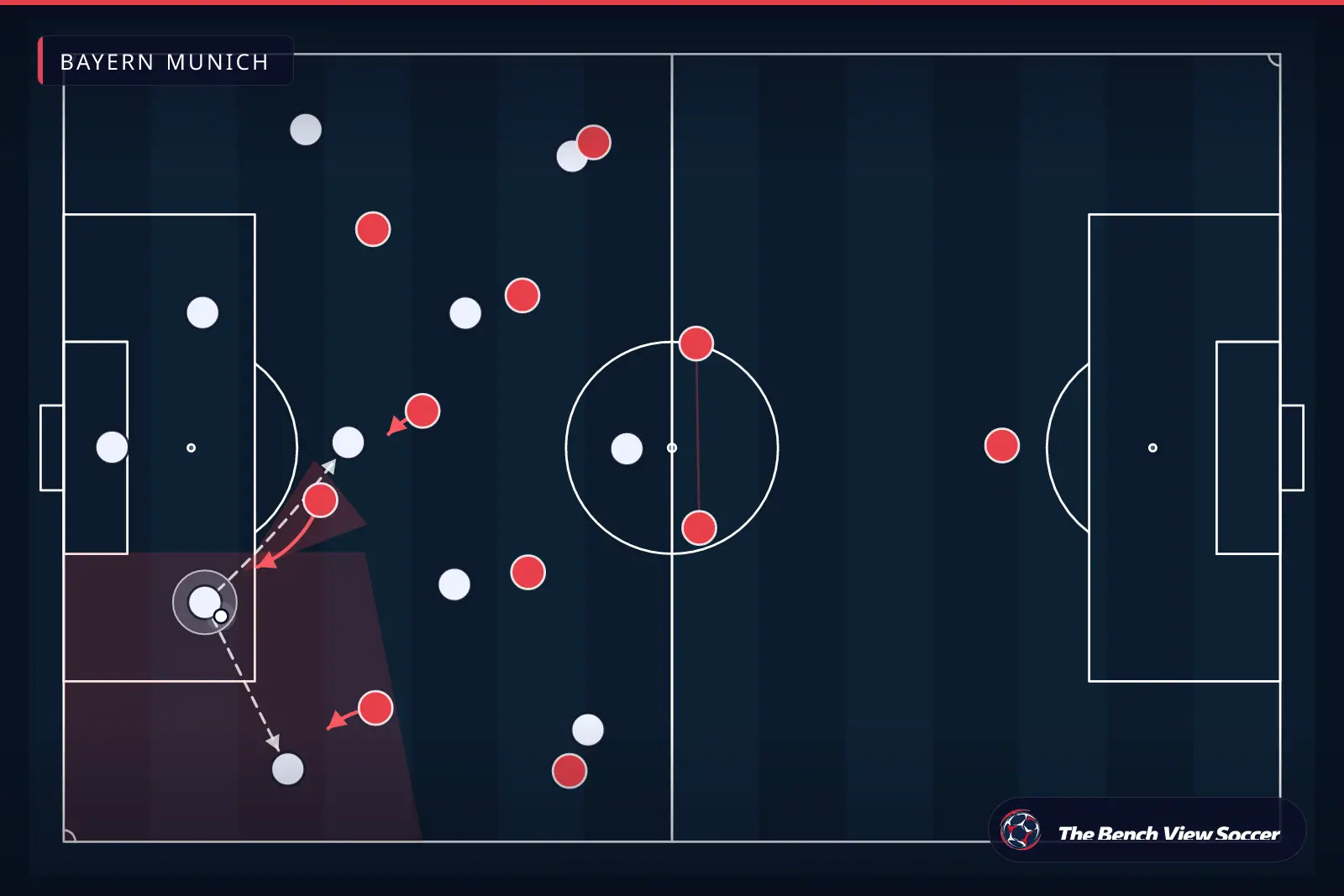
Bayern Munich’s press is not just “running a lot”; it is a coordinated system that tries to win the ball in specific zones, at specific moments, with specific body angles. For fans watching the Bundesliga or the UEFA Champions League, Bayern often looks like they overwhelm opponents through sheer intensity. But the real story is structure: who jumps, who covers, and who protects the space behind. Under managers like Julian Nagelsmann and Thomas Tuchel, Bayern keep the same big idea—recover possession quickly—while changing the details depending on opponents and personnel. When the press works, Bayern create short attacks close to goal, meaning fewer passes are needed to generate a chance. When it fails, you see why “recovery runs” matter: defenders and midfielders sprint back to control counterattacks. This article breaks the press into three learnable parts—triggers (what starts it), angles (how they block options), and recovery runs (how they fix problems when the first wave is beaten).
How It Works
Bayern’s pressing starts with triggers—events that tell the whole team it is time to jump together. Common triggers include: a back pass to the goalkeeper, a slow lateral pass across the opponent’s back line, a receiver taking a poor first touch, or a fullback receiving while facing his own goal. When that trigger appears, Bayern’s nearest forward presses with a curved run. A curved run matters because it closes one passing lane while attacking the ball-carrier: for example, Harry Kane (or previously Robert Lewandowski) curves his approach to block the pass into the opponent’s holding midfielder. Behind the striker, the attacking midfielders and wingers step up to mark “the next pass,” not just a man. Bayern’s wide players often press from outside to inside, guiding play toward the touchline where the sideline becomes an extra defender. The midfield two (often Joshua Kimmich with Leon Goretzka or Konrad Laimer) stay tight enough to intercept, but not so high that one simple wall pass eliminates them. The back line holds a high line to compress space, and the fullbacks squeeze inside to prevent vertical passes through the middle. If the opponent breaks the first wave, Bayern immediately switch to recovery runs: the closest players counterpress (press right after losing the ball) while deeper players sprint back into the central corridor to protect the area in front of the penalty box. This balance—aggressive first wave, disciplined covering, then urgent recovery—defines Bayern’s press.
Match Examples
A clear example appears in the UEFA Champions League 2022–23 Round of 16 against Paris Saint-Germain, especially the second leg at the Allianz Arena under Julian Nagelsmann. Bayern’s front line press is not random: they repeatedly use curved runs to deny PSG’s easiest outlet into midfield, forcing longer passes. When PSG try to play short, Bayern’s wingers step in to block passes into the half-space (the channel between fullback and centre-back), while the midfield squeezes up to attack second balls. The moment PSG’s first touch is heavy, Bayern jump together and win territory quickly. Another useful reference is the Champions League 2023–24 quarter-final first leg against Arsenal at the Emirates Stadium under Thomas Tuchel. Bayern’s pressing intensity rises and falls by design: they often wait in a compact mid-block, then press hard when Arsenal play into wide areas with the receiver facing his own goal. That is a trigger Bayern recognise. The angles are obvious—Bayern’s winger presses to force the line pass, while a nearby midfielder positions to intercept the inside pass. When Arsenal escape, Bayern’s recovery runs are immediate, with defenders sprinting back through the centre rather than chasing the ball wide. For a Bundesliga lens, look at Bayern’s 2023–24 league games against Bayer Leverkusen (Xabi Alonso). Leverkusen’s build-up is excellent, so Bayern’s press becomes more selective and risk-aware. You see Bayern attempt to trap wide, but when Leverkusen play through pressure, Bayern’s recovery runs and compact central shape determine whether they concede big chances or force play back into less dangerous zones.
Related Concepts & Skills
Training Implications
To train Bayern-style pressing principles, start with clarity: players must know the trigger, the run angle, and the safety rule if the press is beaten. Session idea 1 (Trigger Recognition Rondo): play 6v3 in a 12x12m square. The 3 defenders only “activate” the press when you call a trigger (for example, “back pass” or “bad touch”). Coach the first presser to use a curved run that blocks the central pass, not a straight sprint. Rotate quickly and track how many seconds it takes to force a mistake. Session idea 2 (Wide Trap Game): set up a half-pitch with two wide channels. The attacking team scores by playing through the middle; the defending team scores by winning the ball in a wide channel and completing three passes. Give defenders a rule: the winger presses outside-to-in, the fullback steps up to lock the line, and the near central midfielder shifts across to cover the inside pass. Stop the drill to correct distances: if the midfield is too far, opponents play through; if too close, one bounce pass eliminates the press. Session idea 3 (Recovery Run Transition Drill): play 7v7 plus goalkeepers on 60x45m. When possession changes, the team that loses the ball must have two players counterpress for three seconds while the rest sprint back into central lanes (not toward the ball). Reward successful “central protection” by giving an extra point if the opponent is forced wide or backwards. Finally, video your sessions: even on a phone, pause and check body shape, run angles, and whether the second and third defenders arrive on time—these details are the difference between Bayern’s press looking fierce and actually being effective.
The Bench View app
Don’t just read football — train it
Everything you read here, turned into training you can follow step by step.
Physical training at home
AI daily sessions adapted to your level and position. No equipment needed.
Tactical training courses
Step-by-step courses on positioning, pressing, build-up and decision making.
- 7 days free
- No commitment
- Cancel anytime
Free account: 2 physical sessions + the first tactical course. PRO: 7-day free trial — cancel before day 8 and you pay nothing.