Introduction
Real Madrid under Carlo Ancelotti often looks simple at first glance: give the ball to Vinicius Jr, let him run, and trust the quality. But the real structure behind that threat is more organised, especially in how Vinicius Jr and Rodrygo rotate on the wings to create space for themselves and for teammates like Jude Bellingham, Federico Valverde, and the advancing full-backs. “Wing rotation” here means the two wide attackers swap positions, change heights (one comes short, one runs in behind), or drift inside/outside at different moments. The goal is not just to confuse a full-back, but to move an entire defensive line—forcing opponents to decide whether to follow a runner, pass him on, or stay compact. For fans learning tactics, this is a perfect example of how elite teams create advantages without complicated tricks: they use timing, spacing, and repeated patterns until defenders make a mistake. This article breaks down what Real Madrid’s rotations look like, why they work, and how you can spot them during a match.
How It Works
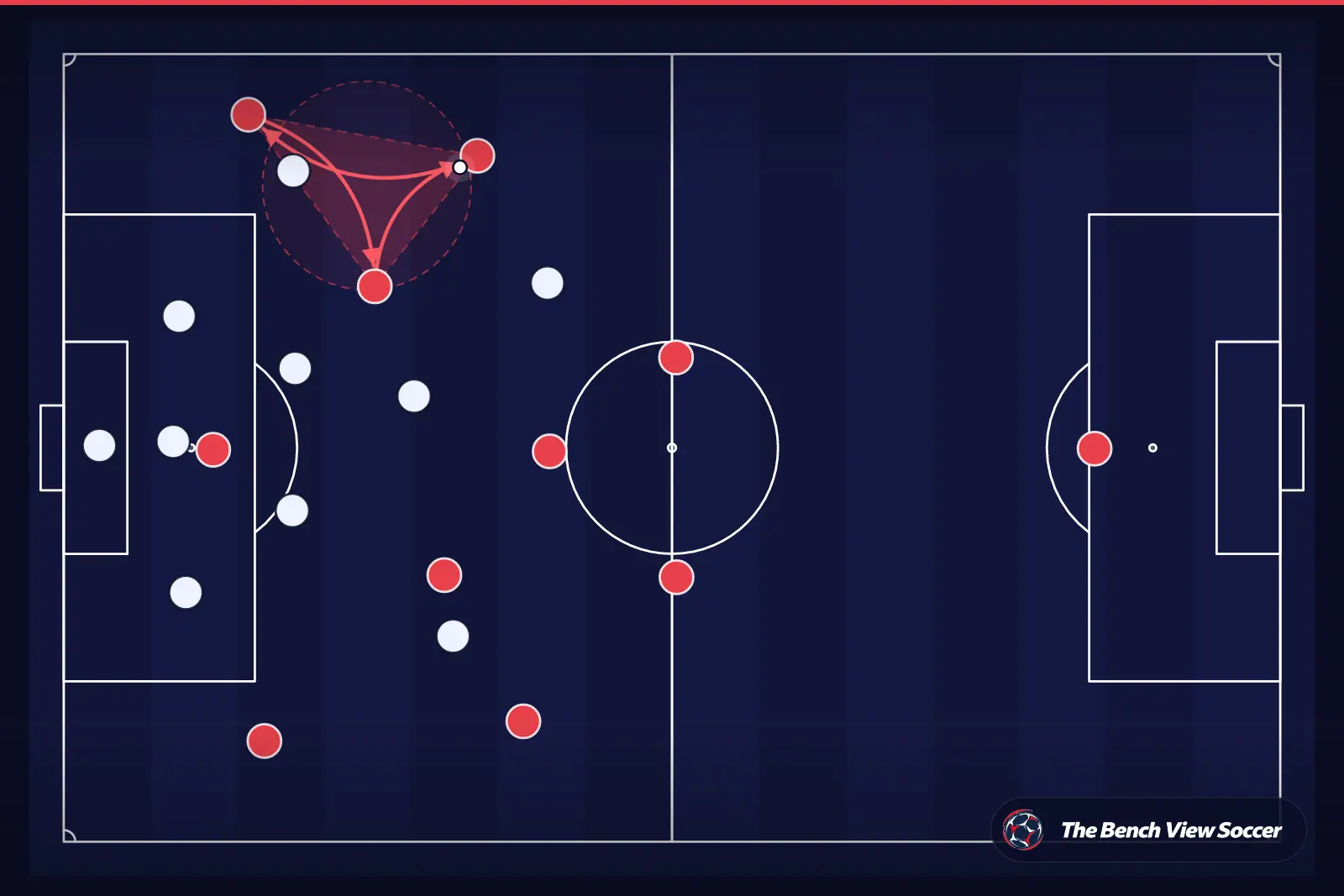
Real Madrid’s wing rotation works because it attacks three defensive problems at once: marking responsibility, distance between defenders, and the angle of the next pass. In many Ancelotti setups (including the 2023-24 season), Vinicius Jr usually starts from the left side, while Rodrygo can start from the right or play as a second forward who drifts wide. The key is that they rarely stay fixed. When Vinicius holds the left touchline, he pins the opposition right-back wide, stretching the back line. At that moment Rodrygo often drifts into the left “half-space” (the channel between full-back and centre-back) or even switches sides, arriving on the left as a hidden runner. If the right-back follows Rodrygo inside, Vinicius gets a clearer 1v1 outside; if the right-back stays, the centre-back now faces a decision: step out to Rodrygo and leave space behind, or hold the line and allow Rodrygo to receive between lines. Another common pattern is a height rotation: Rodrygo comes short to receive to feet while Vinicius runs beyond. This matters because defenders prefer to see the ball and the runner at the same time; when one attacker drops and the other sprints, the defender must either track the run (risking opening a passing lane) or step to the ball (risking being beaten in behind). Real Madrid also benefits from a third man: Bellingham (or a midfielder like Toni Kroos previously) acts as the connector who plays the pass into the dropping forward, then immediately finds the runner beyond with a second pass. The full-back on that side—Ferland Mendy or Eduardo Camavinga at left-back, Dani Carvajal at right-back—often provides an “overlap” or “underlap” (outside run or inside run), adding yet another layer. The end product is not only dribbles and shots; it is also better crossing lanes, cutbacks to the penalty spot, and central gaps for late runners.
Match Examples
A clear reference point is the 2023-24 UEFA Champions League run under Carlo Ancelotti, where Real Madrid regularly uses flexible front rotations rather than strict winger-vs-full-back isolation. Against Manchester City in the 2023-24 Champions League quarter-final tie, Madrid frequently sets Vinicius as the high, wide outlet on the left to stretch Kyle Walker and the near-side centre-back. Rodrygo’s movement becomes the multiplier: he drifts inside and across the line of midfielders, offering a short option that tempts City’s defenders to step out. When City compresses centrally to block passes into the inside channel, the switch back to Vinicius reopens the outside lane for 1v1s and cutbacks. Even when chances do not come from a single dribble, the rotation forces City to defend different distances repeatedly, which is tiring and increases the chance of a positional error. Another match to study is Real Madrid vs RB Leipzig in the 2023-24 Champions League Round of 16. Leipzig’s aggressive pressing creates moments where Madrid must escape pressure quickly. Here, the rotations become a release mechanism: one of Vinicius or Rodrygo drops toward the ball to create a safe pass, while the other immediately runs in behind the space left by Leipzig’s stepping defenders. This “one short, one long” behaviour is visible after recoveries and during transitions (quick attacks after winning the ball). When the first pass breaks Leipzig’s press, the second pass often attacks the space behind the full-back or between centre-back and full-back. In La Liga during the same season, similar patterns appear against teams that defend deep, like Getafe or Cádiz: Rodrygo comes inside to occupy central defenders, freeing Vinicius to receive wider with more time, while Bellingham arrives late into the box for cutbacks. The opponents change, but the principle stays: rotate to move defenders, then attack the gap that opens.
Related Concepts & Skills
Training Implications
To train wing rotation like Vinicius Jr and Rodrygo, start with simple rules and build timing. Drill 1 (2v2+1 channel game): Mark a wide channel and a half-space channel on one side of the pitch. Put two attackers (winger and second forward) against a full-back and centre-back, with one neutral midfielder behind them as the passer. The rule: every attack must include one rotation—either a position swap (wide/inside) or a height swap (one drops, one runs beyond). Coach the cues: if the defender’s hips face the touchline, attack inside; if the centre-back steps, run behind; if nobody steps, receive between lines and turn. Keep reps short (10–15 seconds) to mimic match intensity. Drill 2 (third-man pattern play): Set up three attackers (wide player, inside forward, midfielder) plus a mannequin or passive defender line. Sequence: pass into the inside forward’s feet, bounce to the midfielder, then play into the wide runner or the in-behind run depending on a coach call. This teaches the “one short, one long” habit and the quick second pass that makes rotations dangerous. Demand specific body shapes: the dropping forward opens up to see both the ball and the runner; the midfielder takes the first touch forward to speed up the next pass. Drill 3 (end product with constraints): Use a half-pitch game where goals only count if the shot comes from either a cutback (ball pulled back from near the byline) or a pass into the penalty spot zone. This forces wingers to use rotations to access the byline and forces inside players to arrive at the right moment, like Bellingham does for Madrid. Coaching point: rotations are not random; they must end with someone occupying the box and someone protecting against counters. Assign one midfielder as the “rest defence” player who stays behind the attack to stop transitions.
The Bench View app
Don’t just read football — train it
Everything you read here, turned into training you can follow step by step.
Physical training at home
AI daily sessions adapted to your level and position. No equipment needed.
Tactical training courses
Step-by-step courses on positioning, pressing, build-up and decision making.
- 7 days free
- No commitment
- Cancel anytime
Free account: 2 physical sessions + the first tactical course. PRO: 7-day free trial — cancel before day 8 and you pay nothing.