

Introduction
The shadow striker is the art of arriving into danger zones at the moment defenders lose concentration, marking or positional cover. Unlike a fixed centre-forward or a roaming false nine, the shadow striker operates as a second striker who stays mobile, times late runs and exploits the pockets between opposition lines. This role matters because modern defences compact the centre and force attackers wide; a player who can read moments to arrive between midfield and defence immediately creates overloads, scoring chances and tactical unpredictability.
For coaches and players, understanding the shadow striker means training timing, body orientation, connection with the primary striker and how to read trigger moments — a flick, a hold-up, a defensive recovery or a split-second step by a centre-back. In this article we unpack the positional logic, show elite-team parallels and deliver concrete principles and drills you can use in training to develop a high-impact shadow striker.
Tactical Breakdown
The shadow striker sits in the half-space between a central striker and attacking midfielder or between the opposition full-back and centre-back. In formations like 4-4-2 (one-and-a-half), 4-2-3-1 or a 3-4-1-2, the shadow striker is not the primary focal point but the arriving threat who times runs to arrive behind defenders after ball progression.
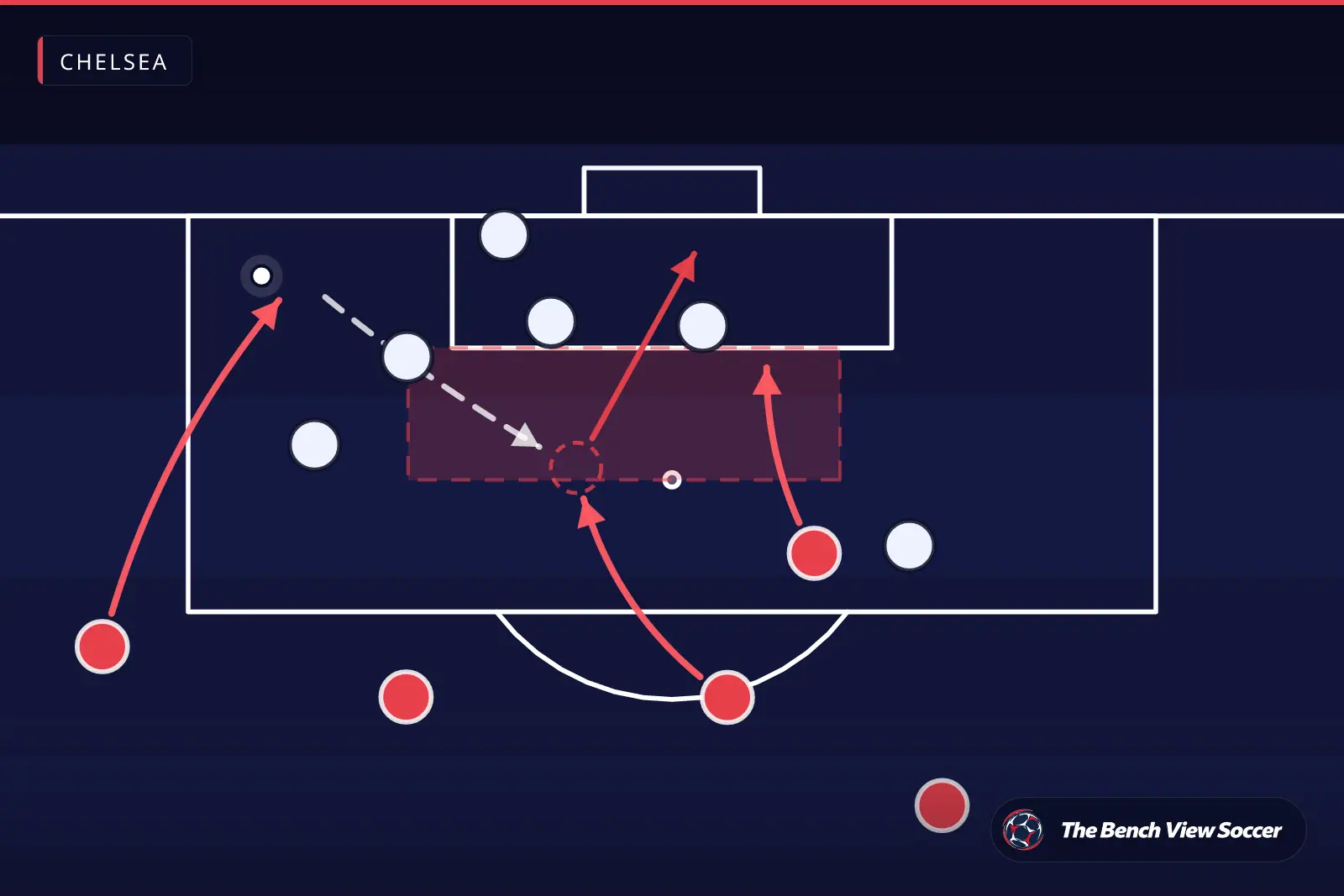
Positionally, the role requires three core actions: positioning to receive in the channel, reading moments to start a late run, and finishing or combining in tight spaces. When the primary striker pins the last defender with a wide or vertical run, the shadow striker darts between the two centre-backs or into the space vacated by a full-back. Against a deep block the shadow striker drifts wide to pull a centre-back out, creating space for midfield runners. Against high defensive lines the role becomes a decoy to draw markers forward, then exploit the space left by counter-runs.
Key interactions are with the ball-playing midfielder (for through-balls), the wide player (who must stretch the defence) and the number nine (whose hold-up play or channel runs create the timing window). Defensively the shadow striker must also be ready to press triggers — closing the defensive midfielder to force hurried passes and hunting second balls. This dual attacking-defensive responsibility makes the role physically and tactically demanding but highly effective in unbalancing organised defences.
Real Match Examples
Frank Lampard at Chelsea is a textbook shadow striker: not the deepest creator, Lampard excelled at arriving late from the edge of the box to finish rebounds and second balls. Under managers like Jose Mourinho and Carlo Ancelotti Lampard’s timing — arriving when centre-backs were distracted by Drogba or a target man — produced high conversion numbers and illustrates the power of coordinated movement.
Thomas Müller at Bayern Munich operates as a modern Raumdeuter, a close cousin of the shadow striker. Under Jupp Heynckes and later Pep Guardiola, Müller read half-space opportunities, drifting beyond midfield lines to score from positions centre-forwards sometimes ignore. Bayern’s wide overloads and quick ball-circulation frequently produced the precise moments Müller needed to arrive behind the last defender.
At Liverpool, Roberto Firmino under Jurgen Klopp blended false-nine duties with shadow-striker instincts. While he often dropped to link play, he also made late box entries and created space for Salah and Mane. This hybrid shows how the shadow striker can be integrated into gegenpress systems: press to force a turnover, then exploit the space with a timed run into the penalty area.
Key Principles
Key Principles
- Timing over speed: the run must start when a defender’s attention is engaged — not necessarily as fast as possible.
- Connection with the striker: the primary striker’s movement should be practiced to act as a decoy or as a blocker for the shadow run.
- Spatial intelligence: players must learn to occupy half-spaces and read passing lines rather than hug the centre.
- Dual role: effective shadow strikers help in pressing phases and recover defensively; work-rate and anticipation are essential.
Training Implications
How to Train the Shadow Striker
Focus training on timing runs, recognition of triggers and combination play. Start with small-sided patterns: 6v6 with a designated shadow striker on each team. Encourage the striker to hold up play while the shadow times runs from the second line. Add a rule that the shadow striker must begin their run only after the hold-up player receives — this develops patience and reading of triggers.
Progress to pattern drills: play sequences with a wide overload where the winger looks to stretch the backline and a midfielder plays a through-ball to the shadow runner. Incorporate finishing under pressure by adding two defenders protecting the near post. For transition training, run 4v3 in the attacking third where the shadow striker’s objective is to arrive for cutbacks and rebounds. Finally, use video review of elite examples (Lampard at Chelsea, Müller at Bayern, Firmino at Liverpool) and have players identify the trigger moments to build match intelligence.
Apply This in Your Game
Reading about tactics is one thing. Our training units teach you to execute these concepts in real match situations.