Introduction
For many fans watching La Liga or Serie A, the most frustrating game state is familiar: one team has 70% possession, but chances don’t come. That is the low block at work—an organised, compact defensive shape set deep near the penalty area, designed to deny space rather than chase the ball. Atlético Madrid under Diego Simeone and Inter Milan under Simone Inzaghi are famous for defending in this way, but they also teach us something more useful: how to beat it. Because these clubs face low blocks too, especially when they play smaller teams in domestic leagues or when opponents protect a lead in the UEFA Champions League. This article breaks down the “art” of attacking a low block: how to create space when space is intentionally removed, how to move defenders without forcing risky passes, and how to turn patient possession into high-quality chances. The goal is not to make you memorise diagrams, but to help you watch games and immediately recognise the patterns that work.
How It Works
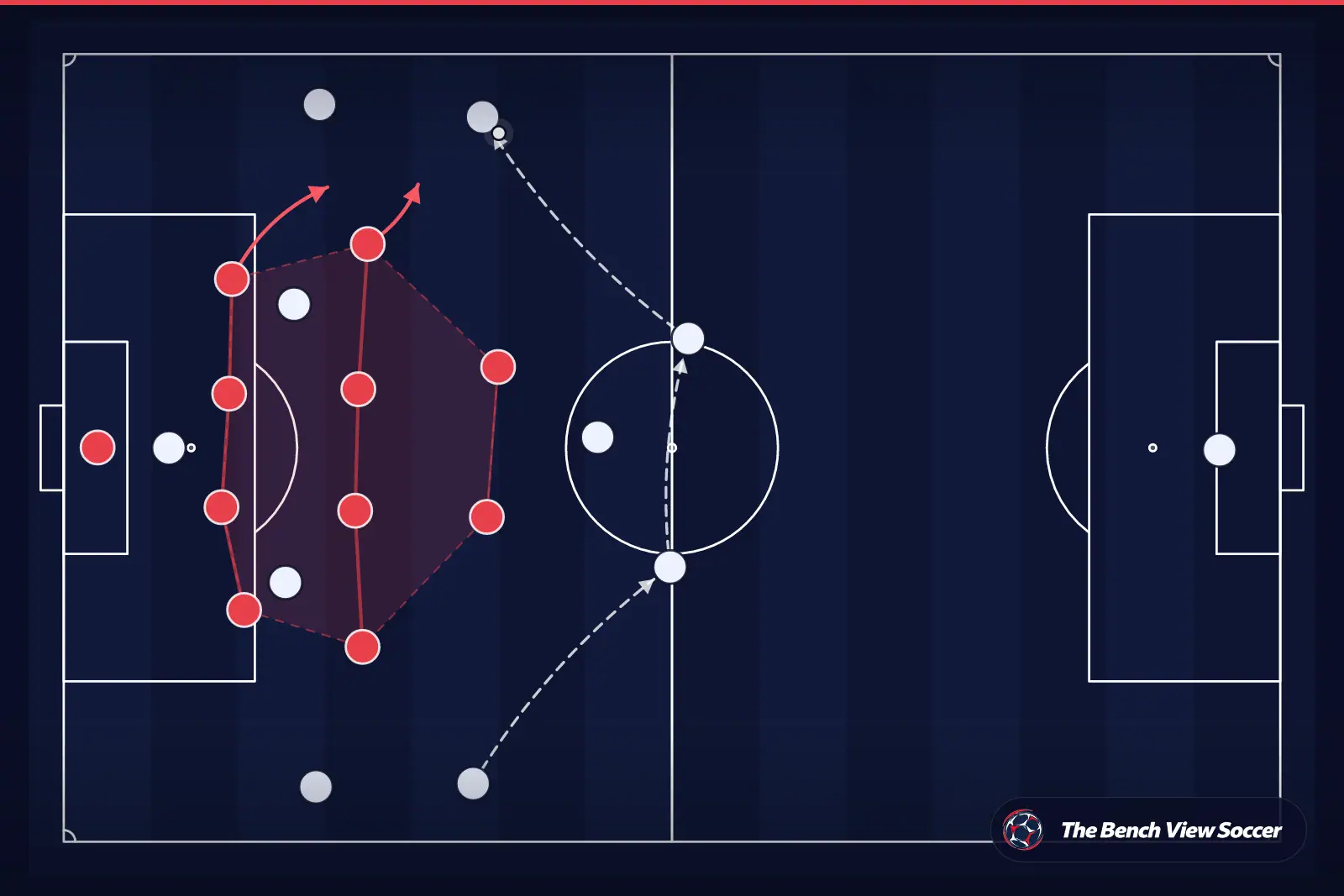
A low block usually means the defending team keeps most players behind the ball, often in a 4-4-2, 5-3-2, or 5-4-1, with small distances between lines. The priority is to protect the central lane (the area straight in front of goal), force you wide, and win the ball for counters. To beat it, the attacking side needs to do three things: stretch the block, pin defenders, and create new angles. First, stretching the block: you widen the defenders with touchline wingers or wing-backs and you occupy both sides at once through fast switches of play. The ball moves quicker than defenders, so switching from left to right forces the block to shuffle and can open a passing lane into the box. Second, pinning defenders: you keep the opposition’s back line “busy” by placing attackers between them—typically a striker on the centre-backs and an extra runner on the far post. This prevents defenders from stepping out freely to intercept. Third, angles: when the central lane is blocked, you manufacture diagonal options. A common method is the “third-man” pattern: Player A passes to Player B under pressure, who immediately lays it off to Player C arriving from a different line. This breaks the static nature of a low block. Another method is underlaps and overlaps from full-backs/wing-backs, which pull wide midfielders inward or outward. Finally, you must value cutbacks (passes pulled back from the byline) over hopeful crosses. Low blocks often defend aerial balls well, but they struggle when the ball is played behind the first line of defenders and then cut back to an arriving midfielder at the edge of the box.
Match Examples
Example 1: Atlético Madrid in La Liga (2020-21 season). Simeone’s title-winning side regularly faces opponents in deep 5-4-1 or 4-5-1 shapes at the Wanda Metropolitano. The key pattern Atlético uses is wing progression followed by a cutback or a quick cross to the far post. When Kieran Trippier (or later Marcos Llorente/Ángel Correa shifting wide) provides width, Atlético often positions two attackers across the box—one at the near corridor to occupy the first centre-back, and another arriving at the far post. This “pins” the back line so the opponent cannot simply step up and clear. Atlético also uses patient circulation: the ball goes from centre-back to full-back, back inside, then switched to the opposite flank. The point is not possession for its own sake; it is to force lateral movement and create a moment when the wide midfielder is late, allowing a pass into the half-space for a cutback. Example 2: Inter Milan in the UEFA Champions League (2022-23 season). Inzaghi’s Inter often meets teams that defend deep for long stretches, especially after Inter scores first. Inter’s 3-5-2 structure gives a built-in answer: natural width through the wing-backs and two strikers to occupy the centre-backs. In matches like Inter vs Porto (Round of 16, 2022-23), Inter attacks a compact block by circulating the ball through the three centre-backs, then finding the wing-back high and wide. The near striker pins, while the far striker and an arriving midfielder (like Nicolò Barella or Henrikh Mkhitaryan) attack the second ball zone. Inter also creates overloads on one side—three players combining near the touchline—then uses a quick diagonal into the box or a switch to the far wing-back. This forces defenders to choose: protect the wide area or protect the central lane, and the hesitation creates the crossing/cutback window. Example 3: A modern reference point—Inter vs AC Milan, Serie A (2023-24). Derby games often feature phases where one team sits deeper to manage risk. When Inter faces a more cautious Milan block, Inter’s wing-backs and midfield rotations are central: the ball travels wide to draw Milan’s wide midfielder, then a midfielder makes a late run into the box for a cutback. Inter’s two-striker occupation is critical because it keeps Milan’s centre-backs from stepping out to meet the ball early. Even when the final action looks like a simple cross, the work is done earlier: Inter’s switches, pins, and late arrivals decide whether it becomes a clear chance or an easy clearance.
Related Concepts & Skills
Training Implications
To translate these ideas into practical improvement, you need training that rewards patience, timing, and clean final actions rather than just “more crosses.” Start with a 7v7 or 8v8 drill in a 40x30 metre area: the defending team sets up in a low block (two compact lines) and is only allowed to score on counters into two mini-goals at halfway. The attacking team scores only if the final pass is a cutback or a ground cross inside the box. This constraint teaches players to reach the byline with control and look for arriving runners instead of hopeful aerial delivery. Next, build switching habits: run a “two-flank switch” drill where the ball must go from left wide channel to right wide channel (or vice versa) before a shot. Coach the details—body shape to receive open, first touch away from pressure, and the speed of the second pass. Add a rule that the far-side winger/wing-back must start wide and only run inside after the switch; this trains the timing that pins full-backs. For third-man patterns, set up a triangle on the edge of the box: a midfielder (A) plays into a forward (B) with back to goal, who lays off to a second midfielder (C) arriving. The shot must come within two touches. Rotate roles so every player learns the “set” pass and the arrival timing. Finally, coach rest defence (protection against counters): keep two players plus one midfielder behind the ball at all times in training games. If they step up recklessly, stop play and reset. Against low blocks, your attack must be brave, but it must also be ready to win the ball back instantly when the opponent clears.
The Bench View app
Don’t just read football — train it
Everything you read here, turned into training you can follow step by step.
Physical training at home
AI daily sessions adapted to your level and position. No equipment needed.
Tactical training courses
Step-by-step courses on positioning, pressing, build-up and decision making.
- 7 days free
- No commitment
- Cancel anytime
Free account: 2 physical sessions + the first tactical course. PRO: 7-day free trial — cancel before day 8 and you pay nothing.