Introduction
Manchester City under Pep Guardiola often looks like a team of chess pieces that never stop sliding into new squares. For many fans watching the Premier League or the UEFA Champions League, it can feel like City “just keeps the ball” and waits. But the real story is how City’s midfield rotates—meaning players swap zones and roles during the same attack—to pull defenders out of shape and open passing lanes that did not exist two seconds earlier. This rotation is not random flair; it is a planned method to create free players between the lines, overload one side, then switch to the other. It is also why City can dominate games even against low blocks (teams defending deep with many players behind the ball). In this tactical breakdown, we focus on how City’s midfield movement creates space for runners, gives safer passing options, and forces opponents into constant decision-making mistakes—step out and leave a gap, or stay and allow City to play through you.
How It Works
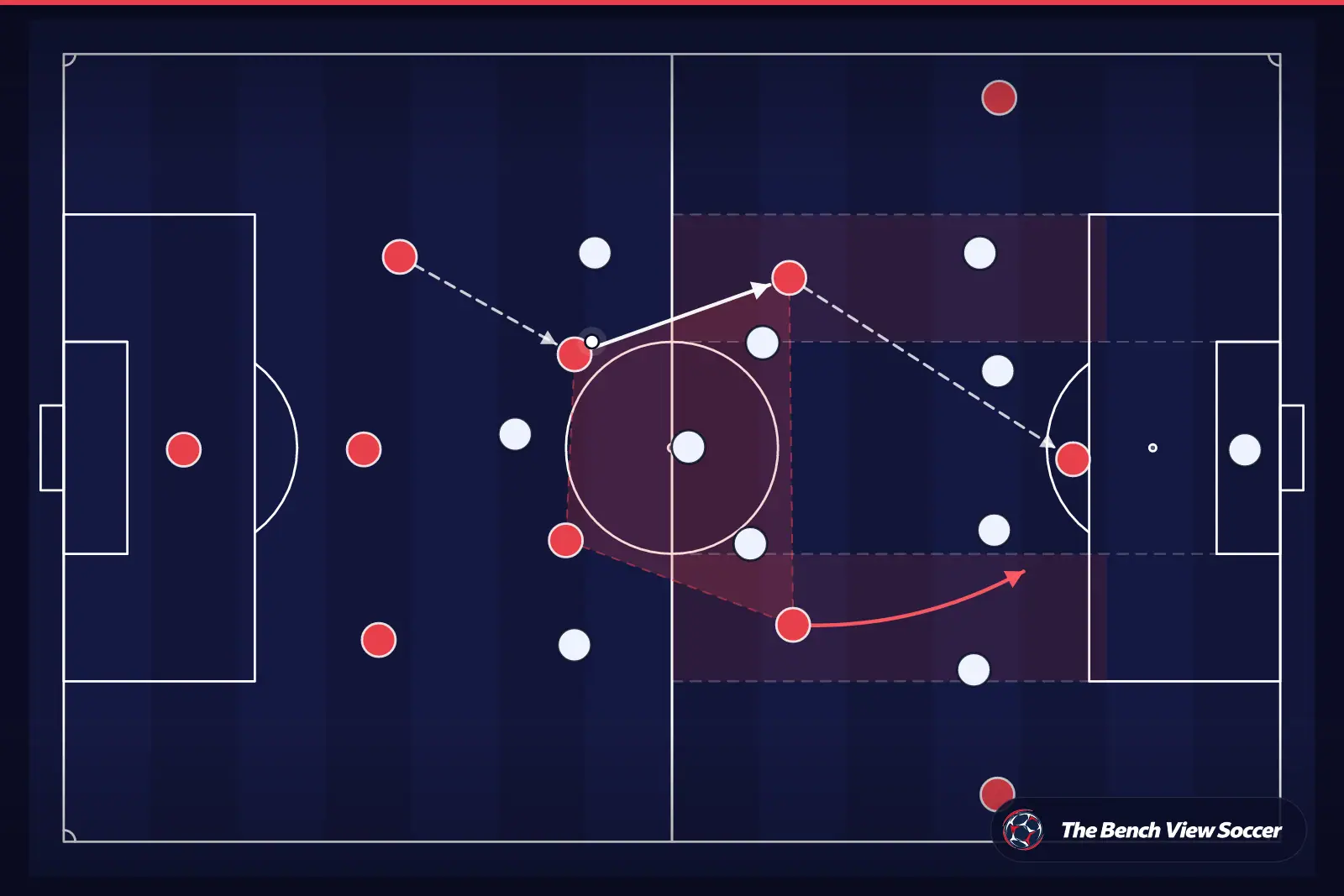
City’s rotation begins with structure: Guardiola usually builds attacks with a “rest defence” behind the ball (players positioned to stop counter-attacks) while the front players rearrange. In many matches, Rodri acts as the central anchor in midfield, offering a stable passing option and protecting the centre. Around him, the “interiors” (often Kevin De Bruyne, Bernardo Silva, or İlkay Gündoğan in earlier seasons) rotate with the full-backs or wingers. When City uses inverted full-backs—like John Stones stepping into midfield in the 2022-23 season—rotation becomes even more powerful: the full-back moves inside, a midfielder can drift higher, and a winger can hold width. The key idea is to manipulate defenders’ reference points. Most defenders like to track either a man or a zone; City makes both uncomfortable. Example: if Bernardo drops into the right half-space to receive, the opposing midfielder steps out. At that moment, De Bruyne can run beyond into the space vacated, or Erling Haaland pins the centre-backs so they cannot cover. If defenders do not step out, Bernardo receives facing forward and City plays through. City also uses “third-man runs”: Player A passes to Player B, but the real target is Player C who runs into the space created because defenders react to the first pass. Rotation is the engine that creates these third-man moments repeatedly, especially around the edge of the box where one wrong step equals a clear chance.
Match Examples
A clear example comes from the 2022-23 UEFA Champions League semi-final second leg: Manchester City vs Real Madrid at the Etihad Stadium. City’s midfield rotation with John Stones stepping into midfield alongside Rodri helps overload Madrid’s central area. With Stones inside, Bernardo Silva can either stay high to attack the channel or drop slightly to connect. Madrid’s midfield line gets stretched: if Toni Kroos or Luka Modrić steps toward the ball, City immediately uses a third-man option to find a free player between the lines. The two Bernardo goals also show the same principle: City’s movement around the right side pulls defenders inward, then exploits the far-side space and second-ball positioning. Another strong reference is the 2022-23 Premier League match Manchester City vs Arsenal at the Etihad (April 2023). City’s rotations around Rodri and De Bruyne repeatedly target the space behind Arsenal’s midfield. De Bruyne does not stay fixed as a classic No.10; he drifts to receive, then spins into depth when Arsenal midfielders step out. Haaland pins the centre-backs, so Arsenal cannot easily “pass on” runners. City’s first goal shows how a small shift—midfielder dropping, forward pinning, runner accelerating—creates a direct path to goal. For a more recent feel, the 2023-24 Premier League season often shows City using Bernardo Silva and Phil Foden as rotating interiors/wingers. They swap sides and heights: one comes short, the other attacks the back line. Against teams like Liverpool or Chelsea, the same rotation is used not just to break deep blocks, but to escape pressure and keep progression clean, showing rotation is a universal tool, not only a “low-block solution.”
Related Concepts & Skills
Training Implications
To learn City-style rotation, training must connect movement to a clear “why”: creating a free player, not just swapping positions for fun. Start with a 4v4+3 rondo (possession game) where three neutral players support the team in possession—one neutral is a fixed pivot (Rodri role), two are “interiors” who must rotate zones every 6–8 seconds. Rule: a goal (one point) counts only if the team completes a pass into a player who receives on the half-turn (body open to play forward). Coach the receivers to scan before the ball arrives and to adjust their body angle. Next, use a positional game on half a pitch: 7v7 with two wide channels marked. Constraint: at least one winger must stay wide, but the interior and full-back on that side can rotate—full-back can invert into midfield, interior can run beyond, winger can come inside only after the ball reaches the pivot. This builds timing: rotation happens after a stabilising pass, not during chaos. Finally, add an end product drill: 6 attackers vs 5 defenders around the box. Objective: create a shot within 12 seconds using one third-man run. Give players triggers: when the interior drops short, the opposite interior attacks the far post; when the pivot receives facing forward, one runner goes beyond immediately. After each repetition, ask two questions: “Who did we move?” and “What space did that open?” This reflection makes rotation a repeatable habit, not a highlight moment.
The Bench View app
Don’t just read football — train it
Everything you read here, turned into training you can follow step by step.
Physical training at home
AI daily sessions adapted to your level and position. No equipment needed.
Tactical training courses
Step-by-step courses on positioning, pressing, build-up and decision making.
- 7 days free
- No commitment
- Cancel anytime
Free account: 2 physical sessions + the first tactical course. PRO: 7-day free trial — cancel before day 8 and you pay nothing.