Introduction
Watch Arsenal under Mikel Arteta and you quickly notice a repeating picture: the full-backs don’t stay “full-back” for long. Instead of hugging the defensive line, they often step high into midfield or even appear near the edge of the opponent’s box. For fans used to older Premier League images—two centre-backs, two full-backs, and wingers out wide—this can look reckless. But it is a calculated way to control space, create passing options, and keep opponents pinned back. In the UEFA Champions League and Premier League, Arsenal faces teams who defend with compact blocks and quick counter-attacks. Pushing full-backs high is Arteta’s answer to both problems: it helps Arsenal build attacks with more numbers in advanced areas, and it helps them win the ball back quickly because their structure is already set up to press. The key is understanding that Arsenal’s “full-backs” are often midfielders in disguise during possession. The benefits are big—width, overloads, and sustained pressure—but the risks are real too, especially against fast transitions.
How It Works
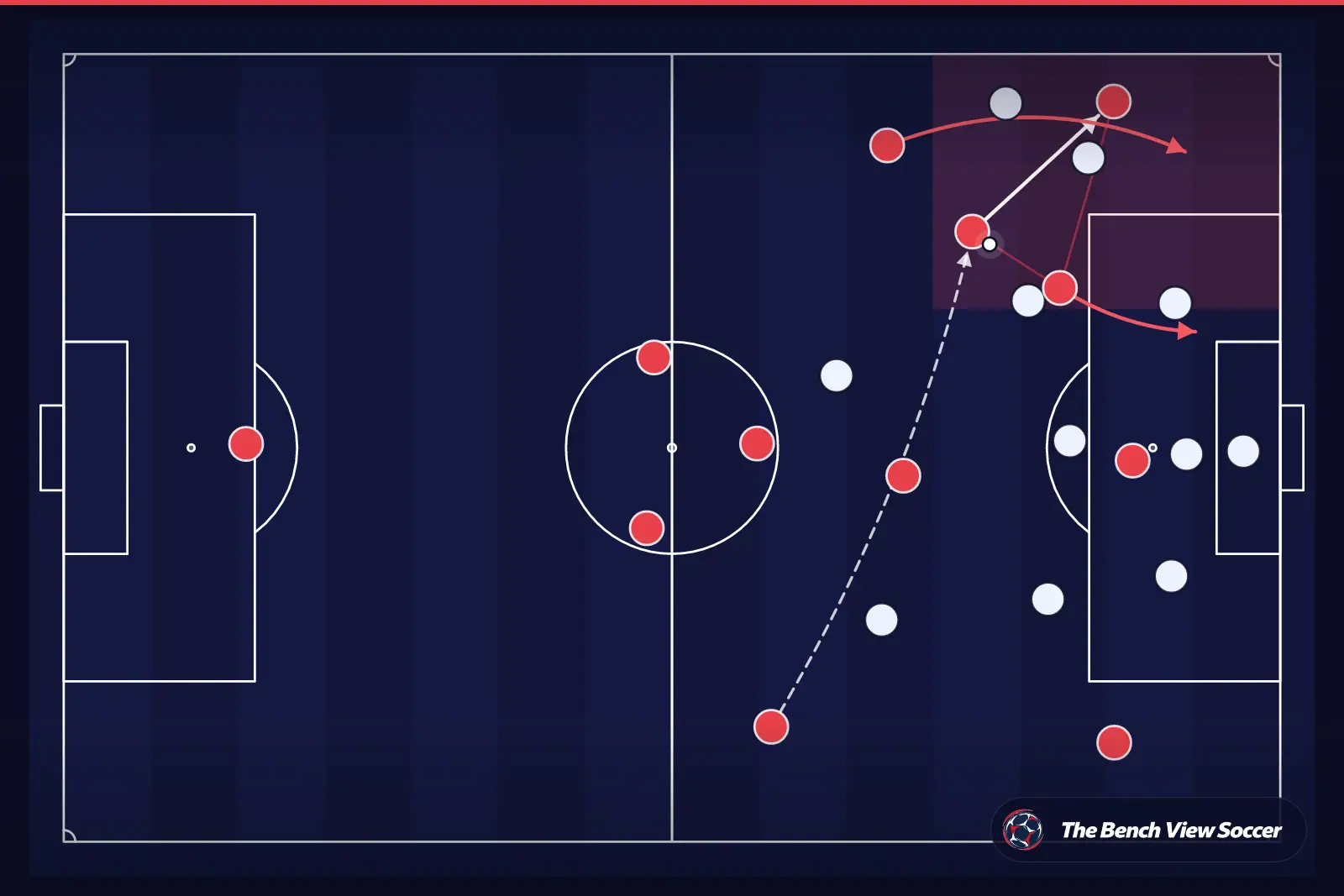
Arsenal pushes full-backs high mainly to solve three puzzles at once: how to create width, how to overload key zones, and how to defend by attacking. First, width: when a team defends in a narrow shape, someone must stretch them. Sometimes Bukayo Saka or Gabriel Martinelli stays wide; other times the full-back provides the wide “rail” so the winger can move inside. This is where players like Ben White and Oleksandr Zinchenko matter. White often overlaps on the right, allowing Saka to receive inside and combine, while Zinchenko often inverts—meaning he moves into central midfield when Arsenal has the ball. Second, overloads: Arsenal wants more players than the opponent in the area where the ball is. If Zinchenko steps into midfield next to Declan Rice, Arsenal can build with a 3-2 base (three defenders behind, two midfielders in front), which gives safer passing angles and lets Martin Ødegaard receive between lines. If White steps high, Arsenal can create a 2v1 against the opponent’s left-back, forcing that defender to choose: press the wide player or protect the inside channel. Third, risk management: pushing full-backs high looks dangerous because it leaves space behind them. Arsenal covers this by shifting the back line across and using Rice (or previously Thomas Partey) as a “rest defense” anchor—players positioned to stop counters before they become sprints at goal. The risk still exists, especially if the ball is lost with the team spread out, but the idea is that Arsenal’s high full-backs support immediate counter-pressing so opponents cannot lift their heads and play direct passes.
Match Examples
A clear example arrives in the 2022-23 Premier League season, particularly Arsenal’s home match against Tottenham Hotspur (Arsenal 3–1 Spurs). Arsenal uses Ben White aggressively high on the right to support Saka. Spurs defend deep in a 5-4-1 shape at times, so Arsenal’s width is vital. White’s high positioning pins Spurs’ wing-back, which gives Saka room to receive and drive inside. This is not only about crossing; it is about manipulating the defender’s body angle so Arsenal can access Ødegaard between the lines. Another strong reference comes from Arsenal’s 2023-24 UEFA Champions League group stage, especially the home game against PSV Eindhoven (Arsenal 4–0 PSV). Zinchenko frequently steps into midfield to help Arsenal play through PSV’s press. When Zinchenko joins central areas, Arsenal builds with an extra passing lane, which helps them escape pressure and keep attacks flowing. You also see the risk side in big-transition matches from the 2023-24 Premier League run-in, where opponents try to hit the space behind the advanced full-back with early balls into the channels. Against elite counter-attacking teams, Arsenal’s high full-backs must be supported by quick pressure on the ball and smart positioning from Rice and the centre-backs. These matches show the full story: high full-backs create consistent attacks, but any sloppy pass or slow counter-press invites trouble.
Related Concepts & Skills
Training Implications
To train the “high full-back” idea in a practical way, focus on roles, spacing, and transition reactions. Start with a 7v7+3 possession game (three neutrals) in a rectangle. Assign two players as “full-backs” who must begin deep but are rewarded with extra points if they receive the ball in the final third zone. Coaching points: one full-back stays wide to stretch; the other can step inside to form a midfield box. Next, add a simple rule to teach risk management: if a full-back goes high, the opposite-side winger must drop five meters and the nearest midfielder must hold a covering position—this builds rest defense habits. For pattern work, run a right-side circuit: centre-back to full-back (high), into winger, bounce to Ødegaard-type midfielder, then release the overlapping full-back or a third-man runner into the half-space. Repeat at game speed with one defender who can intercept to force realistic timing. Finally, train counter-pressing: in small-sided games, when the attacking team loses possession, they have five seconds to win it back; if they fail, the defending team gets a free pass into the channel behind the advanced full-back. This creates a clear consequence and teaches why Arsenal’s high full-backs must be paired with immediate pressure, compact distances, and quick recovery sprints.
The Bench View app
Don’t just read football — train it
Everything you read here, turned into training you can follow step by step.
Physical training at home
AI daily sessions adapted to your level and position. No equipment needed.
Tactical training courses
Step-by-step courses on positioning, pressing, build-up and decision making.
- 7 days free
- No commitment
- Cancel anytime
Free account: 2 physical sessions + the first tactical course. PRO: 7-day free trial — cancel before day 8 and you pay nothing.