Introduction
England’s biggest problem against elite opponents is rarely “effort”; it is access. When teams like Spain, France, or a club side coached in the Pep Guardiola or Jürgen Klopp school push a high press, they aim to lock England near their own box, force long clearances, and then win the second ball. In modern international football, the pressure arrives quicker because pressing structures are well rehearsed at club level, especially in the Premier League and Champions League. This is where England’s wing-backs become a tactical release valve. A wing-back is not just a full-back who runs; in a back five, they are the widest, highest outlets in build-up and the first “escape route” when central passing lanes are blocked. If England can use the wing-backs to receive under pressure, play forward, and connect into the front line, they can resist the press without needing to play risky passes through the middle. For fans learning tactics, the key idea is simple: wing-backs create width, time, and angles—three things a high press tries to remove.
How It Works
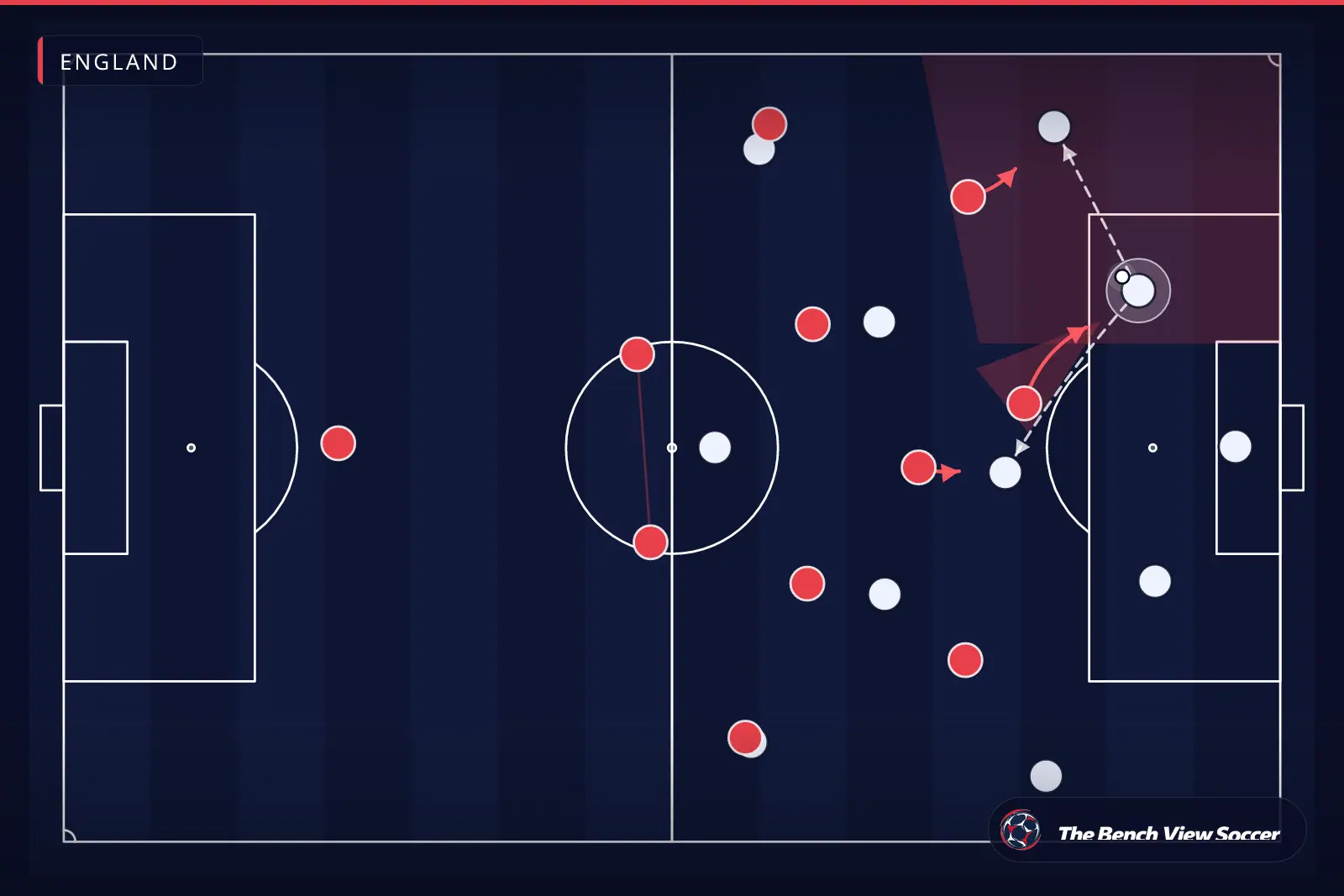
A high press tries to trap the ball near the goalkeeper and centre-backs by closing short passing options and forcing predictable touches. England often builds with three defenders (either a natural back three or a centre-back stepping wide) plus a goalkeeper who acts as an extra passer—something you see at Manchester City under Guardiola and at Brighton under Roberto De Zerbi. Against a high press, England’s wing-backs are crucial for three reasons. First, they provide “outside outlets”: when the opposition front line blocks passes into midfield, the safest forward pass is often out to the wing-back. Second, they create a switch option: if one side is pressed, England can circulate across the back line to the far-side wing-back, turning the press and attacking the space left behind. Third, they help England play over the press without just “hoofing” it. If the wing-back starts high, the centre-back can clip a diagonal to him; if the wing-back starts deeper, he can receive to feet, draw the pressing winger, and then bounce the ball inside to a midfielder or forward. The best wing-back usage also includes the winger/inside forward making an underlapping run (inside the wing-back) to pin the opponent’s full-back, so the wing-back receives with less immediate pressure. The tactical detail that matters: wing-backs must time their height—too high and they are marked tightly, too low and England loses progression.
Match Examples
A clear international reference point is England’s UEFA Euro 2020 campaign under Gareth Southgate, where the 3-4-3/3-4-2-1 shape relies heavily on the wing-backs for progression. In the Euro 2020 semi-final vs Denmark at Wembley (July 2021), Denmark’s mid-to-high pressure tries to force England into slower circulation. England’s wing-backs—especially when Luke Shaw holds width—help move the ball away from central congestion and allow England to attack the far side after switches. Another relevant example is England vs Italy in the Euro 2020 final (July 2021). Italy under Roberto Mancini uses coordinated pressure to stop passes into midfield, and England’s early ability to reach the wing-back zones contributes to their best attacking moments; when those wide outlets become harder to find, England struggles to sustain escapes and ends up defending waves of pressure. For a club-season parallel that helps fans connect ideas, watch Chelsea under Thomas Tuchel in the 2020–21 UEFA Champions League knockout run. In matches like Chelsea vs Manchester City in the 2021 Champions League final, Chelsea’s wing-backs (Reece James/Ben Chilwell role in that system) often receive as the “free man” when City’s first line jumps. The pattern is similar: the wing-back becomes the release, then Chelsea connects inside quickly before the opponent can reset. These examples show the same lesson: against top pressing teams, the wide outlet is not optional—it is the route that keeps you playing.
Related Concepts & Skills
Training Implications
For coaches and players wanting to apply these ideas (even in Indian school, academy, or Sunday-league settings), build habits that make wing-back outlets reliable under pressure. 1) “Escape-side rondos” (6v3 or 7v4): set up a rectangle with two wide zones. The rule: a point only counts if the ball reaches a wide player (wing-back) and then goes inside within two touches. This trains receiving on the touchline and quick inside connection before the press recovers. 2) Pattern play with timed height: rehearse three build-up patterns—(a) wing-back starts deep to receive to feet, (b) wing-back starts high to receive a clipped diagonal, (c) wing-back checks short then spins behind for a return ball. Add a coach’s call (“deep/high/check”) to force decision-making. 3) Body shape and first touch drills: wing-backs practise opening up on the half-turn, with the first touch either down the line (if pressed inside) or inside (if pressed outside). Use a passive defender at first, then active. 4) Counter-press reaction: after every wide reception, if the ball is lost, the nearest three players must sprint to close the ball for five seconds. This teaches that resisting a high press is not only about playing out, but also about immediate recovery when the press wins it.
The Bench View app
Don’t just read football — train it
Everything you read here, turned into training you can follow step by step.
Physical training at home
AI daily sessions adapted to your level and position. No equipment needed.
Tactical training courses
Step-by-step courses on positioning, pressing, build-up and decision making.
- 7 days free
- No commitment
- Cancel anytime
Free account: 2 physical sessions + the first tactical course. PRO: 7-day free trial — cancel before day 8 and you pay nothing.