Introduction
Walk into any modern Champions League night and you see the same picture: the “winger” starts wide, receives, and then drives inside toward goal rather than hugging the touchline. This is the era of the inverted winger, a role popularised in different ways by coaches like Pep Guardiola (Manchester City), Mikel Arteta (Arsenal), and Jürgen Klopp (Liverpool), and refined across leagues from the Premier League to Serie A and La Liga. The change is not just fashion; it is a response to how defences protect the middle and how teams want to create high-quality shots. Inverting increases goal threat because it brings your best dribblers and finishers closer to the penalty area, often onto their stronger foot for shooting or through-balls. But every attacking gain carries a defensive cost. When wide players move inside, width must come from somewhere else, and the team risks counter-attacks into the vacated wing. This article breaks down why inverting is so common now, what it gives you, what it risks, and how top teams manage the trade-off between goals and balance.
How It Works
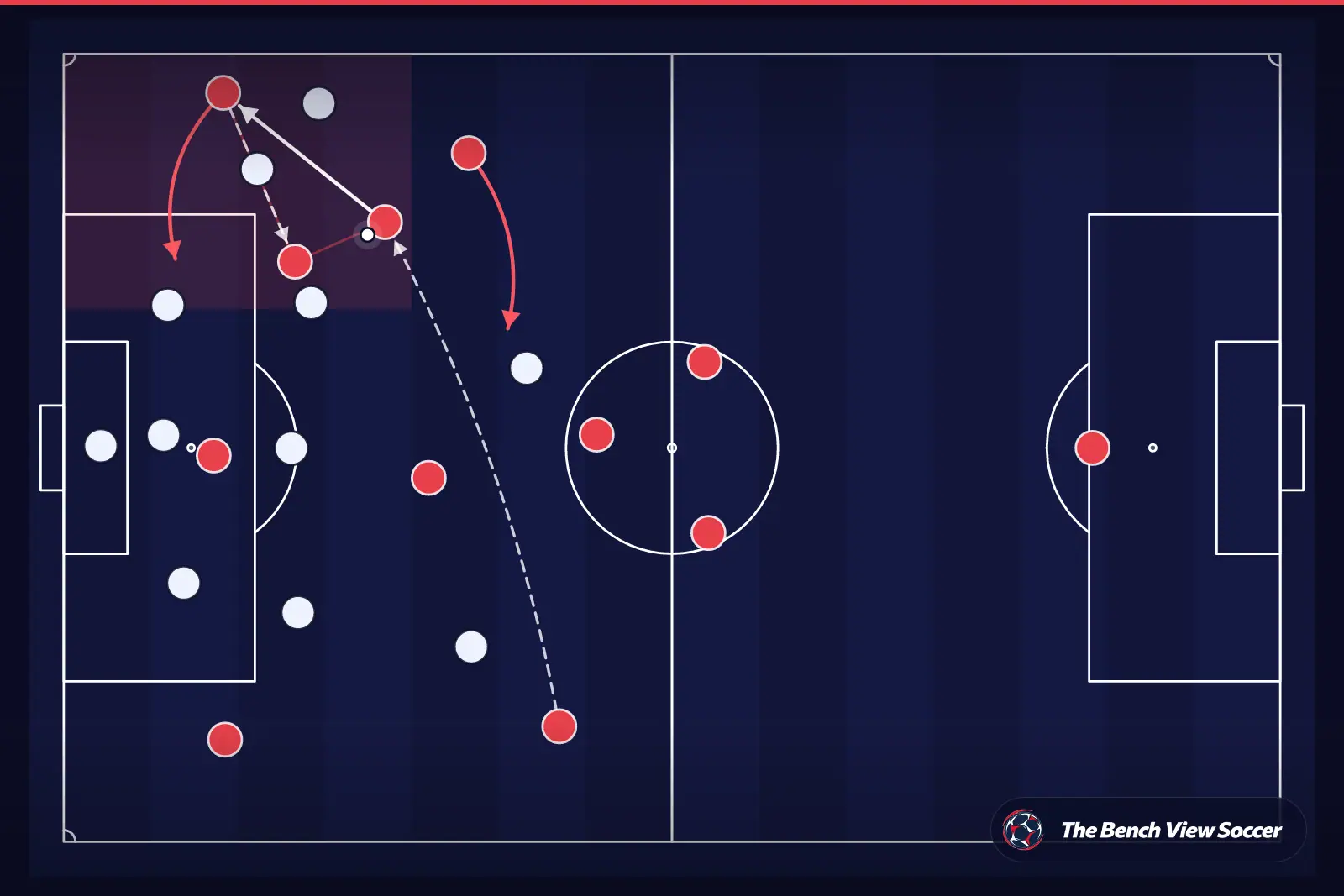
An inverted winger is usually a wide attacker who plays on the “opposite” side to their stronger foot: a right-footed player on the left, or a left-footed player on the right. Instead of staying wide to cross, they come inside into central lanes to shoot, combine, or make runs behind. Tactically, this creates three big advantages. First, it increases shot quality: a left-footed right winger like Mohamed Salah (Liverpool) attacks the inside channel and arrives in the box facing goal, not the corner flag. Second, it overloads the middle: when the winger comes into the half-space (the channel between full-back and centre-back), they add an extra player between the lines, making it harder for a back four to mark and for midfielders to screen passes. Third, it opens the outside lane for an overlapping full-back (or an underlapping run inside). This is why teams like Arsenal under Arteta often build with wide full-backs and wingers who step in to connect. The trade-off is balance. When the winger leaves the touchline, you lose natural width and immediate counter-pressing coverage on the flank. Opponents can win the ball and play quickly into the space behind the advanced full-back. To solve it, modern teams adjust their “rest defence” (the players and spacing that stay ready for transitions while others attack). Manchester City under Guardiola often keeps a back three shape in possession (one full-back tucks inside), so if the winger inverts and the other full-back pushes high, there are still enough defenders and midfielders positioned to stop counters. Another solution is to ask the winger to invert at specific moments, not constantly: they start wide to stretch the back line, then move inside when the ball reaches the central midfielder or when the striker pins the centre-backs. The modern inverted winger, therefore, is not only a dribbler; they must understand timing, spacing, and defensive recovery runs to ensure the team does not become open.
Match Examples
In the Premier League 2022–23 season, Arsenal’s right side shows the inverted winger logic clearly. Bukayo Saka often starts wide right but attacks inside the right half-space as Martin Ødegaard supports close by, while Ben White overlaps to provide width. In Arsenal 3–2 Manchester United (Premier League, 22 January 2023), Saka’s inside movements constantly force Luke Shaw and Lisandro Martínez to make uncomfortable decisions: step out to engage him inside and leave space outside, or hold the line and allow him to combine centrally. Arsenal’s chance creation improves because Saka arrives facing the goal more often, but the cost appears whenever United breaks into the wide space and Arsenal must sprint back to restore shape. A second reference point is Liverpool’s Champions League-winning 2018–19 season, where Salah (right) and Sadio Mané (left) repeatedly invert to become goal threats while Andrew Robertson and Trent Alexander-Arnold provide the width and crossing. In Liverpool 4–0 Barcelona (UEFA Champions League semi-final second leg, 7 May 2019), the wide full-backs and inverted forwards work together: the wingers occupy central defenders and attack the box, while full-backs deliver from wide zones. Liverpool’s structure also highlights the trade-off: because the full-backs are high, Liverpool relies on intense counter-pressing and midfield covering to stop fast counters. In Serie A 2022–23, Napoli under Luciano Spalletti offer another version. Khvicha Kvaratskhelia (left wing) often drives inside to combine with Victor Osimhen and create shooting angles, while the left-back provides width when needed. In Napoli 3–0 Eintracht Frankfurt (UEFA Champions League Round of 16 second leg, 15 March 2023), Kvaratskhelia’s inward dribbles draw defenders into the half-space, opening either a direct shot or a slip pass to Osimhen. Napoli also show the defensive side: when the winger inverts and loses the ball, the nearest midfielders and full-back must instantly close the corridor to prevent counters into the wide channel.
Related Concepts & Skills
Training Implications
For coaches, players, and even viewers who want to “see” the inverted winger role more clearly, training must connect attacking patterns with transition safety. Start with a simple positional game: 6v6 + 2 neutral players in a 40x30 grid, with channels marked on both wings. Rule: a goal (or point) only counts if the winger receives wide first, then makes an inside action (dribble, wall pass, or shot) within five seconds. This trains the key timing: stretch first, then invert. Add the next rule to build balance: if the winger inverts, the full-back must either overlap outside into the wing channel or the nearest central midfielder must slide across to cover; the coach calls “overlap” or “cover” to create habit. Then use a finishing pattern that mirrors modern matches: ball goes from centre-back to central midfielder, then to winger wide, then inside to the edge of the box for a shot on the stronger foot. Progress it by adding a defender who can counter if they win the ball. This forces immediate counter-pressing and recovery runs. Give the winger specific defensive tasks: on losing possession inside, they sprint to block the opponent’s first forward pass into the wing channel, buying time for the full-back to recover. Finally, add video feedback: clip 6–8 moments from a match (for example, Arsenal 2022–23 or Liverpool 2018–19) and pause at the moment the winger starts to drift inside. Ask three questions: Who provides width now? Who protects against the counter? Where is the nearest passing option? If players can answer these quickly, the inverted winger becomes a repeatable team behaviour, not an individual dribble.
The Bench View app
Don’t just read football — train it
Everything you read here, turned into training you can follow step by step.
Physical training at home
AI daily sessions adapted to your level and position. No equipment needed.
Tactical training courses
Step-by-step courses on positioning, pressing, build-up and decision making.
- 7 days free
- No commitment
- Cancel anytime
Free account: 2 physical sessions + the first tactical course. PRO: 7-day free trial — cancel before day 8 and you pay nothing.