Introduction
For many fans, “winger” still means a player who stays wide, beats the full-back, and crosses. In modern European football, especially in the Premier League, top coaches flip that idea: the winger starts wide but attacks inside to become a goal threat. This is the inverted winger—often a right-footed player on the left or a left-footed player on the right—who uses the touchline to stretch the pitch, then dribbles or runs into central spaces to shoot, combine, or create overloads. Pep Guardiola’s Manchester City and Mikel Arteta’s Arsenal both use inverted wingers, but with different supporting structures around them. City often build a “rest defence” behind the ball and use rotations to free the winger into the half-space. Arsenal often use wide isolation and quick combinations with the full-back and No.8 to open the inside lane. Understanding inverted wingers helps you read why teams create cutbacks, why full-backs sometimes stay outside, and why the most dangerous actions happen between the opponent’s full-back and centre-back.
How It Works
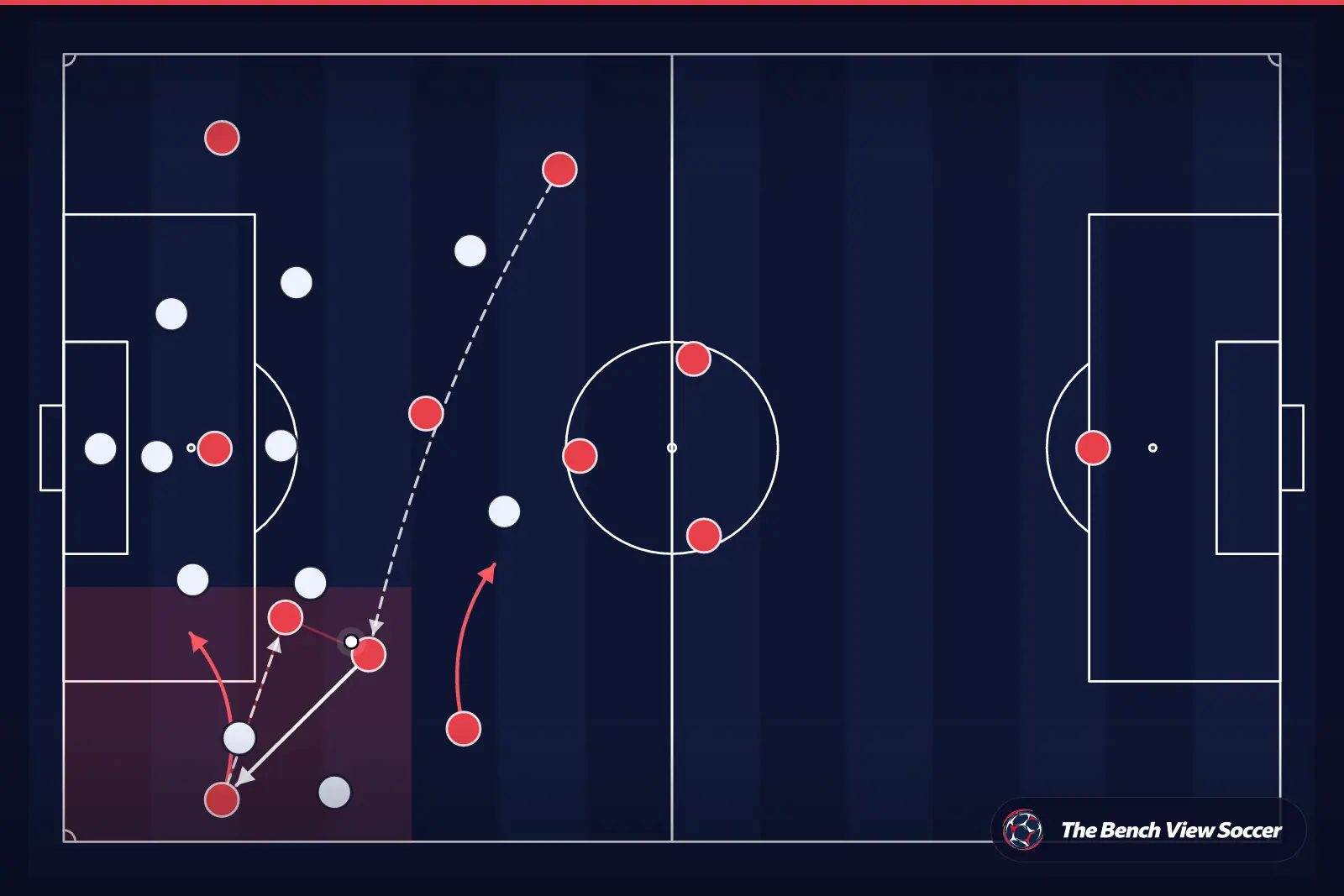
An inverted winger is defined by direction of threat, not just which foot they use. The key idea is: start wide to pin the opponent’s full-back, then attack inside to access higher-value chances. When the winger dribbles inside, three things happen. First, the winger enters the “half-space” (the channel between the wing and the centre), which opens shooting angles to the far post and creates passing lanes to strikers and midfield runners. Second, the opponent’s defensive line faces a dilemma: the full-back can follow inside and leave the flank open, or stay wide and allow the winger to progress centrally. Third, the winger’s inward movement usually requires width from someone else—either a full-back overlapping, a wide No.8 drifting out, or a winger on the far side holding the touchline. Manchester City under Pep Guardiola typically supports the inverted winger with positional play: the winger holds width during the early build-up, while a full-back (often John Stones or Manuel Akanji in 2022–23) steps into midfield to create an extra central player. This gives the winger a clearer 1v1 wide, and once the winger comes inside, City’s midfielders occupy different vertical lines so short passes are always available. Arsenal under Mikel Arteta often builds with a 2–3–5 shape in possession: one full-back (like Oleksandr Zinchenko) moves into midfield to help circulation, while the opposite side (like Ben White) overlaps to keep width. That lets Bukayo Saka (right) and Gabriel Martinelli (left) attack inside with support close by, especially from Martin Ødegaard or Granit Xhaka/Kai Havertz in the left half-space role. The inverted winger’s main end products are: (1) a shot after cutting inside, (2) a through ball to a striker’s run, (3) a disguised pass to an underlapping runner, or (4) a cutback after reaching the byline when defenders over-commit to blocking the inside lane. The best ones choose based on the defender’s body shape: if the full-back shows them outside, they drive inside; if the full-back blocks inside, they go outside and attack the space for a cutback.
Match Examples
1) Arsenal vs Manchester City, Premier League 2023–24 (Emirates Stadium): Arsenal’s wide structure aims to release Bukayo Saka into inside pockets while keeping a runner near him. In phases when Ben White stays high and wide, Saka receives earlier and faces a full-back with less help. That encourages the classic inverted-winger pattern: first touch wide to fix the defender, second action inside to connect with Martin Ødegaard between the lines. Arsenal’s threat comes when Saka attracts a second defender, then slips a pass into the channel for White or a central runner. Even when the match tempo is tight, the pattern is visible: Saka’s inside dribble forces City’s midfield to collapse, which opens the far side for switches. 2) Manchester City vs Real Madrid, UEFA Champions League 2022–23 semi-final second leg (Etihad Stadium): City’s wingers start by holding width to stretch Madrid’s back line, then attack the half-space once City establish control. The key is City’s midfield occupation: with players positioned between Madrid’s lines, the winger’s inside dribble becomes a trigger for third-man combinations. When Madrid’s full-back steps tight, City can bounce passes into Kevin De Bruyne or Bernardo Silva and then back into the winger’s path. The inverted winger is not just “cut inside and shoot” here; it is “cut inside and connect,” which pins Madrid’s midfield and keeps Madrid’s defenders constantly turning. 3) Arsenal vs Liverpool, Premier League 2023–24 (Emirates Stadium): This match shows the defensive response to inverted wingers. Liverpool often try to force play wide and trap near the touchline, but Arsenal’s inverted wingers look for the moment the full-back’s hips open. Martinelli’s inside drive targets the space between right-back and right centre-back, while Saka’s inward movement invites an overlap to maintain width. Arsenal’s best attacks arrive when the winger carries inside just enough to drag a midfielder, then releases a pass into the channel for a runner—creating cutback opportunities rather than hopeful crosses. Across these examples, you can track a simple checklist: where does the winger receive (touchline or half-space), who provides width (full-back or winger), and what is the opponent’s help defender doing (midfielder covering inside or centre-back stepping out). Those three details explain why inverted wingers look dangerous even in matches with few shots.
Related Concepts & Skills
Training Implications
If you coach or play in India—school football, academy level, or even weekend leagues—you can train inverted wingers without copying elite complexity. Start with clear habits and repeatable pictures. 1) First-touch and body shape drill (15 minutes): Put a winger on the touchline with a defender 2–3 metres away and a small goal placed centrally (top of the box zone). The winger receives a pass with an open body (hips facing inside), takes the first touch either down the line or inside depending on the defender’s stance, then finishes within 5 seconds. Coaching points: scan before receiving, keep the ball on the “far” foot to protect it, and change pace after the first touch. 2) 2v2 + support player to teach the “inside + width” relationship (20 minutes): Create a channel on the flank with a winger and full-back vs a full-back and a midfielder, plus one neutral player inside (acting like Ødegaard/De Bruyne). The rule: the winger must enter the half-space at least once before a shot or a cutback pass is allowed. This forces players to experience the real choice: drive inside to combine with the neutral, or play wide to release an overlap. Rotate roles so full-backs learn when to overlap and when to hold. 3) Pattern play for cutbacks (20 minutes): Many Indian teams cross early because it feels natural, but modern inverted wingers create higher-quality chances through cutbacks. Rehearse a simple pattern: winger receives wide, dribbles inside to attract pressure, plays to the No.10, then spins outside while the full-back underlaps into the box for a cutback. Finish with a low cutback to the penalty spot. Coaching points: the pass to the No.10 must be on the move, the runner attacks the “blind side” of the full-back, and the final ball is along the ground. 4) Decision-making constraint game (15–20 minutes): Play 6v6 with wide zones. Award 2 points for goals created after an inside carry from the winger into the half-space, and 1 point for goals created from a traditional cross. This nudges players to value inside threats while still allowing variety. Encourage wingers to recognise the help defender: if a midfielder blocks the inside lane, go outside and cut back; if the full-back shows them outside, attack inside quickly. These sessions build the core of an inverted winger: receiving wide, scanning, accelerating into central space, combining with nearby midfielders, and delivering end product under pressure.
The Bench View app
Don’t just read football — train it
Everything you read here, turned into training you can follow step by step.
Physical training at home
AI daily sessions adapted to your level and position. No equipment needed.
Tactical training courses
Step-by-step courses on positioning, pressing, build-up and decision making.
- 7 days free
- No commitment
- Cancel anytime
Free account: 2 physical sessions + the first tactical course. PRO: 7-day free trial — cancel before day 8 and you pay nothing.