Introduction
Pep Guardiola’s teams are famous for “playing out from the back,” but that phrase can feel vague if you are new to tactics. What actually happens from the goalkeeper’s first touch to the moment the ball reaches the final third? This article breaks down Guardiola’s ball-progression patterns using real examples from Manchester City in the Premier League and UEFA Champions League, with a few references to his earlier work at FC Barcelona and Bayern Munich for context. The main idea is simple: City use the goalkeeper and defenders not just to keep possession, but to attract pressure in specific areas and then bypass it. Think of it like inviting the opponent to step forward, creating space behind them, and then entering that space with a clean pass. We will look at how City build a stable base, how they create passing lanes, and how they choose between short progression and a longer “release” pass—while keeping control of the next action.
How It Works
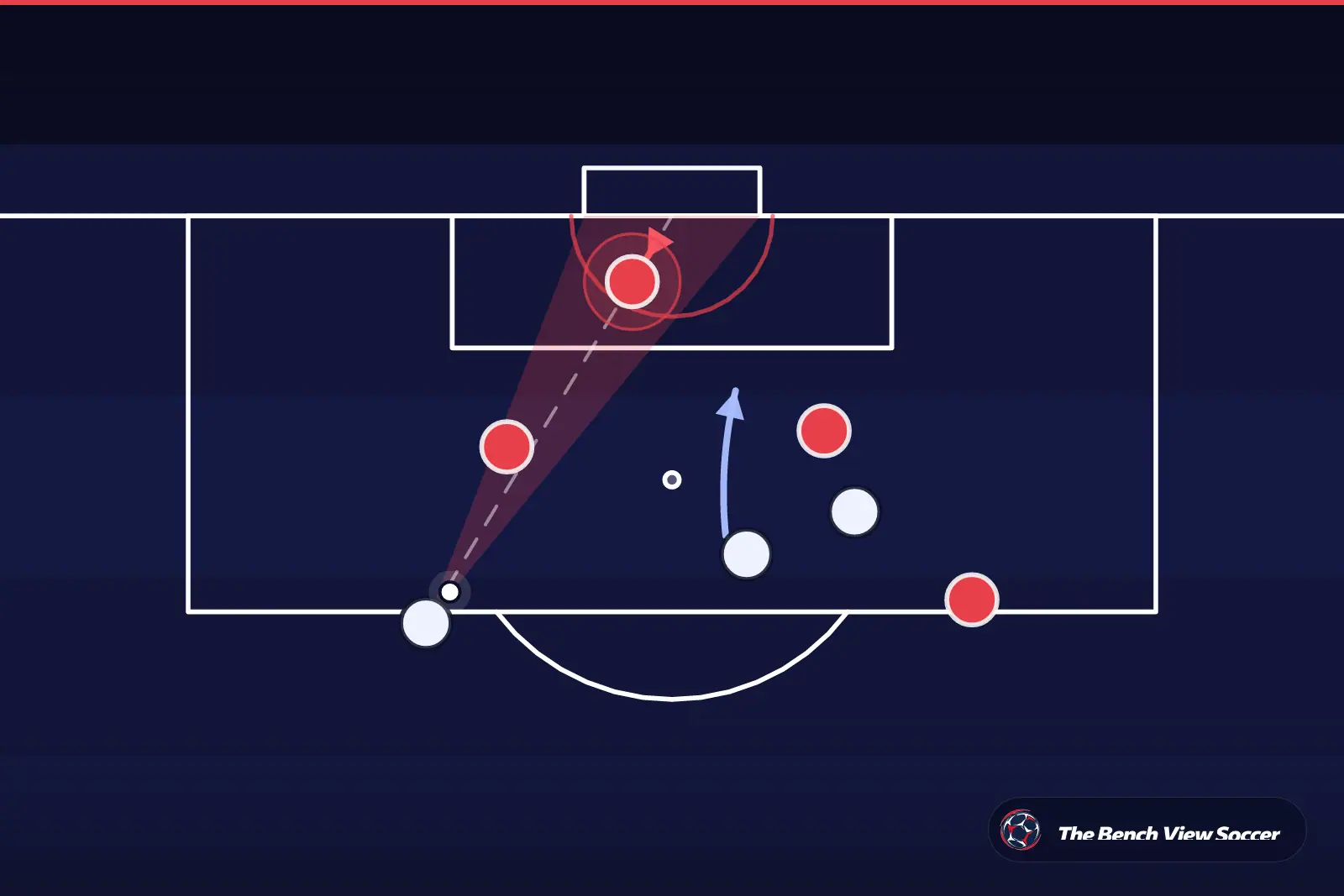
Guardiola’s ball-progression usually begins with the goalkeeper acting as an extra outfield player. At Manchester City, Ederson (and now often Stefan Ortega) positions to create a clear passing angle to one centre-back, while the other centre-back stretches wide to increase the distance the opponent must cover. City often form a “build-up box” (a square of passing options) using the two centre-backs plus two midfielders dropping into the first line. One of those midfielders is commonly Rodri, who offers a safe, central option; the second can be a full-back stepping inside (like John Stones in 2022–23) or an advanced midfielder dropping temporarily. The goal is to create a numerical advantage against the opponent’s first line of pressure, typically 3v2 or 4v3. From there, City progress with three key mechanisms. First, they use “third-man combinations”: Player A passes to Player B, who sets to Player C running free. This beats a marker without needing risky dribbles. Second, they manipulate the press with body shape and tempo—drawing an opponent toward the ball-side and then switching quickly to the far side. Third, they target specific zones between the opponent’s lines: the half-spaces (channels between centre and wing) and the central pocket just behind midfield. When City cannot find a clean short lane, they do not force it; the goalkeeper plays a longer, accurate pass to a winger or striker positioned to secure the second ball. Progression is not about always passing short—it is about reaching the next zone with control and structure for the next pass.
Match Examples
A clear modern example appears in the 2022–23 UEFA Champions League semi-final second leg: Manchester City vs Real Madrid at the Etihad. Carlo Ancelotti’s Madrid try to press higher early, but City’s first line remains calm. Ederson stays available, the centre-backs split, and John Stones steps into midfield next to Rodri to create a box against Madrid’s two forwards. City then find the free man by moving the ball one touch quicker than the press can shift. When Madrid’s midfield jumps to Rodri, City access the half-space runner—often Kevin De Bruyne or Bernardo Silva—through a third-man pattern, and suddenly the ball arrives in the final third with Madrid’s defensive line retreating. Another strong reference is the 2023–24 Premier League match Manchester City vs Liverpool at the Etihad. Jürgen Klopp’s side press with intensity, trying to lock City near one side. City respond by inviting the trap and then escaping with either a quick switch through Rodri or a direct Ederson pass into the wide channel for the winger to secure. You can notice how City’s full-backs do not simply hug the touchline; one often steps inside to give an extra central pass, while the far-side winger stays high to pin the opponent’s full-back. This “pinning” matters because it stops Liverpool from compressing the entire pitch. For historical context, Guardiola’s FC Barcelona in the 2010–11 Champions League regularly use Victor Valdés as a calm extra passer to draw pressure, then find Sergio Busquets behind the first press. The principle stays consistent across clubs and competitions: attract the first wave, find the free pivot, and then connect quickly into advanced midfielders to enter the final third.
Related Concepts & Skills
Training Implications
To train Guardiola-style progression in an Indian academy or fan group session, focus on repeatable habits rather than copying exact player roles. Start with a 6v4 build-out rondo in a 30x25m area: goalkeeper + back four + one pivot (6) try to play through four pressers and dribble/pass into a marked “midfield gate.” Coaching points: the goalkeeper must stand slightly off-centre to open a diagonal lane; centre-backs must split early; the pivot must scan (check shoulders) before receiving and open body to play forward in two touches. Next, add a “third-man” circuit: CB passes into pivot, pivot sets to full-back-inverted midfielder, who then plays into an attacking midfielder between cones. Rotate roles every two minutes. Demand that the set pass is played with correct weight—too hard kills the angle, too soft invites the press. Then run an 8v8 with constraints to force progression: goals count only if the team completes a pass into the final third zone after breaking the first line. Give the pressing team a rule: they can score in mini-goals within 6 seconds after winning the ball. This creates realistic fear of turnovers and teaches rest defence. Finally, track three metrics each session: (1) number of forward passes from the first line completed, (2) number of successful switches after attracting pressure, and (3) turnovers in central areas. Improvement becomes measurable, not just “we kept the ball.”
The Bench View app
Don’t just read football — train it
Everything you read here, turned into training you can follow step by step.
Physical training at home
AI daily sessions adapted to your level and position. No equipment needed.
Tactical training courses
Step-by-step courses on positioning, pressing, build-up and decision making.
- 7 days free
- No commitment
- Cancel anytime
Free account: 2 physical sessions + the first tactical course. PRO: 7-day free trial — cancel before day 8 and you pay nothing.