Introduction
Real Madrid’s modern midfield is less about three fixed “positions” and more about a rotating system designed to win the second ball and keep control of matches. A “second ball” is what drops loose after a duel, a clearance, or a deflection—often the moment that decides whether you attack again or defend in chaos. Under Carlo Ancelotti, Madrid’s midfielders constantly exchange roles: one supports the build-up, one protects the centre, and one arrives to compete for the next loose ball. This rotation helps them survive different game states in La Liga and the UEFA Champions League: slow control phases, sudden transition moments, and long spells without the ball. For fans learning tactics, this is a great case study because it shows how elite teams “manage randomness.” Instead of hoping the ball falls kindly, Madrid set their structure so the next action is theirs—whether that means counter-pressing immediately, recycling possession, or launching a fast attack through Vinícius Júnior or Rodrygo.
How It Works
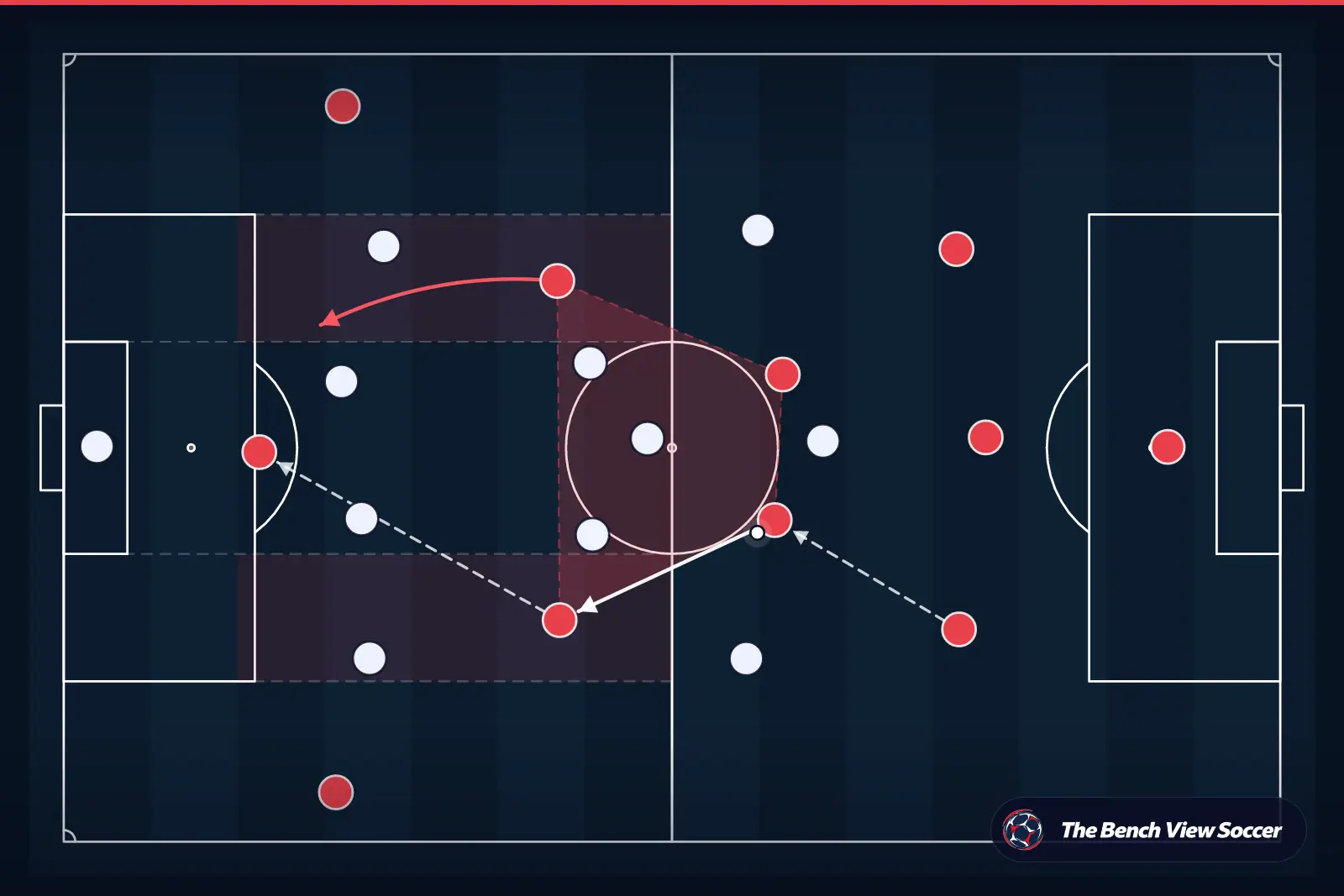
Real Madrid’s midfield rotation works like a moving triangle whose shape changes based on where the ball goes and what type of pass is played. The key idea is spacing: Madrid keep two midfielders close enough to support the ball, while the third positions slightly away to anticipate the next bounce. When Toni Kroos plays, he often starts deeper to guide circulation—he offers a safe passing lane behind pressure and uses his body angle to play forward quickly. Aurélien Tchouaméni (or Eduardo Camavinga) anchors the centre and “screens” passes, meaning he blocks direct balls into the striker or attacking midfielder. Jude Bellingham then shifts between midfield and the space behind the opposition midfield line. This is crucial for second balls: if Madrid play a longer pass or cross-field switch, Bellingham times his movement to arrive at the landing zone just as the duel happens. The rotation is also defensive. When a full-back pushes high, a midfielder slides wide to cover the channel, keeping the team from being countered immediately. If Madrid lose the ball, the nearest midfielder presses while the other two compress the space around the ball, forming a net to recover loose touches and rebounds. The goal is not constant possession for its own sake; it is controlled possession with a structure that makes Madrid the favourite to collect the next ball after any contest.
Match Examples
A clear example appears in the 2023-24 UEFA Champions League knockout run under Carlo Ancelotti, especially the semi-final second leg against Bayern Munich at the Santiago Bernabéu. Madrid often face Bayern’s intense midfield pressure and direct transitions. In response, Madrid’s midfield rotation prioritises the next contest: when a forward pass is challenged, Bellingham positions to attack the loose ball while Tchouaméni holds central balance to stop Bayern breaking through the middle. The same pattern shows in the 2023-24 Champions League quarter-final tie against Manchester City. City’s structure under Pep Guardiola tries to pin opponents with sustained pressure, but Madrid’s midfielders do not simply sit deep; they rotate to survive. One player supports the outlet pass, one stays as a “rest defender” (the player who remains prepared to defend during attacks), and one attacks the second ball zone when clearances or blocked passes pop out around the edge of the box. In La Liga 2023-24, Madrid’s rotation also helps them manage matches against compact mid-blocks like Getafe or Atlético de Madrid under Diego Simeone, where first passes into the box are often blocked. Madrid keep recycling, but the real advantage comes when a shot is saved or a cross is half-cleared: the arriving midfielder is already set to regain the ball and restart pressure, turning one attack into three or four waves without losing defensive stability.
Related Concepts & Skills
Training Implications
To train this in an academy or amateur setting, focus on habits rather than copying Real Madrid’s exact personnel. Start with a 6v6+2 neutral players “second-ball game” in a 40x30 metre area: coaches serve balls that create duels (aerial throws, bounced passes, or driven passes into a marked zone). Award 2 points for winning the second ball and completing three passes, and 1 point for winning the duel itself—this teaches players that the loose ball matters more than the first contact. Next, run a “rotating triangle” drill: three midfielders operate as a unit with rules—one must always be behind the ball (safety), one must be within 10 metres of the ball (support), and one must be in the next zone (anticipation). Rotate roles every 30 seconds so players learn scanning and timing. Add a transition rule: if possession is lost, the nearest player presses for three seconds while the other two block forward lanes—this builds counter-press structure. For actionable coaching cues, use simple language: “one behind, one near, one ahead,” “arrive on the bounce,” and “see shoulder before you move.” Finally, video your small-sided games and count second-ball wins per team; set a target improvement (for example, +20% over four sessions) to make the learning measurable, not just motivational.
The Bench View app
Don’t just read football — train it
Everything you read here, turned into training you can follow step by step.
Physical training at home
AI daily sessions adapted to your level and position. No equipment needed.
Tactical training courses
Step-by-step courses on positioning, pressing, build-up and decision making.
- 7 days free
- No commitment
- Cancel anytime
Free account: 2 physical sessions + the first tactical course. PRO: 7-day free trial — cancel before day 8 and you pay nothing.