Introduction
Arsenal under Mikel Arteta treat “building from the back” as more than simply passing out from the goalkeeper. It is a repeatable method to control the game: invite pressure, create a free player, and progress into the middle third without losing stability. For fans used to highlight-driven narratives, the key lesson is that good build-up is a defensive tool as much as an attacking one. When Arsenal circulate through Gabriel Magalhães and William Saliba, they are not “playing risky”; they are stretching the opponent’s first pressing line and choosing the moment to accelerate. Declan Rice then becomes the safety net and the connector: he protects the centre if the ball is lost and offers a calm option to keep moves alive. This article breaks down how Arsenal’s back line plus Rice forms a “midfield shield” that makes their possession game safer, faster, and more consistent in the Premier League and UEFA Champions League environments.
How It Works
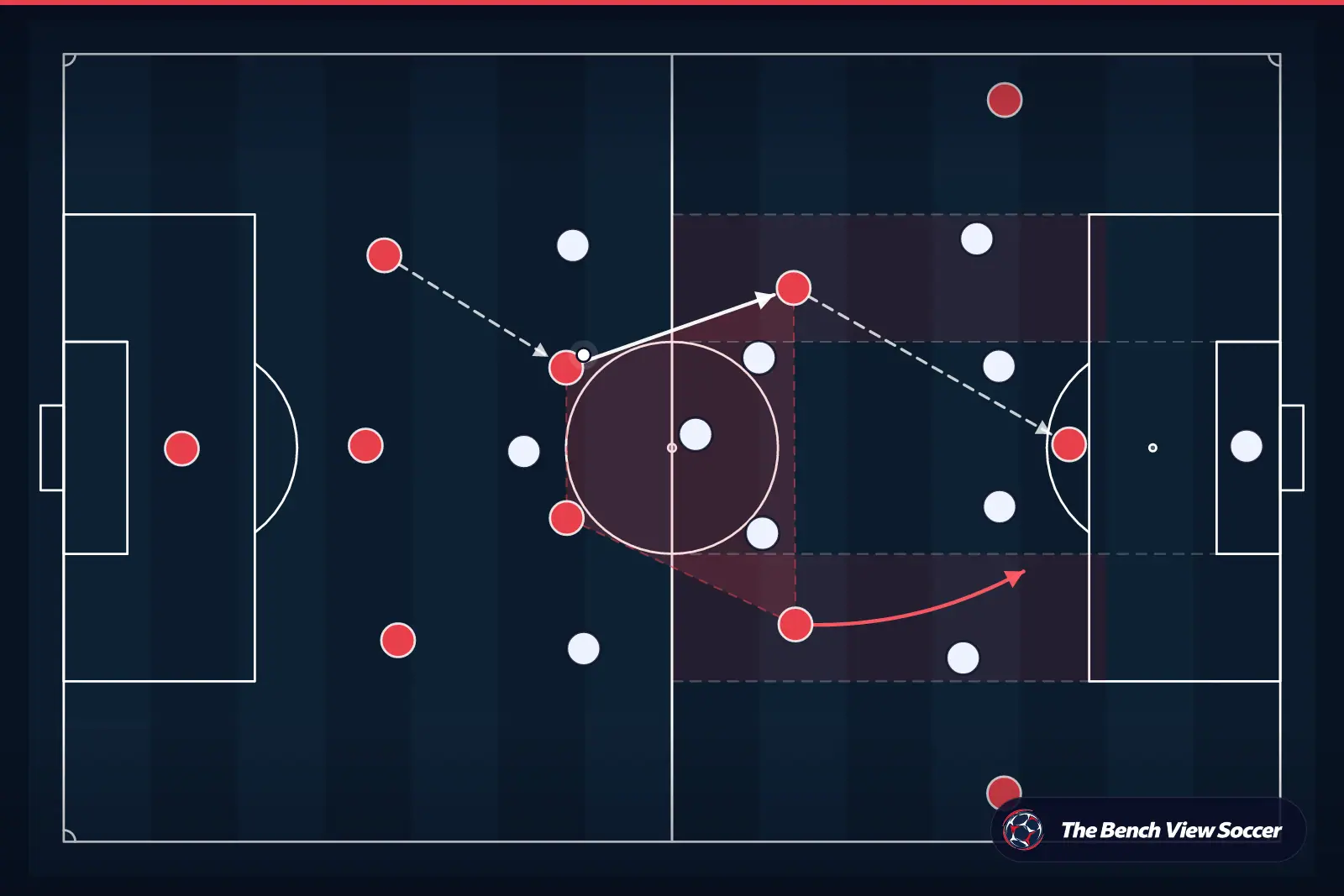
Arsenal’s base idea in build-up is to create a stable platform behind the ball while still threatening progression. In many phases, Aaron Ramsdale or David Raya starts short, drawing the opponent forward. Gabriel and Saliba split to offer two wide centre-back options, and one full-back (often Oleksandr Zinchenko) steps into midfield. When Zinchenko inverts (moves inside), he helps create a numerical advantage around the ball: Arsenal can form a 3-2 shape in the first two lines—three behind (two centre-backs plus a full-back or goalkeeper support) and two midfielders in front. Rice is central to this. Even when he is not the deepest midfielder, he behaves like a “rest-defence” anchor: he positions himself so that if the ball is lost, he can delay counters and protect the space in front of the centre-backs. This is what the article means by “midfield shield.” It is not just tackling; it is anticipation and spacing. Rice offers a passing lane that faces forward, letting Arsenal play through pressure rather than around it. Gabriel’s role is equally important: he is the aggressive left-sided centre-back who attracts pressure and then either plays into Rice, clips passes into the left half-space (the channel between full-back and centre-back), or fires a line-breaking pass into a forward’s feet. Because Gabriel is left-footed, his body angle naturally opens the pitch, making Arsenal’s first pass forward quicker. When the opponent presses with two forwards, Arsenal often uses the goalkeeper as an extra man to create a 3v2, then finds Rice or a tucked-in full-back. When the opponent marks Rice tightly, Arsenal use third-man combinations: Gabriel plays into Zinchenko, who bounces to Martin Ødegaard or Kai Havertz dropping in, and then the next pass releases Bukayo Saka or Gabriel Martinelli. The aim is consistent: pin the opponent’s first line, tempt them to jump, and then exploit the space behind that jump with structure still intact.
Match Examples
A clear Premier League reference point is Arsenal vs Manchester City at the Emirates Stadium in the 2023/24 season (Premier League, October 2023). Pep Guardiola’s City press in waves and try to block central access. Arsenal respond by keeping Gabriel brave on the ball and using Rice’s positioning to avoid cheap turnovers. When City’s first line steps to press the centre-backs, Arsenal look for controlled releases into Rice or into the inverted full-back, then immediately try to find Ødegaard between lines. Even when the game becomes tense and low-scoring, the build-up structure keeps Arsenal from being stretched into constant transitions, which is exactly what City want. In the UEFA Champions League 2023/24 group stage, Arsenal vs Sevilla at the Emirates (October 2023) shows another angle. Sevilla do not press as relentlessly as City, but they try to trap Arsenal near the touchline. Arsenal’s solution is to keep Rice available as a central reset option and use Gabriel as a switch passer. Gabriel’s diagonals and Rice’s ability to turn away from pressure help Arsenal change the point of attack—moving the opponent side to side until a winger receives in space. For a domestic example with a different opponent profile, Arsenal vs Liverpool in the Premier League 2023/24 at the Emirates (February 2024) highlights why the “shield” matters. Jürgen Klopp’s Liverpool press aggressively and punish mistakes with fast wide transitions. Arsenal’s build-up therefore prioritises security: Rice stays close enough to counter-press immediately after turnovers, and Gabriel is careful about when to force vertical passes. The effect is that Arsenal can still progress, but they reduce the number of moments where Liverpool can attack an open centre. Across these matches, the pattern is consistent: Arsenal build to attract pressure, but they keep Rice and the back line positioned to win the ball back quickly if the move breaks down.
Related Concepts & Skills
Training Implications
To train these ideas at grassroots or academy level (even in small groups), you need exercises that reward good spacing, body orientation, and decision-making under pressure. 1) Build-up Rondo (6v3): set up a rectangle. Use two centre-backs, a goalkeeper, a pivot (Rice role), and two full-backs/advanced midfielders as the six. The three pressers try to win the ball and score into mini-goals. Coaching points: centre-backs split wide, pivot stays on a different vertical line (not hiding behind pressers), and the first touch always opens the body to see forward. Score a point only if the team connects through the pivot at least once before switching sides. 2) “Inverted Full-back” Pattern Play: in a half-pitch, place cones for a back four plus pivot. Rehearse: GK to LCB (Gabriel role), LCB to inverted LB, inverted LB to pivot, pivot to right-sided midfielder, then out to a winger. Add passive defenders first, then active defenders. Coaching points: the inverted player checks shoulders before receiving, and the pivot receives on the half-turn to play forward quickly. 3) Rest-Defence Transition Game (7v7): create two teams with neutral wide players. Condition: when a team attacks, one midfielder must stay connected to the centre-backs (Rice role). If possession is lost, that midfielder must delay for three seconds before teammates recover. This forces players to value protective positioning, not just chasing the ball. 4) Video Self-Check: record 10 minutes of your session. Ask three questions: Are the centre-backs far enough apart to stretch the press? Is the pivot visible and available at least every second pass? After losing the ball, do you have at least three players behind it? These are simple, measurable habits that recreate Arsenal’s build-up logic.
The Bench View app
Don’t just read football — train it
Everything you read here, turned into training you can follow step by step.
Physical training at home
AI daily sessions adapted to your level and position. No equipment needed.
Tactical training courses
Step-by-step courses on positioning, pressing, build-up and decision making.
- 7 days free
- No commitment
- Cancel anytime
Free account: 2 physical sessions + the first tactical course. PRO: 7-day free trial — cancel before day 8 and you pay nothing.