Introduction
Arsenal under Mikel Arteta build from the back as a deliberate way to control matches, not just to “play nicely.” In the Premier League, where teams like Liverpool (Jürgen Klopp), Manchester City (Pep Guardiola), and Aston Villa (Unai Emery) press aggressively, Arsenal’s first 30 metres become a tactical battlefield. For fans watching on late-night broadcasts, this phase can look risky: short passes near goal, the goalkeeper involved, and defenders splitting wide. But the point is simple—if you can draw the opponent forward and escape, you attack a broken structure with space ahead. Arsenal’s build-up aims to create a free player, usually by manipulating the press: they invite pressure on one side and then play through, over, or around it. The key is that Arsenal do not build the same way every time. They adjust based on the opponent, game state, and personnel (for example, when William Saliba is available versus when Jakub Kiwior plays). Understanding these patterns helps you see why some “dangerous” passes are actually calculated, and why one pressing mistake by the opponent can lead to Arsenal progressing 40 metres in two passes.
How It Works
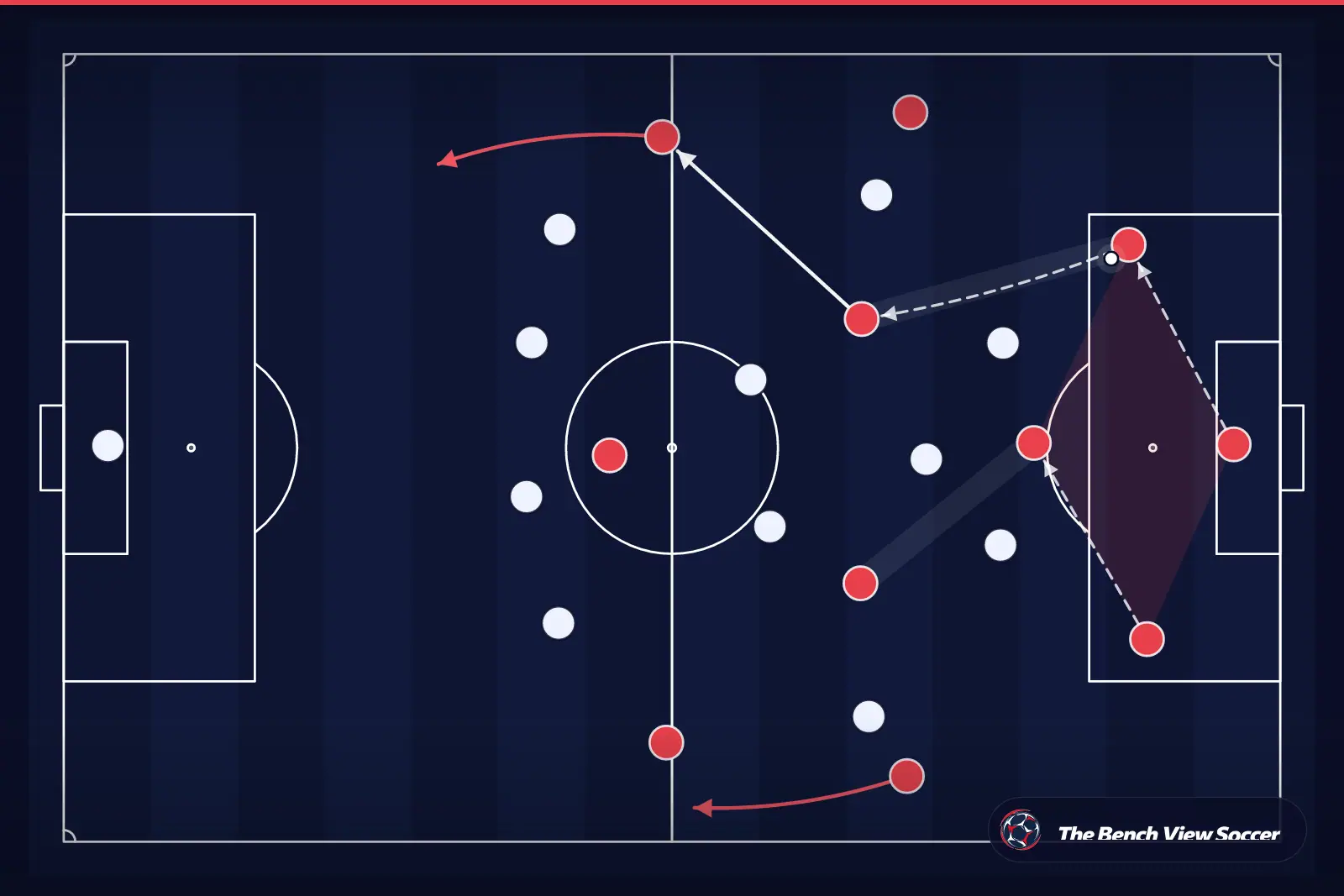
Arsenal’s build from the back starts with structure. In open play, the centre-backs split, and the goalkeeper (David Raya in 2023–24 and 2024–25) acts like an extra outfield player to create a 3v2 or 4v3 against the first line of pressure. When opponents press with two forwards, Arsenal often form a back three: one full-back (frequently Oleksandr Zinchenko) steps into midfield while the other full-back holds width, or a midfielder drops to help. The goal is to create a “free man,” meaning a player not directly marked who can receive facing forward. Arsenal also use bait-and-switch: they circulate the ball on one side to attract the press, then switch quickly to the far side where space opens. If the opponent blocks short options, Raya and the centre-backs look for a clipped pass into the pivot (often Declan Rice or Jorginho) or into the wide channel for Bukayo Saka or Gabriel Martinelli. These passes are not random long balls; they target specific zones behind an aggressive full-back or into the space next to a pressing midfielder. Importantly, Arsenal’s spacing supports the next action: when the ball goes into midfield, nearby players offer bounce passes (a quick return pass) while the far-side winger and the advanced midfielder position themselves to receive the third pass into space. Under heavy pressure, Arsenal sometimes accept a reset: they play back to the goalkeeper, then move the ball to the opposite centre-back to restart the pattern, forcing the pressing team to run and make decisions repeatedly.
Match Examples
A clear example comes from the 2023–24 Premier League match Arsenal vs Liverpool at the Emirates Stadium (February 2024). Liverpool press with intensity, often using a forward line that tries to curve their runs to block central passes. Arsenal respond by involving David Raya and splitting the centre-backs to stretch the first press. When Liverpool jump to one side, Arsenal look for the opposite centre-back or a quick release into the full-back/midfield connection, aiming to find Martin Ødegaard or Rice receiving with a half-turn. Another reference point is the 2023–24 Champions League quarter-final tie against Bayern Munich (managed by Thomas Tuchel). Bayern’s press is more selective: they wait, then spring when a pass travels into a predictable area. Arsenal’s build-up therefore becomes more cautious and pattern-based, using Raya’s positioning and the centre-backs’ composure to avoid obvious traps and to invite pressure only when an escape route is prepared. In the Premier League away match against Manchester City in 2023–24 (at the Etihad), City’s press tries to lock Arsenal near the touchline and prevent central progression. Arsenal’s response often includes using the goalkeeper as a bounce option and attempting to find Rice or Ødegaard between City’s first and second lines, even if it means a slightly riskier vertical pass. Across these matches, the repeating lesson is that “playing out” is not one fixed script: Arsenal change the height of their midfield support, the role of the full-backs, and the timing of longer passes based on who presses, how they press, and where they leave space.
Related Concepts & Skills
Training Implications
To train Arsenal-style build-up under pressure, design practices that force decision-making rather than perfect passing in isolation. First, run a 6v4 or 7v5 “build-out game” in a 40x30 metre area: goalkeeper + back four + two midfielders against a pressing front four (or five). The objective is not scoring; it is to progress the ball into a marked zone at midfield within 8–10 seconds. Coach three rules: (1) the goalkeeper must touch the ball at least once in every possession to encourage calm recycling; (2) the team in possession earns double points if they break the press through a central pass into a midfielder who can turn; (3) if the press wins the ball, they get an immediate shot within 5 seconds to simulate real punishment. Second, teach “scan before receive” as a measurable habit: before any midfielder receives, they must check both shoulders; if they do not, stop play and restart. Third, train the full-back inversion concept with clear triggers: when the ball is with the near centre-back and the opponent winger presses high, the near full-back steps inside to become a midfielder; if the opponent stays deeper, the full-back stays wide to stretch. Fourth, add an “escape switch” pattern: after three passes on one side, require a switch to the far side via the goalkeeper or centre-back, then immediate forward progression—this builds the bait-and-switch instinct. Finally, review video clips (even from Arsenal matches on highlights) and ask players to name the free man before the pass happens. If they can identify it verbally, they will start to see it on the pitch under pressure.
The Bench View app
Don’t just read football — train it
Everything you read here, turned into training you can follow step by step.
Physical training at home
AI daily sessions adapted to your level and position. No equipment needed.
Tactical training courses
Step-by-step courses on positioning, pressing, build-up and decision making.
- 7 days free
- No commitment
- Cancel anytime
Free account: 2 physical sessions + the first tactical course. PRO: 7-day free trial — cancel before day 8 and you pay nothing.