Introduction
For fans watching the Premier League, “playing out from the back” can look like needless risk—especially when the opponent is pressing high and the goalkeeper is involved. Under Mikel Arteta, Arsenal treats this phase as the start of their attack, not just a way to avoid danger. The idea is simple: if you can attract pressure near your own goal and still escape, you create space higher up the pitch for Bukayo Saka, Gabriel Martinelli, Martin Ødegaard, and the striker to attack a stretched defence. In modern European football, teams like Manchester City under Pep Guardiola and Brighton under Roberto De Zerbi show how build-up is a weapon. Arsenal follows the same trend but with its own structure: calm circulation, clear “escape routes,” and planned movements from the full-backs and midfielders. This article explains what Arsenal does when they are pressed, why it works, and what it teaches about decision-making under pressure.
How It Works
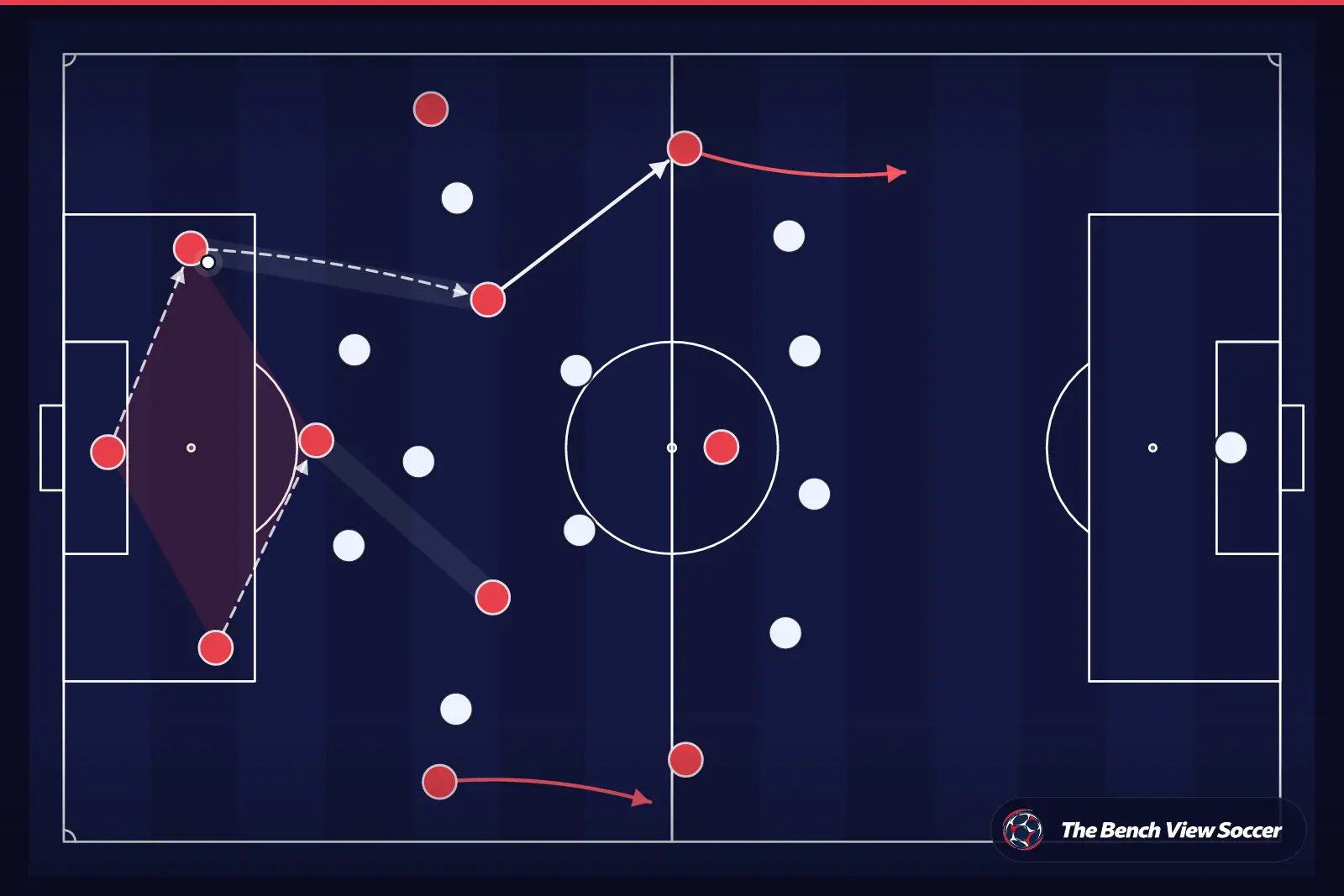
Arsenal’s build-up under pressure starts with structure. In many Premier League games, they form a 2–3 shape in the first line: two centre-backs (often William Saliba and Gabriel Magalhães) plus a line of three ahead of them. That “three” usually includes Declan Rice as the central connector and one full-back stepping inside (Oleksandr Zinchenko historically; in 2023–24 and beyond, Arteta also uses Ben White or a midfielder to create similar interior support). When pressed, Arsenal’s key principle is to create a free player (a “spare man”) by drawing opponents toward the ball, then finding the open option quickly. David Raya plays a big role: he stays available as an extra passing option, which forces the opponent’s striker to choose—press the keeper and leave a defender free, or cover defenders and allow Raya time. Arsenal then “invites” the press with short passes, but the goal is not possession for its own sake; it is to open a lane into midfield. If the opponent presses man-to-man, Arsenal uses rotations: Rice drops closer to the centre-backs, Ødegaard positions between lines, and the near winger holds width to pin the full-back. The inside full-back offers a bounce pass (a quick return pass) to change the angle and escape. If the central lane is blocked, Arsenal uses a switch: centre-back to centre-back, then out to the far side where the winger and full-back have more space. Another escape is the “third-man” pattern: Saliba passes into Rice, Rice lays it off first-time to the advancing full-back or Ødegaard, and the third player breaks pressure. When the press is too aggressive, Arsenal also goes longer—but with purpose. Raya targets the striker or wide forward with support underneath, aiming to win the second ball through Rice and the nearest midfielder. Under pressure, the tactical message is consistent: keep distances short, always have a back pass available, and attack the space that the press leaves behind.
Match Examples
A useful reference point is Arsenal vs Manchester City in the Premier League at the Emirates Stadium (2023–24 season, the 1–0 Arsenal win in October 2023). City under Pep Guardiola presses with clear triggers: a sideways pass between centre-backs or a pass back to the goalkeeper often signals the press to jump. Arsenal responds by keeping Raya active and building with controlled patience, using Rice and the inverted full-back to create safe central options. When City tries to lock one side, Arsenal switches the ball quickly to escape the “pressing trap” (a planned area where the opponent tries to win the ball). Even when the game becomes tense, Arsenal avoids panicked clearances and instead looks for targeted longer passes that allow them to compete for second balls. Another good case is Arsenal vs Liverpool in the Premier League at the Emirates (2023–24 season, February 2024, Arsenal win 3–1). Liverpool under Jürgen Klopp presses aggressively with the front three, trying to force mistakes near goal. Arsenal’s build-up focuses on controlling the first pass out and then exploiting the space behind the press. You see sequences where the centre-backs split wider, Raya stays calm, and Rice provides the “release” option. When Liverpool jumps to press the ball-side defender, Arsenal often finds the opposite side quickly, creating room for Saka or Martinelli to receive facing forward. Importantly, Arsenal does not insist on short passes every time. When Liverpool’s line is too tight, Arsenal uses a more direct ball into the forward line, trusting their midfield to arrive quickly for the second ball. For a Champions League context, look at Arsenal’s 2023–24 UEFA Champions League group stage matches, where opponents often press in short bursts rather than constantly. Arsenal still builds with the same habits: goalkeeper involvement, midfield support close to the ball, and fast switching when one side is overloaded. Across these examples, the pattern is clear: Arsenal’s build-up is less about “risking it” and more about rehearsed solutions to different press shapes.
Related Concepts & Skills
Training Implications
To train Arsenal-style build-up under pressure, focus on decision-making, spacing, and repeatable patterns rather than just “passing drills.” First, run a 6v4 build-up rondo in a half-pitch: goalkeeper + back four + one pivot (6) versus four pressers. Set a rule that a goal counts only if the team plays into a target midfielder in the middle third. Coach the goalkeeper to scan early and offer angles, not stand on the goal line. Second, add a “pressing trigger” constraint: every time there is a back pass to the keeper, the pressers must sprint to press for five seconds. This teaches calmness and speed of play under realistic pressure. Third, rehearse the third-man pattern: centre-back to pivot, pivot one-touch to full-back or No. 8, then a forward pass into a winger checking inside. Run it on both sides and demand correct body orientation (receiving side-on so the next pass is forward). Fourth, work on the switch of play with a timed rule: after three passes on one side, the ball must reach the far side within two passes. This builds the habit Arsenal uses to escape traps. Finally, include a “direct option” module: goalkeeper practices clipped passes to a striker with two midfielders tasked to win the second ball. Score points for clean second-ball recoveries. The key coaching cues are: keep distances between players short, always leave one safe back pass, and decide quickly whether to play short, switch, or go direct based on the opponent’s pressure shape.
The Bench View app
Don’t just read football — train it
Everything you read here, turned into training you can follow step by step.
Physical training at home
AI daily sessions adapted to your level and position. No equipment needed.
Tactical training courses
Step-by-step courses on positioning, pressing, build-up and decision making.
- 7 days free
- No commitment
- Cancel anytime
Free account: 2 physical sessions + the first tactical course. PRO: 7-day free trial — cancel before day 8 and you pay nothing.