Introduction
Manchester City under Pep Guardiola controls matches not only with famous stars, but with a simple geometric habit: building compact triangles all over the pitch. A triangle is just three passing options that stay close enough to connect quickly, but spread enough to stretch the defender’s decision-making. For fans used to thinking “possession = lots of sideways passing,” City offers a clearer lesson: possession is a tool to decide where the opponent runs, when they jump to press, and which spaces become free. In the Premier League and UEFA Champions League, City’s attacks often look calm because their players constantly create short, safe passing angles. This is also why City rarely looks “stuck” even against deep blocks, like teams managed by David Moyes (West Ham) or Sean Dyche (Everton). Compact triangles reduce risky long balls, protect against counterattacks, and help City keep the ball in dangerous areas without losing structure.
How It Works
City’s triangles come from positional discipline. Guardiola’s idea is that each player occupies a lane and a height (depth) so that the ball carrier always sees at least two close options. The key word is compact: the distances are short enough to play one- and two-touch passes under pressure. In buildup, City forms triangles between the centre-back, the full-back (or an inverted full-back stepping into midfield), and a midfielder dropping to show. When Kyle Walker or John Stones steps inside, City creates a midfield triangle with Rodri and a No. 8 like Bernardo Silva or Kevin De Bruyne. In the final third, the triangle often becomes winger–advanced midfielder–full-back, allowing third-man runs: Player A passes to B, B lays off to C, and C finds the runner behind the line. Compact triangles also act as a defensive tool. When City loses the ball, the nearest three players are already close enough to counter-press immediately, trying to win it back within seconds. Because the triangle’s shape offers short recovery distances, City controls transitions: even if the opponent escapes, City’s rest defence (the players staying behind the ball, usually two centre-backs plus Rodri) remains ready to delay counters.
Match Examples
A clear example appears in the 2022–23 UEFA Champions League semi-final second leg: Manchester City vs Real Madrid at the Etihad. Against Carlo Ancelotti’s midfield, City repeatedly forms compact triangles on the right side with Bernardo Silva, Kevin De Bruyne, and either John Stones stepping in or Kyle Walker supporting. Madrid’s wingers hesitate: if they press the wide player, the inside pass is open; if they stay narrow, City plays around them. The first-half dominance and Bernardo’s two goals come from sustained pressure created by these short connections, not from constant dribbling. Another strong reference is the 2023–24 Premier League match Manchester City vs Liverpool at the Etihad (Pep Guardiola vs Jürgen Klopp). Liverpool’s pressing tries to lock City near the touchline, but City uses tight triangles to bounce the ball inside to Rodri or a dropping forward, breaking the first wave and keeping the ball in central areas. You also see it in 2020–21 Premier League matches during City’s long winning run, when João Cancelo regularly inverts into midfield to form triangles with İlkay Gündoğan and Rodri, letting City circulate possession quickly and then accelerate into the half-spaces. Across these games, the pattern stays consistent: short angles first, then a sudden vertical pass when the opponent steps out of shape.
Related Concepts & Skills
Training Implications
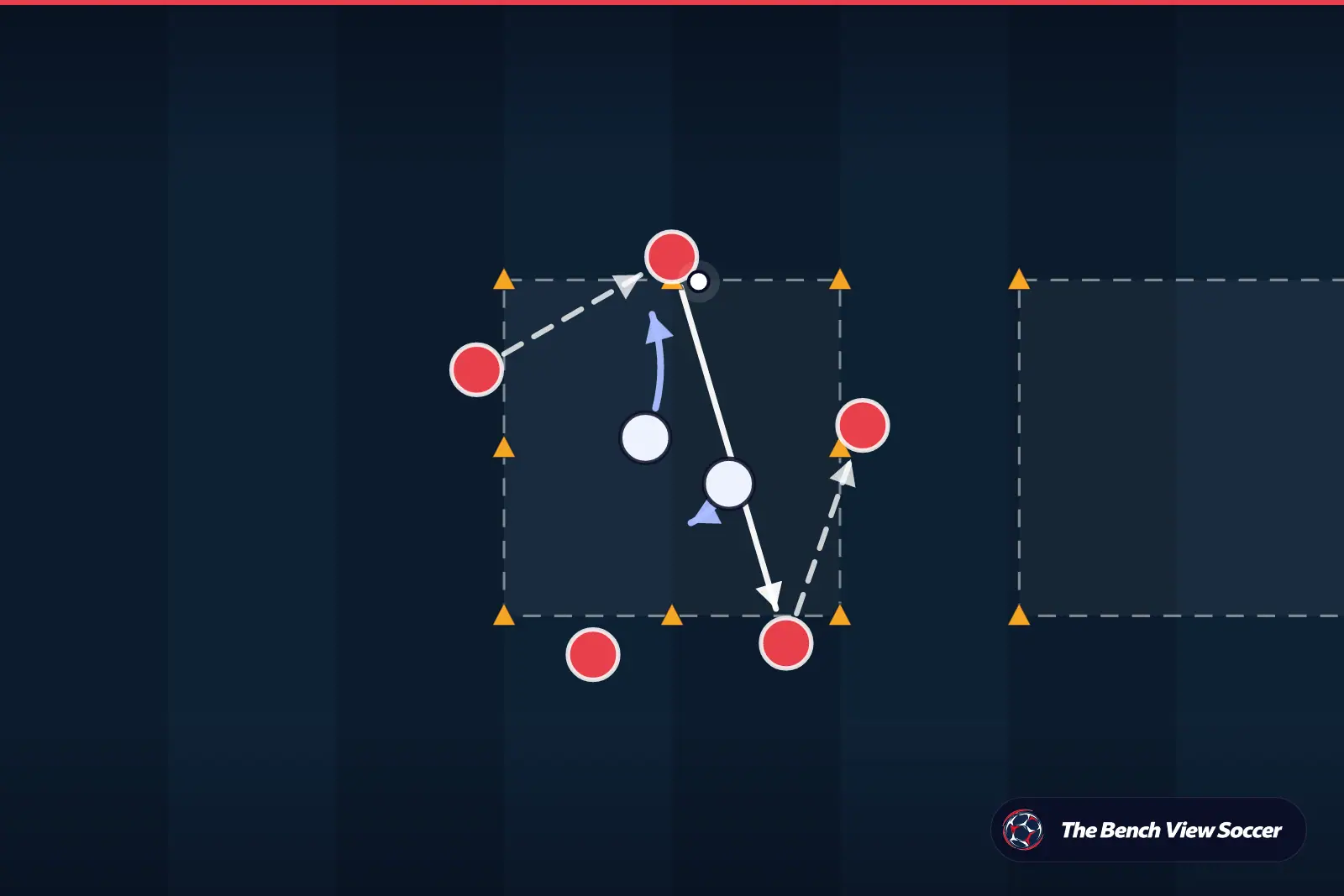
To train City-style compact triangles, focus on distances, angles, and scanning. Start with a 3v1 or 4v2 rondo (keep-away) in a tight square (8–12 metres). Coaching point: the ball carrier must always have two clear passing lanes; if a defender blocks one, the group adjusts by moving a few steps, not by playing a hopeful long pass. Add a rule: maximum two touches, but allow one player to take three touches only after scanning (head up before receiving). Next, use a “triangle lane” drill: set three cones in a triangle and one defender in the middle. Players pass around the triangle while one player occasionally checks away then drops in, simulating a midfielder showing between lines. Demand constant body shape: receive side-on so the next pass can go forward. Then progress to a small-sided game (6v6) with two neutral midfielders. Condition: goals count only if the attacking team completes a three-pass sequence that includes a third-man combination (A to B, B to C, C to runner). Finally, include transition work: after losing the ball, the nearest three players must press for five seconds before retreating. This teaches why compact triangles are not just for keeping possession, but also for winning it back quickly and safely.
The Bench View app
Don’t just read football — train it
Everything you read here, turned into training you can follow step by step.
Physical training at home
AI daily sessions adapted to your level and position. No equipment needed.
Tactical training courses
Step-by-step courses on positioning, pressing, build-up and decision making.
- 7 days free
- No commitment
- Cancel anytime
Free account: 2 physical sessions + the first tactical course. PRO: 7-day free trial — cancel before day 8 and you pay nothing.