Introduction
Real Madrid’s most feared weapon in Europe is not always long spells of possession; it is how quickly they turn a defensive moment into an attacking one. Under Carlo Ancelotti, especially in the Champions League era where margins are tiny, Madrid treat recoveries (tackles, interceptions, loose-ball wins) as the start of an attack, not the end of defending. For fans learning tactics, it helps to see transitions as a “two-touch mindset”: first touch secures the ball, second touch breaks the opponent’s shape. When teams push full-backs high or commit midfielders forward, the space behind them becomes a runway. Madrid consistently identify that runway faster than most clubs because their attackers start moving before the pass is even played. The result is the classic “lightning counter”: one vertical pass, one supporting run, and a finish before the opponent can reset their defensive line. This article breaks down the mechanics—where the ball is won, who makes the first decision, and how the runners create simple but devastating options.
How It Works
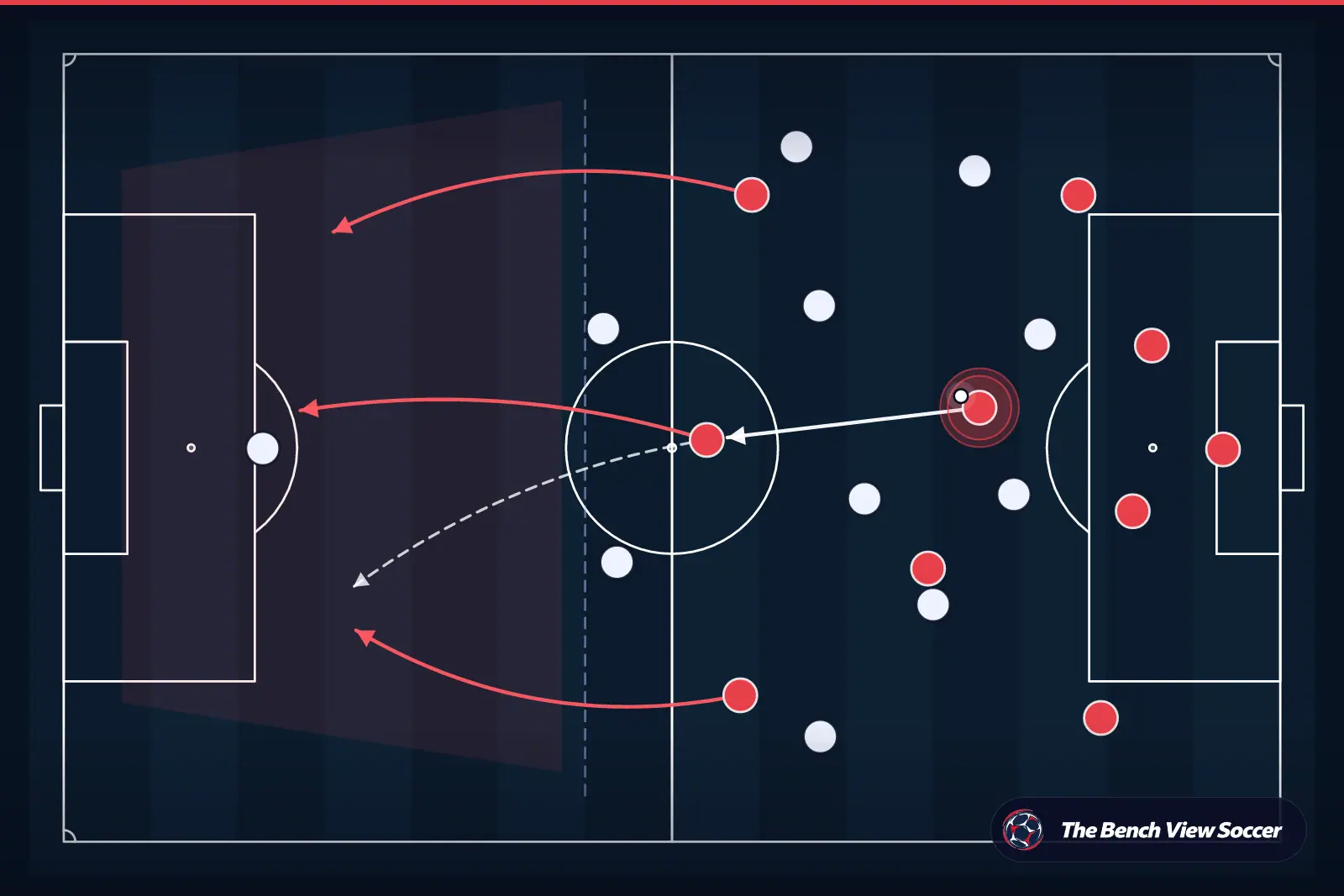
Real Madrid’s transition begins with how they defend: they often sit in a compact mid-block, keeping the distance between defenders and midfielders small so second balls are easier to win. When the ball is recovered, Madrid immediately search for a forward-facing player—often Toni Kroos, Luka Modrić, Jude Bellingham, Federico Valverde, or a full-back stepping inside—who can play the “first progressive pass.” The key is speed of decision, not just speed of running. Madrid usually choose one of three routes. Route one: a direct vertical pass into the striker (Karim Benzema previously, now often a forward receiving between lines) to set a layoff, then a third-man run from Vinícius Júnior or Rodrygo. Route two: an early pass into the channel behind the opponent’s full-back, letting Vinícius attack space with the ball rather than receiving to feet under pressure. Route three: a switch or diagonal if the opponent overloads one side, using Valverde’s running to arrive in the box. Notice how Madrid’s spacing supports this: one runner attacks depth (in behind), one runner offers a short option (to secure possession if the counter is blocked), and one runner arrives late at the edge of the box for cut-backs. They also use “rest defence” in possession—keeping at least two defenders and a midfielder ready behind the ball—so that when they lose it, they can win it back quickly and counter from a more advanced zone.
Match Examples
A clear example arrives in the 2021-22 UEFA Champions League semi-final second leg versus Manchester City at the Santiago Bernabéu. City often pushes numbers forward to control territory, but Madrid’s recovery moments become launch pads: they look for immediate forward passes and aggressive box runs. Even when the initial pass is not perfect, Madrid’s attackers continue their runs, trusting that the second ball or the deflection can become the real trigger. Another strong reference point is the 2023-24 Champions League knockout run under Ancelotti, where Jude Bellingham’s role as a transition connector stands out: he frequently receives on the half-turn after a recovery and releases wide runners early, allowing Vinícius Júnior to attack the open grass behind advanced full-backs. In El Clásico contexts, such as the 2023-24 La Liga meetings with Barcelona, Madrid repeatedly punish moments when Barça lose the ball with their full-backs high; the first pass goes forward quickly, and the wide forwards sprint into the channels. Across these examples, the pattern stays consistent: win the ball, play forward within two or three passes, and ensure at least two runners attack the box so the final pass has a high-value target rather than becoming a hopeful cross.
Related Concepts & Skills
Training Implications
To train “recovery-to-counter” like Real Madrid, build sessions that reward fast forward decisions and coordinated running. Drill 1 (6v6 + 2 neutral midfielders): play in a 40x30m area. When a team wins the ball, they have 6 seconds to attempt a shot or a through pass into a mini-goal. Coach the first receiver to open their body (receive side-on) and play forward early; if they take extra touches, stop and reset. Drill 2 (channel counters): set two wide channels and mark a line 10m behind the defensive line. On winning the ball, the rule is the first pass must go into a channel or to a forward who can set a layoff. This teaches the “route one/route two” options Madrid use. Drill 3 (box-run timing): run 4v3 transition waves where two attackers must sprint to the far post and penalty spot every time, while one arrives late at the edge for a cut-back—this recreates Madrid’s multi-run finishing structure. Coaching points: (1) shout a simple cue like “forward or secure” so players decide quickly whether to force the counter or keep possession; (2) insist on one depth run and one support run on every transition; (3) measure success not only by goals but by creating a shot within 8 seconds. Finally, use video clips from Champions League matches to show players where the space appears—behind full-backs and beside centre-backs—so their running becomes anticipatory, not reactive.
The Bench View app
Don’t just read football — train it
Everything you read here, turned into training you can follow step by step.
Physical training at home
AI daily sessions adapted to your level and position. No equipment needed.
Tactical training courses
Step-by-step courses on positioning, pressing, build-up and decision making.
- 7 days free
- No commitment
- Cancel anytime
Free account: 2 physical sessions + the first tactical course. PRO: 7-day free trial — cancel before day 8 and you pay nothing.