Introduction
Real Madrid’s most reliable “superpower” in modern European football is not just possession or individual brilliance; it is how quickly they turn an opponent’s mistake into a clear chance. Under Carlo Ancelotti, Madrid often accept moments without the ball, then explode forward the instant a turnover happens. For fans who watch UEFA Champions League nights and wonder why Madrid look calm for long spells and then suddenly score, the answer is quick vertical transitions. “Vertical” simply means the first pass and the first runs go towards the opponent’s goal, not sideways. The key idea is speed with purpose: one or two passes that immediately break lines, plus runners who attack space before defenders can reset. This is why Madrid punish sloppy touches, risky passes into midfield, or full-backs caught high—common turnover moments even for top clubs like Manchester City, Liverpool, or Barcelona. Understanding this pattern helps you read Madrid matches like a coach: you start to anticipate danger not when Madrid build slowly, but when they win the ball and the opponent’s shape is stretched.
How It Works
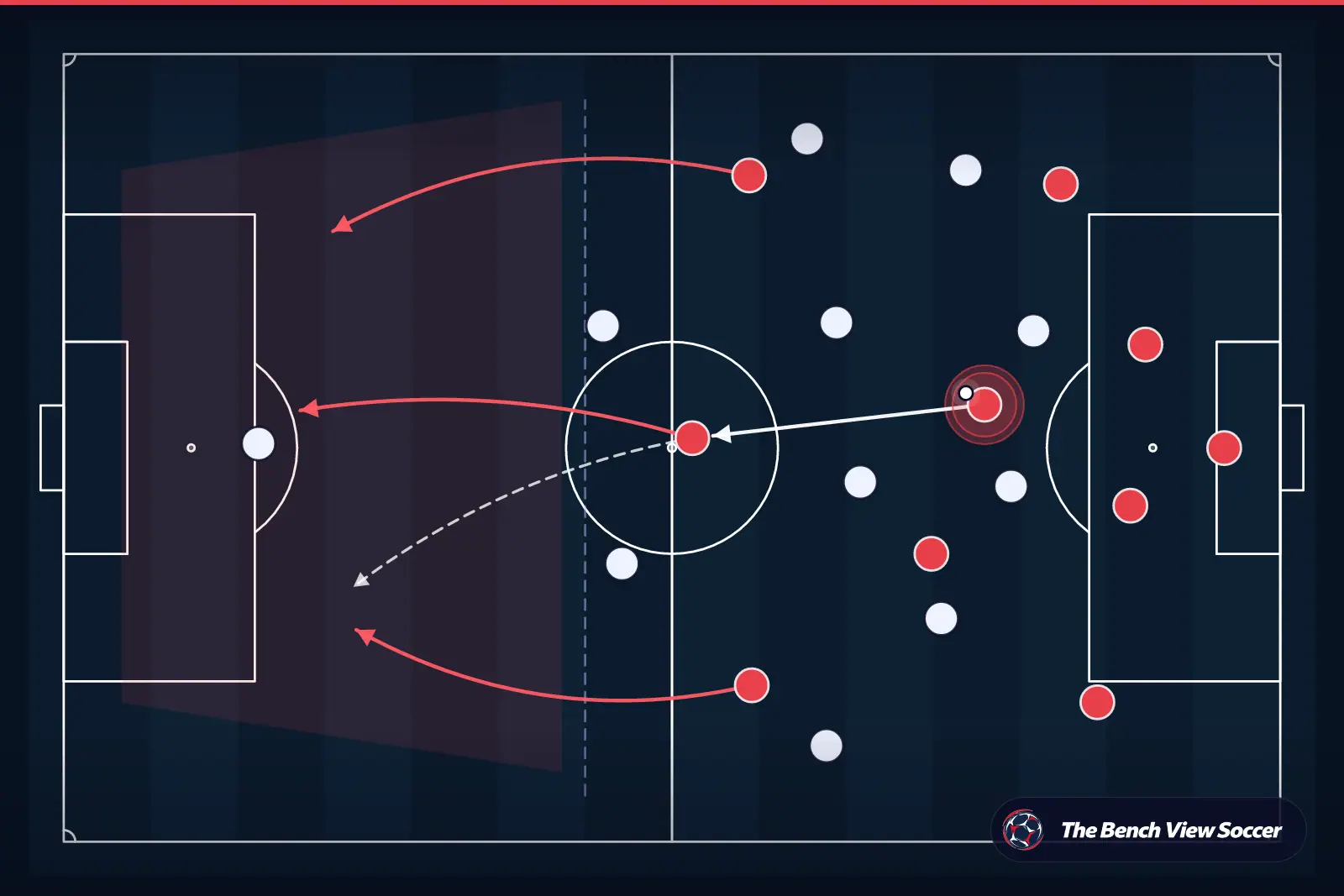
Real Madrid’s quick vertical transition starts with how they position themselves for the moment the ball is won. Even when defending in a mid-block (a medium defensive line, not extremely deep), Madrid keep at least two “launch points”: a forward runner and a progressive passer. In recent seasons, the passer is often Toni Kroos or Luka Modrić; when they are not on the pitch, Federico Valverde or Jude Bellingham often take responsibility. The runner is usually Vinícius Júnior on the left, Rodrygo on the right, and a central target like Karim Benzema (in earlier seasons) or the arriving Bellingham/Valverde. The transition has a clear sequence. First, the ball winner—often Aurélien Tchouaméni, Eduardo Camavinga, or a centre-back like Antonio Rüdiger—plays forward quickly instead of recycling possession. Second, Madrid aim to access the space behind the opponent’s midfield line immediately, because that is when the rival is most disorganised. Third, wide forwards sprint into the channel between full-back and centre-back, forcing defenders to turn and run toward their own goal. This is critical: defenders running toward their goal cannot press, they can only retreat, which gives Madrid time to pick the final pass. Finally, Madrid commit just enough numbers to finish the attack while keeping protection behind the ball—usually one full-back stays slightly safer, and one midfielder holds position to prevent an instant counter-counter. The result is a transition that looks simple but is highly rehearsed: win it, play forward early, run beyond, and arrive in the box with timing rather than overcrowding.
Match Examples
A clear example comes from the 2021–22 UEFA Champions League semi-final against Manchester City, especially the second leg at the Santiago Bernabéu. Pep Guardiola’s City dominate long spells, but Madrid’s threat grows whenever City lose the ball with their full-backs advanced and midfield stretched. Madrid immediately look for a forward pass into Benzema or into the path of Vinícius, with Modrić and Kroos ready to release runners early. The late turnaround is not just “magic”; it is also City being forced to defend long sprints toward their own goal after small errors and second balls. Another strong reference is Real Madrid vs Liverpool in the 2022–23 Champions League Round of 16, first leg at Anfield. Liverpool start aggressively, but their high line and risky build-up create turnover windows. When Madrid win the ball, they go vertical quickly—often targeting Vinícius on the left side to attack the space behind Trent Alexander-Arnold. The speed of the first pass and the directness of the first run repeatedly turn Liverpool’s attacking structure into a defensive emergency. In La Liga 2023–24, Real Madrid’s transition threat also shows clearly as Jude Bellingham becomes a major “third-man runner” (a player who arrives after the first pass, not the initial receiver). In matches where opponents push full-backs high to pin Madrid back—like many mid-table La Liga sides at the Bernabéu—Madrid win the ball and immediately look for Bellingham arriving between midfield and defence, while Vinícius and Rodrygo stretch the back line. This combination of a fast vertical pass plus late arriving midfield runs keeps opponents guessing: stop the wide run and you open the central lane; block the centre and Vinícius attacks the channel.
Related Concepts & Skills
Training Implications
If you coach a school, college, or amateur side in India and want to copy Madrid’s transition threat, build habits that make “win-and-go” automatic. First, train the first pass forward. Set up a 6v6+2 neutral possession game: when a team wins the ball, they get 6 seconds to play a forward pass into a mini-goal or a target player. Reward early vertical passes with extra points, but only if the receiver is facing forward (so players learn to scan and receive on the half-turn). Second, coach runner timing. Use a simple drill: 3 attackers vs 2 defenders starting at midfield. On the coach’s whistle, a midfielder plays a forward pass and two wide runners must sprint into the channel; the central player either sets the ball or runs beyond. Rotate roles so everyone learns both passing and running. Third, build a transition “shape.” In small-sided games, assign one midfielder as the holder (your Tchouaméni role): when you counter, that player stays behind the ball to stop the opponent’s immediate break. This prevents the common amateur problem of sending everyone forward and conceding straight away. Fourth, practise decision-making: add a rule that the first receiver has only two touches. This forces quick choices—drive forward, slip a through pass, or switch to the far runner. Finally, teach scanning with a measurable habit: before receiving, players must look over both shoulders once. Coaches can score teams not only on goals but on the number of successful “scan + forward action” moments. Over time, your team becomes faster not just in running, but in thinking—exactly what makes Real Madrid’s vertical transitions so deadly.
The Bench View app
Don’t just read football — train it
Everything you read here, turned into training you can follow step by step.
Physical training at home
AI daily sessions adapted to your level and position. No equipment needed.
Tactical training courses
Step-by-step courses on positioning, pressing, build-up and decision making.
- 7 days free
- No commitment
- Cancel anytime
Free account: 2 physical sessions + the first tactical course. PRO: 7-day free trial — cancel before day 8 and you pay nothing.