

Introduction
Positioning and the creation of triangles are core principles that separate efficient midfield play from chaos. For central midfielders and playmakers the ability to "be in the right place before the play happens" determines whether your team keeps control or constantly scrambles to regain it. That anticipation is not instinct alone — it's structure, angles and repeatable patterns that make the next pass easier and the opposition's decisions harder.
At an intermediate level this means thinking in spatial terms: where to receive safely, which teammate will provide a third-man option, and how to shape the field so defenders face uncomfortable choices. Managers such as Pep Guardiola and Xavi have institutionalized these concepts: triangles provide security, create overloads, and open channels into half-spaces. In this article we break down the tactical logic, show how elite teams use it, and give actionable principles coaches and midfielders can adopt in training and match situations.
Tactical Breakdown
Triangles are the connective tissue of positional play. A triangle — two teammates and the ball carrier — creates multiple passing lanes, supports rotation, and offers a reliable "third-man" option. For a central midfielder this manifests as three core actions: orient to the ball, check shoulders for the surrounding shape, and take up a unit position that preserves angle and distance.
Distance and angle matter. Too close and you become a static option, inviting presses; too far and you break the triangle. Effective midfield triangles typically maintain 8–15 meters between nodes and aim for a roughly 45–90 degree angle between passes so receivers can play forward or sideways without heavy adjustments. Depth is as important as width — a midfielder dropping between the centre-backs creates a vertical triangle that opens forward passing lanes, while a wide midfielder providing the side node stretches the defence horizontally.
Role specificity helps. The deep midfielder (No. 6) should orient to the goalkeeper and one of the centre-backs to form the spine triangle for progression. The No. 8 provides the half-space option and can rotate into the box, while the No. 10 occupies pockets and offers the line-breaking pass. Anticipation comes from understanding triggers: a press forces a drop, a full-back's forward run requires covering, and a striker dropping deep creates a third-man pass opportunity. When positioned correctly before the press arrives, midfielders turn reactive defending into proactive control.
Real Match Examples
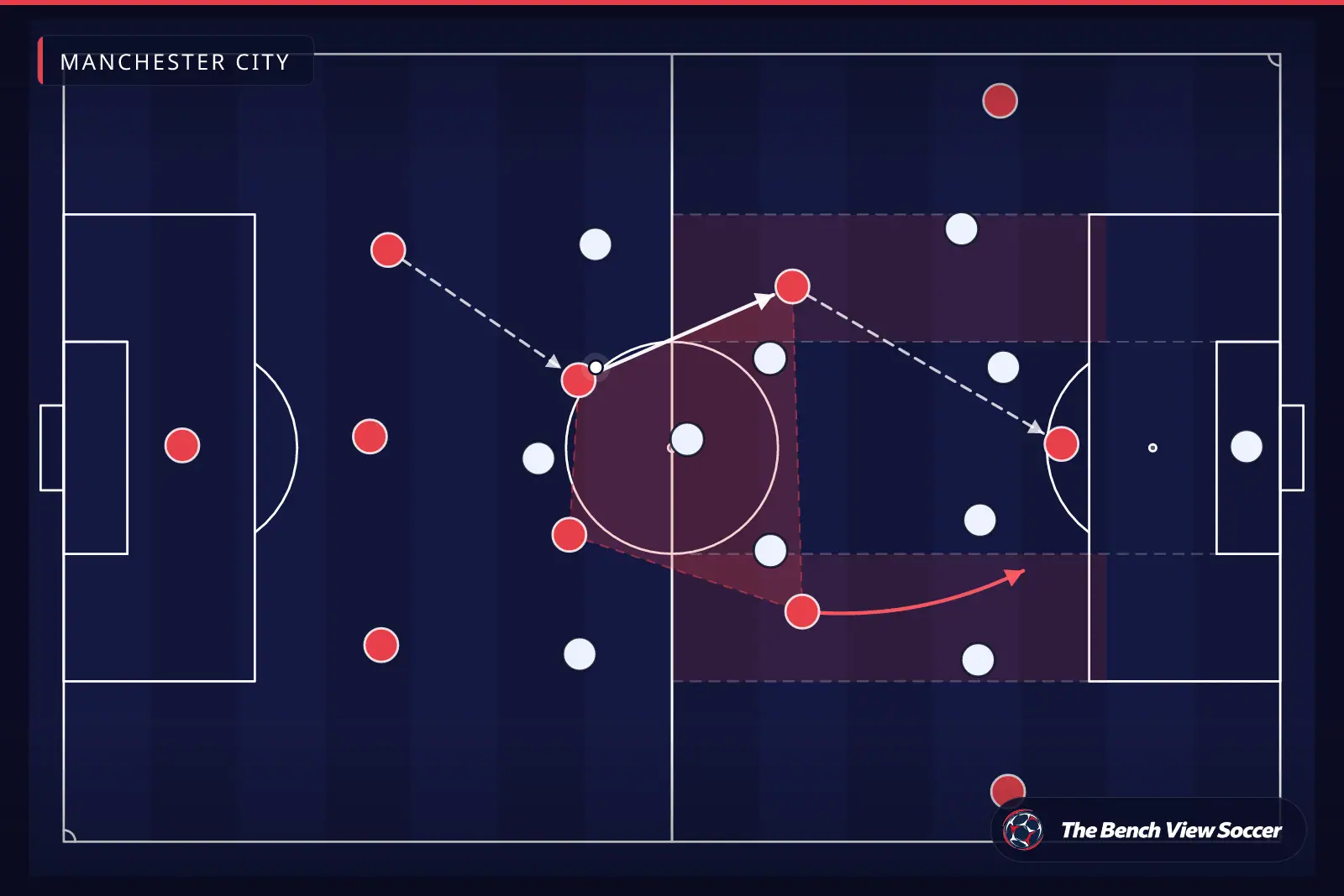
Manchester City (Pep Guardiola) — City's build-up often begins with Ederson, Rodri and Kevin De Bruyne forming a vertical triangle. Rodri drops between the centre-backs; De Bruyne moves into a half-space so the ball can be switched quickly or played forward. That pre-positioning allows City to bypass the first line of press and create clear passing lanes into advanced players like Foden and Grealish.
Barcelona (Pep Guardiola / Xavi era) — The classic Busquets-Xavi-Iniesta triangle controlled possession by providing constant short options and third-man runs. Busquets' pass-and-move instincts meant the team rarely had to rely on long clearances; instead, positional triangles created gradual progress up the field and pulled defenders out of shape.
Real Madrid (Carlo Ancelotti) — Kroos and Modrić exemplify how two creative midfielders can combine with a dropping striker such as Karim Benzema to form dynamic triangles. Benzema vacates the central striker line to become a link, and the midfield pair use diagonal switches and third-man passes to exploit channels, particularly in Champions League knockout ties where space is tighter.
Key Principles
Key Principles Coaches Should Remember
- Pre-position, don’t react: Train midfielders to occupy the right angle and distance before the opponent presses — anticipation reduces turnovers and speeds the attack.
- Maintain triangle geometry: Keep 8–15m separation and 45–90 degree passing angles so every node has at least two safe options and one progressive option.
- Use depth and half-spaces: Vertical drops and half-space positions create line-breaking passing lanes; encourage midfielders to vary positions, not stay flat.
- Third-man thinking: Always present a potential third-man. If A>B is the first pass, C should be positioned to exploit the receiving defender’s shift.
Training Implications
Training to Master Positioning and Triangles
Train with purpose-built drills that replicate the spatial demands of matches. Start with 6v3 rondos focused on creating and preserving triangles — reward quick orientation, encourage constant scanning and require at least one third-man pass before progression.
Progress to positional rondos with zones: players have assigned vertical and horizontal constraints and must create a triangle inside a target zone to play a progressive pass. Add transitional elements (e.g., a turnover triggers a 20-second counter-attack) so midfielders learn to reconstitute triangles under pressure.
Use pattern-of-play drills where the goalkeeper plays long to a target triangle (GK, deep mid, half-space mid). Practice the sequence slowly, then increase speed and add opposition pressure. Coaching cues: "check shoulders before the pass", "create 45-degree angles", and "look for the third-man". Measure success by reduction in forced long passes and increased successful line-breaking passes in game-like scrimmages.
Apply This in Your Game
Reading about tactics is one thing. Our training units teach you to execute these concepts in real match situations.