

Introduction
Switching the point of attack is a defining skill for modern central midfielders and playmakers. Rather than patiently waiting for an opponent's block to open, elite midfielders actively force the defensive shape to move and then hit the opposite side before it can reset. That split-second movement unbalances compact defences, creates space for fullbacks and wingers, and turns predictable possession into clear scoring opportunities.
This article breaks down the how and why behind the concept with reference to elite teams and players. We'll look at positional cues — body orientation, timing, and third-man rotations — and show how managers like Pep Guardiola and Xavi structure moments where a single long diagonal or quick combination can change the point of attack and win games. Whether you're a coach training an under-15 unit or an intermediate midfielder looking to refine decision-making, the principles here will give you practical, tactical tools to move the block before it resets.
Tactical Breakdown
What does it mean to 'move the block before it resets'? At its core it's a tempo-based tactic: manipulate the opponent's defensive compactness with a lateral or vertical cue, then exploit the opposite flank with pace or a diagonal ball before defenders can recover. Timing is as important as technique.
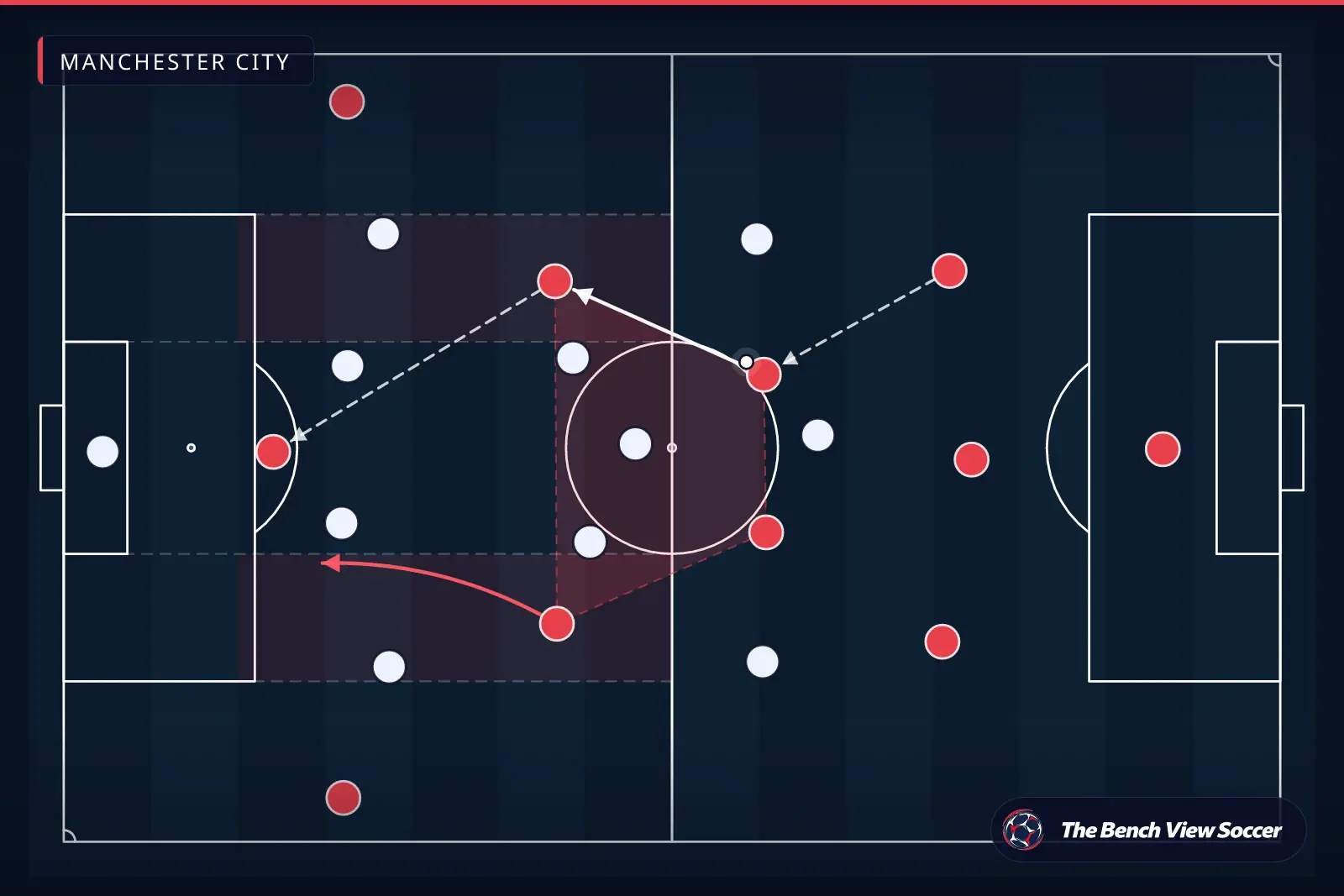
From a positional perspective the central midfielder has three levers. First, the ball-carry or short pass to draw an opponent across the spine. Second, orientation and feints that sell the immediate direction. Third, the decisive switch — either a weighted long diagonal from deep or a fast combination that sends a winger or fullback into space. When Rodri or Sergio Busquets drops between centre-backs they drag a defensive midfielder or one of the centre-backs out of the central channel. That movement creates a vertical or lateral corridor for a long switch. When Kevin De Bruyne positions his torso early, defenders commit to his lane; his timing of the diagonal makes the target player free to run into space.
Defensive teams will try to delay the reset by rotating compactly, but the limit is reaction time. The attacking side wants to create an overload on the far side — often a 2v1 or 3v2 — immediately after the switch. This requires an understanding of angles, pass height, and follow runs: long passes must be played ahead of the receiver's run, while short switches demand rapid combination and vertical penetration.
Real Match Examples
Manchester City (Pep Guardiola) – City’s use of Rodri and De Bruyne shows the textbook application. Rodri stepping into the left half-space drags a holding midfielder; De Bruyne then plays a diagonal to Cancelo or a winger breaking into space. Guardiola coaches this as a coordinated action: the midfielder's drop + the wide player's movement + the receiving run must be synchronized to beat a compact low block.
FC Barcelona / Spain (Xavi / Luis Enrique) – Sergio Busquets and Pedri often operate as the switchers. Busquets’ quick lateral deliveries to Jordi Alba or Aleix Vidal in transition are designed to hit the fullback before the opposition can shift its block. Barcelona’s pattern play shows how short combos around the midfield pivot can create the space for a swift opposite-side overload.
Liverpool (Jürgen Klopp) – Klopp's teams use fullback-overlaps and midfield switches in counterpress scenarios. A quick recovery by a midfielder draws a centre-back out; the follow-up long pass into Robertson or Trent exploits the space created on the opposite side. Klopp’s emphasis on speed of execution is a practical lesson: if the switch is delayed, the moment is lost.
Key Principles
Key Principles Coaches and Players Must Remember
- Move first, then switch: Use a short carry or pass to force a defender to commit. The switch must follow before they reorganize.
- Timing and angle over power: A perfectly timed, angled diagonal is more effective than a high-speed, straight ball that the defence can intercept.
- Create far-side overloads: Design the receiving patterns so the opposite flank becomes a 2v1 or 3v2 immediately after the switch.
- Body orientation and deception: Midfielders should use eyes, shoulders and small feints to sell the initial direction and stretch the block.
Training Implications
Training: Drills to Practice Switching the Point of Attack
Start with progressive, game-like drills that combine the initial bait action and the switch. A simple 6v6+2 rondo with a conditioned rule works well: when the ball is played into a target zone, the central midfielder must play a long diagonal to a neutral attacker on the opposite flank within three seconds.
Second drill: 'Trigger and Switch' (7v7). Have a central pivot drop between centre-backs; a designated winger times a run to the far post. The pivot must draw a defender, play a switching pass, and the receiving winger must attack with a fullback overlap. Progress to compressing the decision time to force faster recognition.
Coaching cues: rehearse the exact weight and trajectory of diagonals, emphasise early body orientation, and enforce communication so the receiving players make decisive runs. Finish with full-pitch scenarios where teams must switch and immediately create a crossing or penetrative finish — that closes the loop from practice to match application.
Apply This in Your Game
Reading about tactics is one thing. Our training units teach you to execute these concepts in real match situations.