Introduction
When fans first hear “build-up from the back,” it can sound like a risky hobby—passing around your own box while the opponent hunts you. Under Mikel Arteta at Arsenal, it is not a gimmick; it is a controlled way to move the game into areas where Arsenal’s best technicians can dominate. The aim is simple: draw pressure, create a free player, and then progress into midfield or the wings with an advantage. This article breaks down how Arsenal use their goalkeeper, centre-backs, and especially fullbacks to form reliable passing triangles, and how that structure protects them against counter-attacks. We will also unpack “risk management”: when Arsenal choose safer passes, when they invite pressure on purpose, and how they reduce the cost of mistakes through spacing, rest-defence (the shape behind the ball), and clear decision rules. Think of it as chess from the first pass—except the opponent is sprinting at you.
How It Works
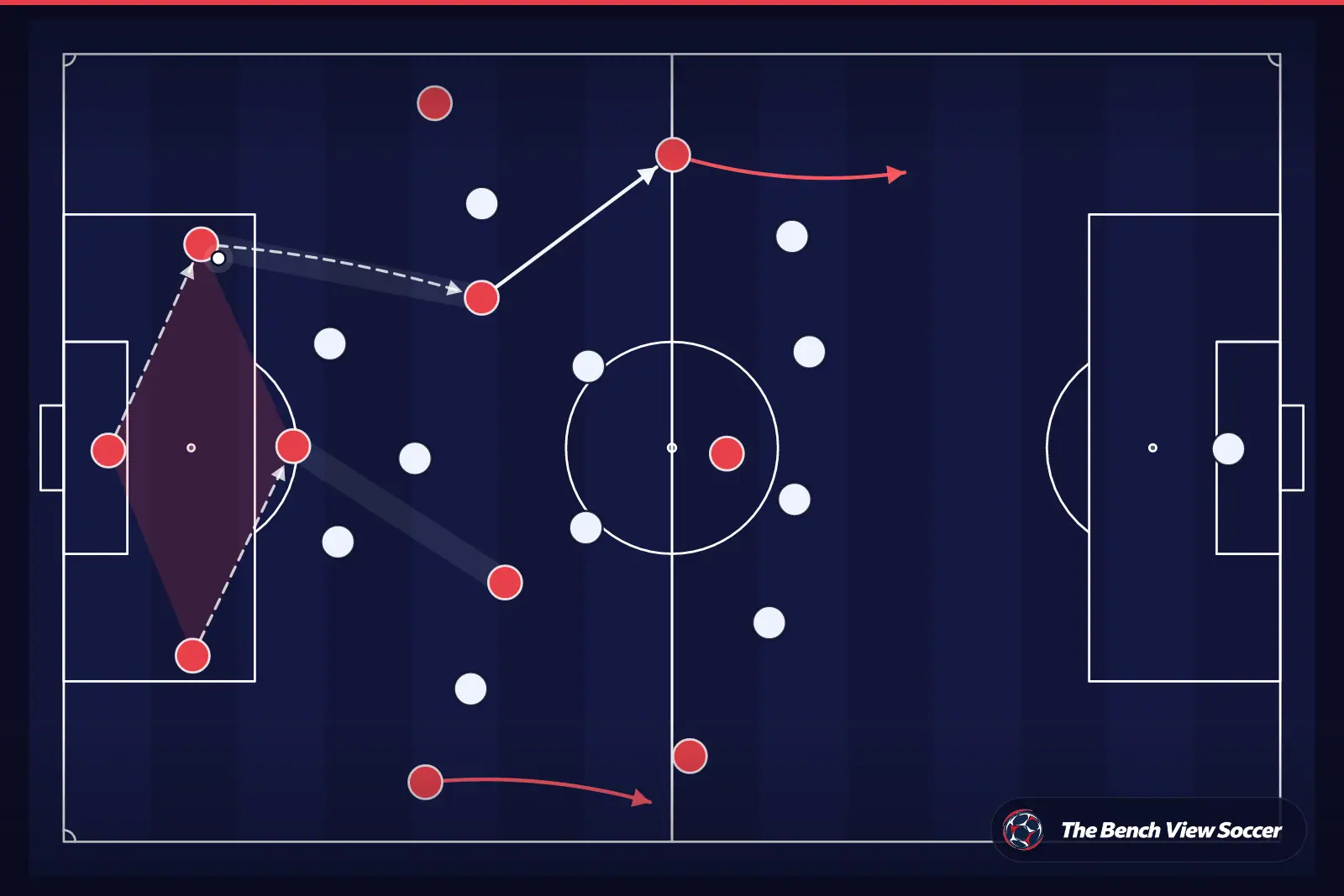
Arsenal’s build-up usually starts with David Raya (and previously Aaron Ramsdale) acting as an extra outfield player. The goalkeeper’s passing forces the opponent’s first line to commit, which creates gaps elsewhere. In front of him, William Saliba and Gabriel Magalhães split wide, stretching the press and opening a central lane for a midfielder. The most important modern Arsenal detail is what the fullbacks do. Often, Ben White stays wider and slightly deeper on the right to offer a safe outlet and keep the right winger high. On the left, Oleksandr Zinchenko frequently “inverts,” meaning he steps inside into midfield instead of hugging the touchline. This creates an extra central player, turning a 2v2 press into a 3v2 or 4v3. Those numbers matter because triangles are the basic unit of press resistance. A triangle gives the ball-carrier two short options: one behind (security) and one ahead (progression). For Arsenal, a common triangle is Saliba–White–Martin Ødegaard on the right, or Gabriel–Zinchenko–Declan Rice on the left. If the opponent presses man-to-man, Arsenal use third-man combinations: Player A passes to Player B, who sets to Player C running free. If the opponent blocks central routes, Arsenal go around via the fullback and then back inside. Risk management is constant. Arsenal do not force central passes when the receiver is tightly marked and facing his own goal; they recycle to the centre-back or goalkeeper to reset. They also keep “rest-defence” ready: usually two centre-backs plus a midfielder (often Rice) positioned to stop counters. When Arsenal commit one fullback into midfield, the other fullback and one midfielder remain disciplined to prevent a transition into open space. The build-up is therefore not just about keeping the ball; it is about moving it with a safety net.
Match Examples
A clear reference point is the Premier League 2022–23 season, when Arteta’s Arsenal use Zinchenko’s inversion as a major tool to control matches. In Arsenal 3–2 Manchester United (Premier League, January 2023), Arsenal repeatedly build through the left half of the pitch: Gabriel and Zinchenko connect to Granit Xhaka (then the advanced left midfielder), and this triangle helps Arsenal play through United’s first press before switching to the right for Bukayo Saka and Ødegaard. The key detail is how Zinchenko steps inside to create a spare man, letting Arsenal keep progression even when United try to lock onto the pivot. In Arsenal 2–0 Newcastle United (Premier League, May 2023), the match shows the “patience” side of risk management. Newcastle under Eddie Howe press aggressively in waves, but Arsenal often choose to reset via the goalkeeper and centre-backs rather than forcing a risky vertical pass. When the press jumps, Arsenal lure it and then release wide, using White as a calmer outlet before finding Ødegaard between the lines. From the 2023–24 UEFA Champions League group stage, Arsenal 4–0 PSV Eindhoven (September 2023) illustrates how build-up shapes attacking positions. Arsenal’s first and second phase passing (goalkeeper to centre-backs to inverted fullback/midfielder) pulls PSV’s first line forward, creating space for quick combinations in the final third. The sequence is not random: stable circulation at the back sets the platform for fast, clean attacks. Finally, in the Premier League 2023–24 run-in—like Arsenal 0–0 Manchester City (March 2024)—the build-up becomes more conservative by design. Against Pep Guardiola’s City, Arsenal do not overplay inside their box. They still use Raya’s distribution and centre-back spacing, but the priority is avoiding “cheap” turnovers in central areas. That is risk management: the structure remains, but the decision thresholds change depending on opponent quality and game state.
Related Concepts & Skills
Training Implications
For coaches and players training in India—whether in academies, school teams, or Sunday leagues—the biggest takeaway is that build-up is a repeatable skill, not a brave mood. Start with simple, measurable habits. First, train a 4v2 or 5v3 rondo (keep-away) with constraints: the outside players must stay in a wide “U” shape, and the ball must switch sides within six passes. This teaches spacing and circulation like Arsenal’s centre-backs and goalkeeper. Add a rule that one player is the “inverting fullback” who must receive inside the square at least once per sequence, copying Zinchenko’s role. Second, coach body orientation. Every receiver should scan (look over shoulder) before the pass arrives and open up their hips so they can play forward in one touch. A simple drill: in a triangle, the middle player must receive on the back foot and play to the third player in two touches maximum. If they receive square, restart. This creates the habit Arsenal rely on when a press closes fast. Third, build decision rules for risk management. Use a small-sided build-up game: goalkeeper + back four + one pivot versus three pressers. Give the building team two “safe reset” options per possession: a back pass to the goalkeeper counts as neutral, not negative. But punish central turnovers by awarding the pressers an immediate shot from the top of the box. Players quickly learn what Arsenal learn: losing the ball in the middle is more dangerous than losing it near the touchline. Fourth, rehearse rest-defence. In any possession drill, assign two centre-backs and one midfielder to stay connected behind the ball. If the ball is lost, their job is to delay, not dive in. Track success by timing: can they stop the counter for three seconds to allow teammates to recover? That is practical, Arsenal-style protection without needing elite speed.
The Bench View app
Don’t just read football — train it
Everything you read here, turned into training you can follow step by step.
Physical training at home
AI daily sessions adapted to your level and position. No equipment needed.
Tactical training courses
Step-by-step courses on positioning, pressing, build-up and decision making.
- 7 days free
- No commitment
- Cancel anytime
Free account: 2 physical sessions + the first tactical course. PRO: 7-day free trial — cancel before day 8 and you pay nothing.