Introduction
European football often debates two very different answers to the same question: who leads the line? The “false nine” and the “target man” are not just striker types; they shape an entire team’s attacking structure, pressing plan, and even how midfielders and wingers behave. For fans learning tactics, this is a helpful contrast because it shows how managers solve problems with opposite ideas. A target man stays high, pins centre-backs, and gives the team a direct outlet under pressure—think of a classic No.9 who receives with his back to goal and brings others into play. A false nine, by contrast, starts as a striker but repeatedly drops into midfield zones, pulling defenders away and creating space for runners. Managers in the UEFA Champions League and Premier League pick between these profiles based on opponent defending, their own midfield quality, and how they want to progress the ball. Understanding this choice makes watching top teams—Manchester City under Pep Guardiola, Liverpool under Jürgen Klopp, Inter under Simone Inzaghi, or Atlético Madrid under Diego Simeone—more meaningful because you can “see” the team’s plan rather than only the goals.
How It Works
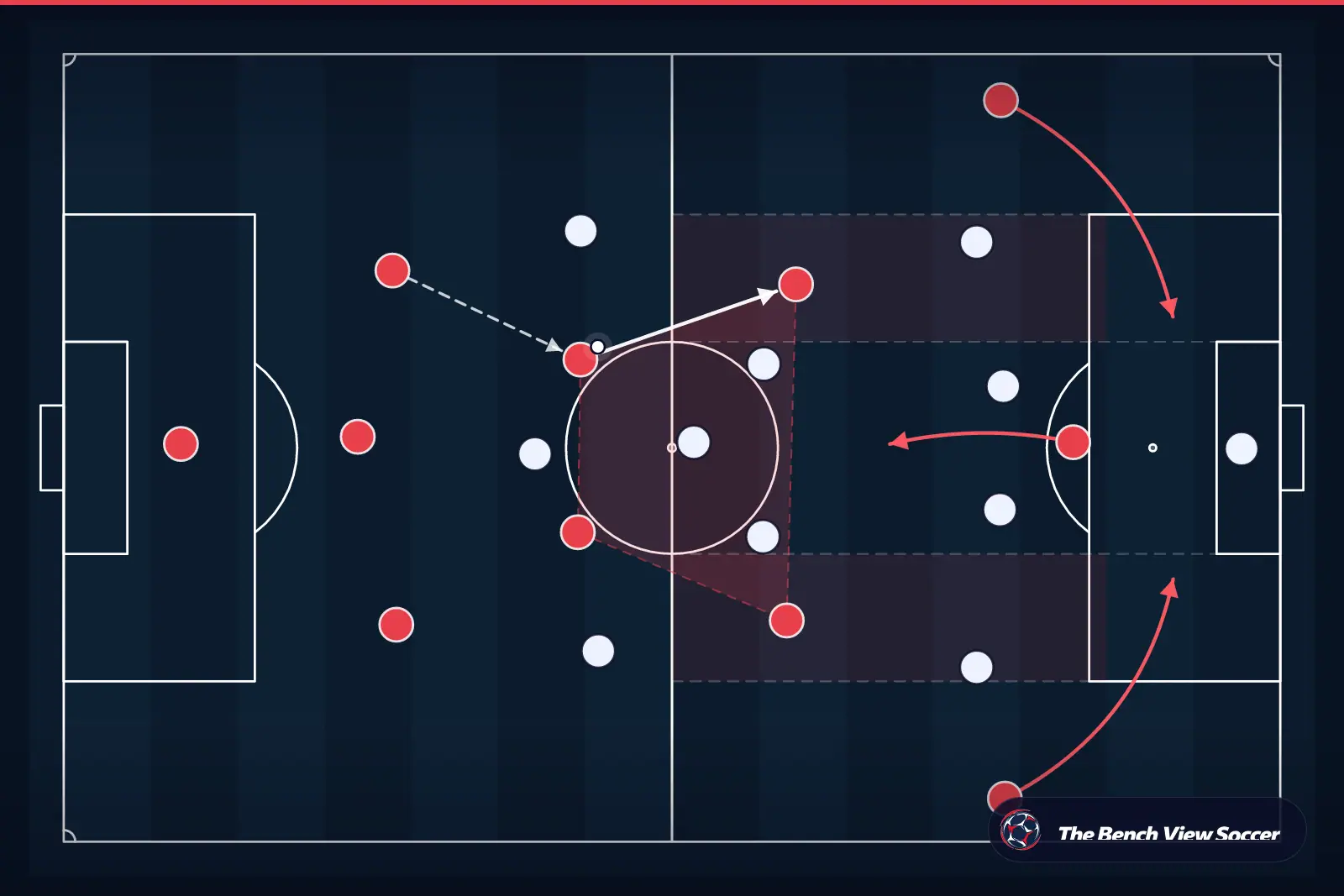
A false nine is an attacker who is listed as the central forward but does not behave like a fixed striker. In possession, he drops into the space between the opponent’s midfield and defence (often called “the pocket”) to receive and combine. This movement creates a dilemma for centre-backs: if they follow him, they leave a gap behind; if they hold their line, the false nine turns and plays forward. The key is that the team around him must attack the space he creates. Wingers and attacking midfielders make diagonal runs inside, full-backs provide width to stretch the back line, and midfielders step higher to overload central areas. Without these runners, a false nine can look harmless because there is no one benefiting from the vacated space. A target man does the opposite. He stays high, provides a reference point, and occupies both centre-backs. The team then plays into him directly (ground passes into feet or aerial balls), and he sets the ball off to midfielders or wingers—this is often called “layoffs” or “set-and-spin” combinations. Tactically, the target man helps when a team cannot build cleanly through midfield or when the opponent presses aggressively; he becomes a safe outlet to bypass pressure. The false nine, meanwhile, helps when a team wants to dominate the ball and break compact blocks by creating central overloads and third-man runs (a “third man” is the runner who receives after a quick one-two, not the original passer or receiver). Both profiles also change defending: a false nine usually leads pressing by closing passing lanes into midfield, while a target man can press too but is often used to block centre-back passes and force play wide.
Match Examples
A classic false nine reference point is FC Barcelona under Pep Guardiola, especially the 2010–11 UEFA Champions League campaign. In the 2011 final at Wembley vs Manchester United, Lionel Messi repeatedly drops away from the centre-backs into midfield. United’s defenders hesitate: if they step out, Barcelona’s wide forwards attack the space behind; if they stay, Messi receives freely and combines with Xavi Hernández and Andrés Iniesta. The result is not only chances, but territorial control—Barcelona sustains attacks because the “striker” becomes an extra midfielder during buildup and in the final third. A more modern, Premier League example is Manchester City under Guardiola in the 2022–23 season, including the Champions League final vs Inter in 2023. City often uses a “dropping” forward option (even with Erling Haaland on the pitch, City’s central attacker at times functions like a connector), but their false-nine principles appear clearly when players like Phil Foden, Kevin De Bruyne, or Bernardo Silva occupy central pockets and rotate positions. City creates space for wide and half-space runners by pulling Inter’s back line into tough decisions about stepping out. For a target man contrast, look at Chelsea in the 2020–21 Champions League run under Thomas Tuchel, particularly matches where Olivier Giroud leads the line. Giroud stays high, pins defenders, and offers a direct out-ball so Chelsea can escape pressure and then connect to runners like Timo Werner and Kai Havertz. Another target-man reference is Tottenham Hotspur under Mauricio Pochettino in the 2016–17 Premier League season, where Harry Kane often plays as a traditional No.9: he occupies centre-backs, receives into feet, and allows Dele Alli and Son Heung-min to run beyond him. These examples show the core trade-off: the false nine improves central overloads and manipulation of defensive lines, while the target man improves direct access, pinning, and second-ball attacks.
Related Concepts & Skills
Training Implications
To coach or practice the false nine vs target man ideas in a realistic way, build sessions around roles and spacing rather than just finishing. For a false nine pattern, run a 7v7 or 8v8 exercise with one team instructed to use a dropping striker. Mark a central “pocket zone” (about 10–12 meters deep) between midfield and defence that only the false nine can enter to receive. Coaching points: the false nine checks away then drops to receive on the half-turn; the nearest winger makes an immediate diagonal run inside when the centre-back steps out; an attacking midfielder becomes the “third man” and arrives beyond the line; full-backs stay wide to stretch the defence. Score double if the goal comes from a pass into the pocket followed by a through ball to a runner—this rewards the correct mechanism, not random dribbling. For a target man pattern, run a transition-focused drill: 6v6 plus two neutral wide players, with one side required to play into a designated target striker within three passes after winning the ball. Coaching points: the target man sets the ball back with one touch (“layoff”) to a supporting midfielder; wingers sprint beyond immediately; one midfielder stays close for second balls; centre-backs practice clipping diagonal passes into the striker’s chest or feet. Add a constraint that goals count only if at least one player makes a run beyond the target man before the shot, so the team learns that a target man is a connector, not just a finisher. Finally, include a pressing module: in both models, rehearse the first five seconds after losing possession. In a false-nine setup, the front players angle their press to block passes into central midfield; in a target-man setup, the striker blocks the centre-back’s direct lane and forces play wide, where the team can trap. These are actionable habits that translate directly to watching and understanding elite European matches.
The Bench View app
Don’t just read football — train it
Everything you read here, turned into training you can follow step by step.
Physical training at home
AI daily sessions adapted to your level and position. No equipment needed.
Tactical training courses
Step-by-step courses on positioning, pressing, build-up and decision making.
- 7 days free
- No commitment
- Cancel anytime
Free account: 2 physical sessions + the first tactical course. PRO: 7-day free trial — cancel before day 8 and you pay nothing.