

Introduction
Tournament football rewards teams that suffer well. Across the UEFA Champions League knockouts, the UEFA European Championship, and the FIFA World Cup, matches often turn into one or two decisive moments. In that environment, a compact defence—meaning a team stays close together horizontally (side to side) and vertically (front to back)—reduces the space an opponent can use to create high-quality chances. For Indian fans watching Europe’s best sides, it can look “negative,” but compactness is not just sitting deep. It is a coordinated way to control space, guide the opponent into less dangerous areas, and stay prepared for transitions (the seconds after winning or losing the ball). Coaches like Diego Simeone at Atlético Madrid, Carlo Ancelotti at Real Madrid, and Didier Deschamps with France consistently show how a compact block can beat technically superior teams. Looking ahead to World Cup 2026, where travel and squad rotation matter, compact defending becomes even more valuable because it scales: it works even when rhythm and chemistry are not perfect.
How It Works
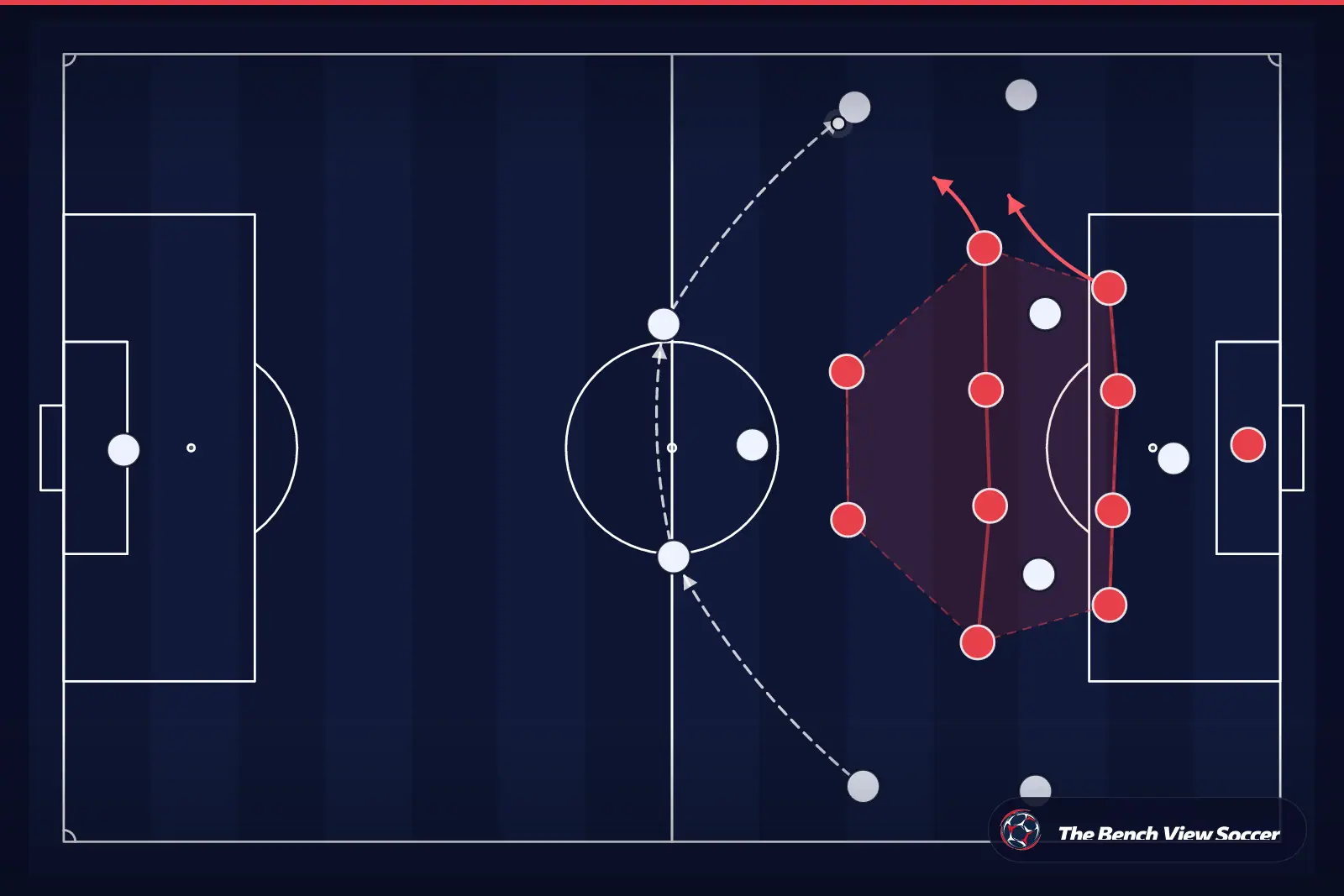
A compact defence has three core pieces: distances, reference points, and timing. First, distances: a team keeps the back line, midfield line, and forward line close enough that passes into the “pocket” (space between midfield and defence) are crowded. Coaches often target a vertical gap of roughly 10–15 metres between lines during sustained defending; the exact number changes with pace, opponent, and field position. Second, reference points: players defend space, not just men. The ball, the nearest opponent, and the goal are the anchors. When the ball shifts wide, the block shifts as a unit, squeezing the central lane so the opponent can cross rather than combine through the middle. This is why compact teams look “narrow” in the centre and force play outside. Third, timing: compact defending is active. A team delays (slows the attack), then presses at specific moments—like a bad first touch, a backwards pass, or a receiver facing their own goal. Even in a low block, the nearest player steps out while the rest cover behind, so the shape never breaks. The big payoff is shot quality. Compactness reduces cut-backs and central shots—two of the highest-value chance types in modern football—and it also sets up counter-attacks because the team wins the ball with many players close enough to support the first pass.
Match Examples
Atlético Madrid under Diego Simeone provides a clean reference point for compact blocks in Europe. In the 2013–14 UEFA Champions League run, Atlético consistently defends with two tight banks, protecting the centre and forcing opponents wide; the semi-final second leg against Chelsea at Stamford Bridge shows how the midfield stays connected to the back line even when the forwards drop to help. Another strong example is José Mourinho’s Inter in the 2009–10 Champions League semi-final against Pep Guardiola’s Barcelona, especially the second leg at Camp Nou. Inter plays with extreme compactness near their box, compressing central space so Barcelona circulates the ball without finding clean through-passes; Inter accepts crosses and protects the six-yard box and cut-back zones. A more recent and very instructive case is Argentina at the 2022 FIFA World Cup under Lionel Scaloni, particularly the quarter-final against the Netherlands and the final against France. Argentina often defends in a compact mid-block, with midfielders staying close enough to block passes into Kylian Mbappé’s inside channels while still being ready to jump to the ball-side. In the UEFA Champions League, Carlo Ancelotti’s Real Madrid in the 2021–22 season repeatedly shows compact defending plus lethal transitions, notably in the knockout rounds; Madrid frequently stays organised without pressing high for long spells, then attacks quickly once they regain. These matches teach Indian viewers a key lesson: compact defending is not about having less ambition—it is a way to choose where the game is played and to protect the most valuable spaces in front of goal.
Related Concepts & Skills
Training Implications
For coaches and players in India trying to build compact defending, start with spacing and communication before complex schemes. (1) “Three-Line Distance” drill: set up three horizontal lines with cones (defence, midfield, forwards). In an 8v8 or 9v9 game, score a point for the defending team every time the opponent plays into the central pocket and you force a backwards pass within three seconds. Coach the vertical distances: midfield must stay close enough to the back line to deny pocket receptions, while the forward line stays connected so the block is not split. (2) Wide trap exercise: play 7v7 with two wide channels marked. The defending team earns double points for regains in the wide channel after guiding the ball there. Teach the ball-near winger to press, the ball-near fullback to step and lock, and the near central midfielder to cover inside; the far side tucks in to protect the centre. (3) Cut-back protection habit: run a crossing drill where attackers aim for cut-backs (passes pulled back to the edge of the box). Defenders score by blocking the cut-back lane first, not by chasing the cross. This trains priorities: protect the zone between penalty spot and “D” area. (4) Transition rule in small-sided games: after losing the ball, the nearest two players must press for two seconds while everyone else sprints into a compact shape. This creates realistic tournament defending, where you cannot press forever but you also cannot switch off. Track success with simple metrics: number of central entries conceded, number of shots from the middle, and time taken to restore compact shape after a turnover.
Apply This in Your Game
Reading about tactics is one thing. Our training units teach you to execute these concepts in real match situations.