Introduction
The “false nine” is a centre-forward who does not stay on the last line like a classic striker. Instead, he drops away from the opposition centre-backs into midfield zones, often to receive, combine, and manipulate defensive shape. Fans who watch the Premier League, La Liga, and the UEFA Champions League see this constantly: Manchester City under Pep Guardiola, Arsenal under Mikel Arteta, and even Spain’s national team model all use versions of it. The big question is: why does the modern game encourage strikers to come deeper, and what does it do to defenders who are trained to “mark the number 9”? The answer sits at the intersection of space, pressing, and passing angles. When the false nine drops, he creates a dilemma: if a centre-back follows, space opens behind; if the centre-back holds position, the false nine receives between the lines and turns the game into a midfield overload. Opponents respond with different tools—tight marking, midfield screens, back-line discipline, or tactical fouls—and each response has trade-offs.
How It Works
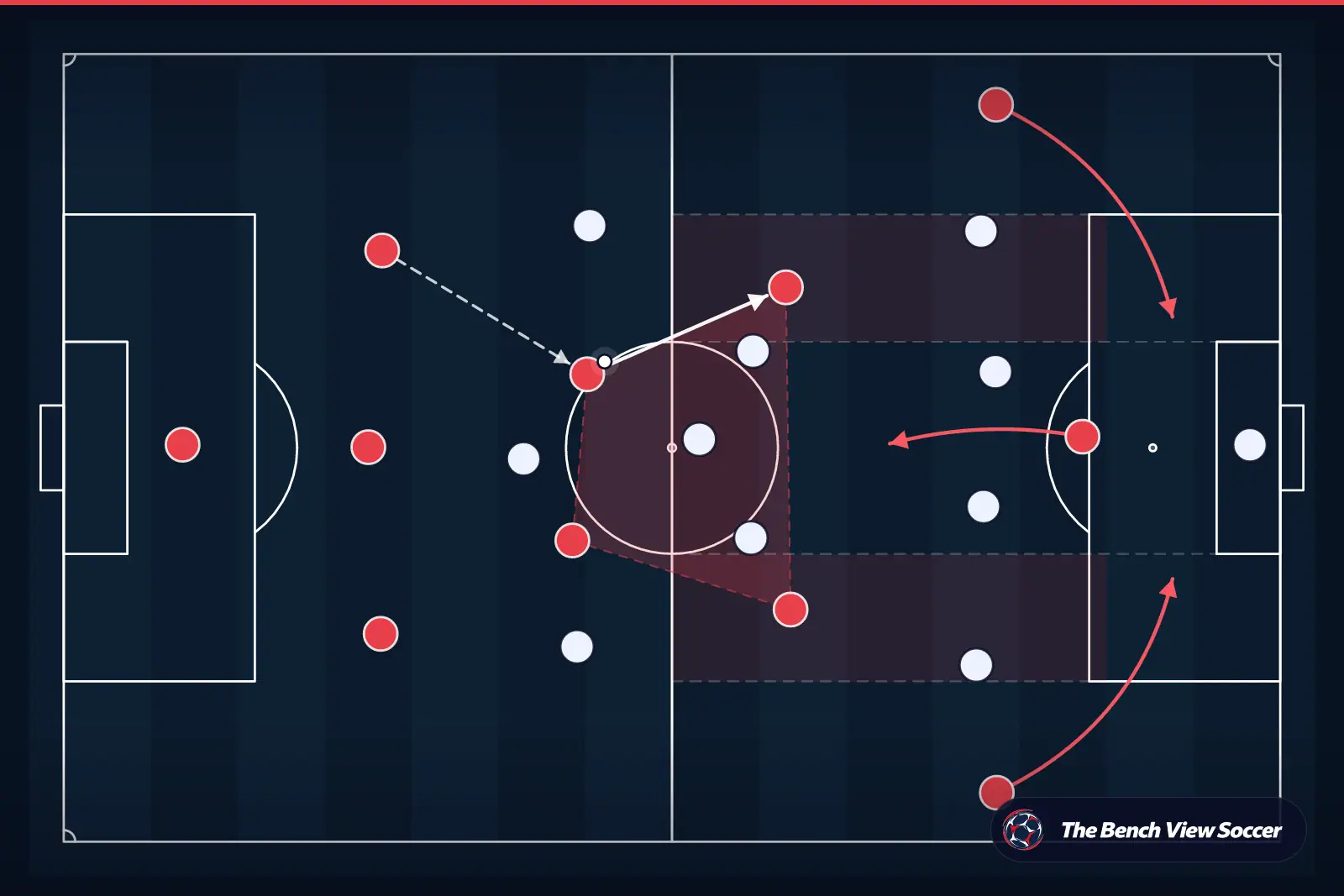
Modern false nines drop deep mainly to create a free man and to disrupt the opponent’s defensive reference points. Most defensive structures in Europe are built around protecting the central corridor: two centre-backs defend the box, and one or two midfielders protect the space in front (often called the “screen”). When the striker drops into that screened area, he changes the opponent’s decision-making. If the nearest centre-back steps out to follow him, the back line loses its compactness and a channel appears for a winger or attacking midfielder to run into. If the centre-back refuses to step out, the false nine receives between midfield and defence, combines on the half-turn, and helps his team progress through the middle instead of being forced wide. In possession, the false nine acts like an extra midfielder: he offers a passing lane for the goalkeeper and centre-backs, sets “third-man” combinations (A passes to B, B lays off to C running beyond), and attracts pressure that frees teammates. This is why teams like Manchester City often look like they have five midfielders at times—because the “9” is not fixed. Out of possession, the same player can lead the press by curving his runs to block central passes into the opponent pivot (the deeper midfielder). Opponents respond in a few common ways. One is to assign a dedicated marker—either a centre-back who follows aggressively or a defensive midfielder who tracks the dropping striker while centre-backs hold their line. Another response is to defend space rather than man: keep the back line compact, keep the midfield screen disciplined, and concede the false nine’s reception but prevent the turn by collapsing quickly. A third response is to change shape—moving from a back four to a back three or using a double pivot—to protect the channels that open when centre-backs are tempted to step out. The key is that every response tries to solve the same problem: stop central progression without gifting runs in behind.
Match Examples
A classic reference point is the 2010–11 UEFA Champions League semi-final between Pep Guardiola’s Barcelona and José Mourinho’s Inter. Lionel Messi operates as a false nine, repeatedly dropping off the centre-backs into midfield pockets. Inter respond by keeping their back line compact and using disciplined midfield screening, refusing to chase recklessly. They accept that Messi will touch the ball, but they try to deny him clean turns and deny the runners around him. A more recent Premier League example is Liverpool vs Manchester City at Anfield in 2022–23 (Premier League). City often use a fluid front line with a dropping forward to connect play, while Liverpool defend with intense central compactness and midfield pressure to prevent easy “between the lines” receptions. The defensive idea is not always to win the ball immediately, but to force the false nine to receive with his back to goal and then play sideways. In the 2020–21 season, Arsenal under Mikel Arteta frequently use a dropping striker profile in phases to connect their build-up to the attacking midfielders. Opponents often respond by having a defensive midfielder stay touch-tight to the dropping forward while the centre-backs hold their line, a common Premier League solution to avoid opening the space behind. In the UEFA Champions League, Manchester City’s use of a false-nine-like connector in 2020–21 also shows another opponent response: teams sit in a compact 4-4-2/4-5-1 mid-block, crowd the central lane, and allow circulation outside, betting they can defend crosses and cut-backs rather than central through balls. Across these examples, the pattern is consistent: the false nine’s drop is not “running away from goal,” it is a deliberate tool to pull defenders out of shape, create central access, and open the most valuable space in football—the zone between the lines and the space behind the back line.
Related Concepts & Skills
Training Implications
To train a false nine role—and to train defenders to face it—sessions should focus on scanning, body orientation, and coordinated movement. For attackers, start with a 4v4+3 rondo in a central grid: the “false nine” is one of the inside players who must receive on the half-turn. Coaching points: scan before the ball arrives, open your hips to play forward, and set the ball with one or two touches to attract pressure and release a third-man runner. Progress it into a pattern drill: centre-back plays into the false nine, false nine sets to a midfielder, winger or attacking midfielder immediately runs in behind, and the final pass attacks the channel the centre-back vacates. Make the timing strict: the runner goes as the centre-back steps, not after. For team tactics, use an 8v8 on two-thirds of a pitch with a rule: goals count double if they come from a pass into the false nine followed by a forward pass within three seconds. This teaches quick vertical play instead of slow recycling. Add an opposition constraint to simulate real responses: allow defenders to assign either a centre-back or a defensive midfielder to track the false nine. Your attackers then learn to punish each choice—if a centre-back follows, attack the space behind; if a midfielder tracks, use the false nine to pin that midfielder and free another passer. For defenders, run a back-four + two midfielders vs front-four drill. Coach the key decision: centre-backs hold the line unless there is cover and clear communication; the nearest midfielder applies contact and blocks the turn. Use clear triggers: if the false nine receives facing his own goal, press from behind and lock the inside; if he receives side-on, collapse with a second defender to stop the forward pass. Finish with video feedback: clip 3–5 moments where the line steps or holds, and ask players to verbalise why. The goal is not “always follow” or “never follow,” but coordinated choices that protect the space behind while denying central progression.
The Bench View app
Don’t just read football — train it
Everything you read here, turned into training you can follow step by step.
Physical training at home
AI daily sessions adapted to your level and position. No equipment needed.
Tactical training courses
Step-by-step courses on positioning, pressing, build-up and decision making.
- 7 days free
- No commitment
- Cancel anytime
Free account: 2 physical sessions + the first tactical course. PRO: 7-day free trial — cancel before day 8 and you pay nothing.