Introduction
Fans often grow up imagining the “number 9” as a fixed target: the striker stays between centre-backs, wins duels, and finishes crosses. Modern elite football keeps evolving, and one of the biggest shifts is the false nine—an attacker who starts centrally but drops away from the defensive line to create problems that traditional marking cannot solve. This role is not just a Barcelona nostalgia story from Pep Guardiola’s era; it remains relevant because today’s top teams face compact blocks, aggressive pressing, and defenders who are quicker and smarter than ever. For clubs like Real Madrid—especially in big Champions League nights, where opponents defend deep and counter fast—the false nine helps the team control where the game is played. It also suits squads filled with explosive wingers and midfield runners, which Madrid consistently possess under managers like Carlo Ancelotti. The false nine is not “playing without a striker”; it is playing with a striker who manipulates space as much as he attacks it.
How It Works
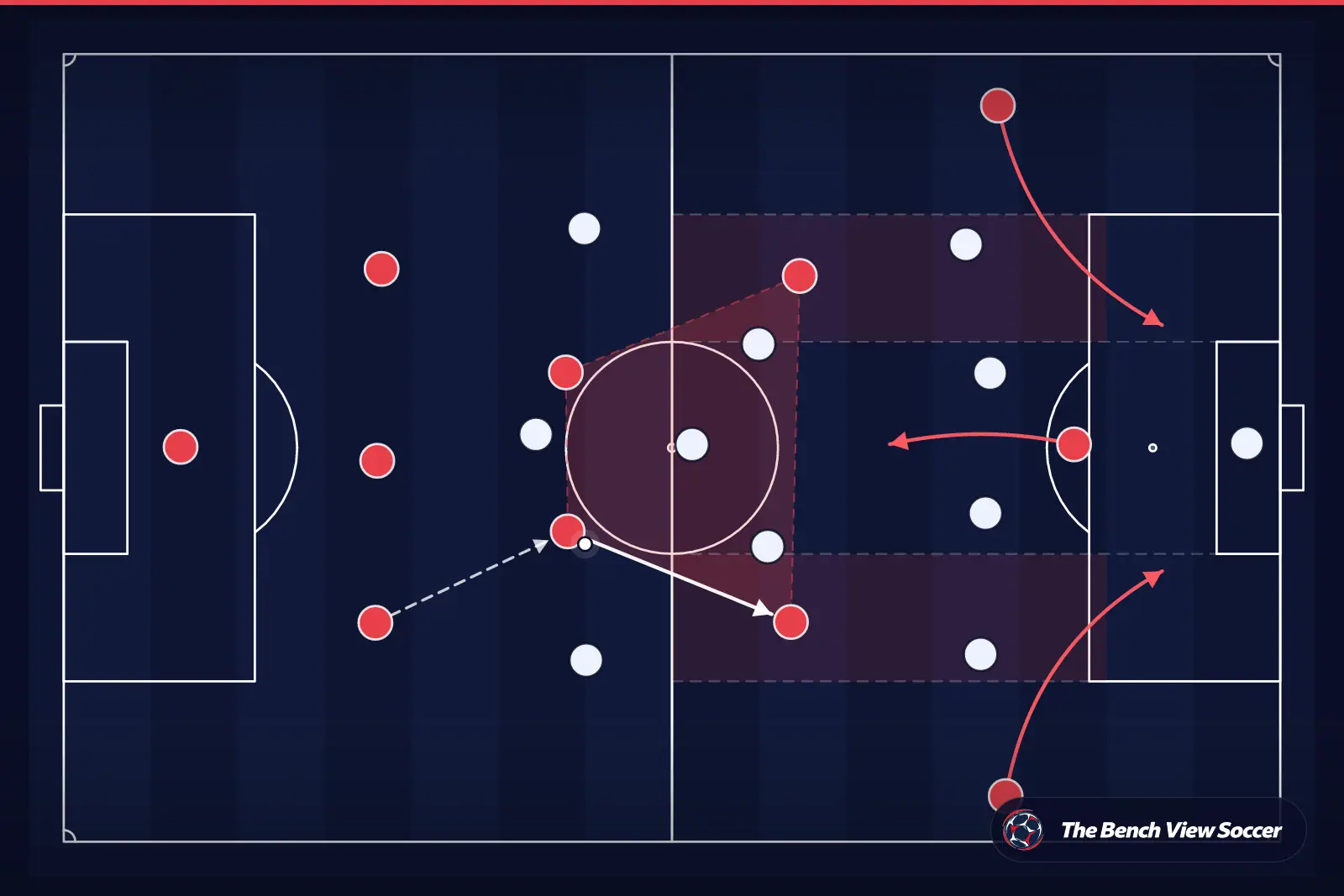
A false nine is a central forward who regularly moves into midfield zones instead of staying on the last line. Tactically, this movement asks a key question: do the centre-backs follow him or hold their position? If a centre-back steps out, the defensive line breaks shape and creates channels for runners—usually wingers cutting inside or midfielders arriving late. If the centre-backs stay, the false nine receives between the lines, turns, and links play like an extra midfielder, helping the team sustain attacks. Real Madrid’s squad-building makes this particularly useful. Their wide forwards (think Vinícius Júnior, Rodrygo, or previously Cristiano Ronaldo) love attacking the inside-left or inside-right lanes, so a false nine can “vacate” the central lane and open diagonal runs into the box. It also improves counter-pressing: when the false nine drops, he is closer to the ball after a turnover, so Madrid can press immediately and stop counters before they start. In possession, Madrid can form a box midfield (two deeper midfielders plus two advanced receivers) without changing the lineup on paper, because the false nine essentially becomes an extra connector. Against low blocks in La Liga, this helps create overloads around the D (the edge of the penalty area), pulling out a defensive midfielder and freeing shooting lanes or through passes.
Match Examples
A classic reference point is Barcelona under Pep Guardiola, especially the 2010–11 UEFA Champions League season. In the 2011 Champions League final at Wembley, Lionel Messi plays as a false nine against Manchester United, repeatedly dropping into central pockets and forcing United’s midfield to collapse. When defenders hesitate to follow, Messi receives, turns, and combines, and Barcelona’s runners attack the spaces he creates. Closer to the “Madrid profile,” Spain’s Euro 2012 campaign under Vicente del Bosque shows how a false nine unlocks matches even without a traditional striker: in the Euro 2012 semi-final versus Portugal, Spain often uses Cesc Fàbregas as a false nine to help dominate midfield control and create better passing angles against a strong defensive structure. For a Real Madrid-flavoured club example, Manchester City under Guardiola in the 2020–21 Champions League run frequently uses Kevin De Bruyne or Phil Foden in a false-nine-like function to pull centre-backs out and open lanes for wide attackers; this is visible in phases of the semi-final tie against Paris Saint-Germain, where City’s central movements help create half-space entries and cutbacks. These examples matter because Madrid often face similar problems: opponents protect the centre, defend deep, and plan counters. The false nine offers a repeatable solution—create midfield superiority, then attack the newly opened spaces with speed.
Related Concepts & Skills
Training Implications
To train a false nine system, start with positioning and decision-making, not fancy flicks. First, run a 6v6+3 possession game (two teams plus three neutral players) in a medium grid: the “false nine” is one neutral who must check into pockets between two marked lines on the pitch (use cones to create a central lane). Coach the habit: scan before receiving, take the first touch away from pressure, and play one- or two-touch to the far side to switch the point of attack. Second, add a pattern drill that mirrors match reality: centre-back to midfielder, midfielder to false nine dropping, then a third-man run from a winger into the channel. Rotate roles so wingers learn timing—go too early and you’re offside; go too late and the defence resets. Third, train the defenders’ response with a guided 8v8: instruct one centre-back to follow the false nine for five minutes, then forbid it for the next five minutes. This teaches attackers to recognise both outcomes: if followed, attack the vacated space; if not followed, the false nine turns and plays forward. Finally, include a counter-pressing rule: after losing the ball, the nearest three players have five seconds to win it back or force a long clearance. This builds the real advantage of the false nine—he is already close to midfield duels, so the team can protect itself against counters, which is essential for teams like Real Madrid that attack with speed and numbers.
The Bench View app
Don’t just read football — train it
Everything you read here, turned into training you can follow step by step.
Physical training at home
AI daily sessions adapted to your level and position. No equipment needed.
Tactical training courses
Step-by-step courses on positioning, pressing, build-up and decision making.
- 7 days free
- No commitment
- Cancel anytime
Free account: 2 physical sessions + the first tactical course. PRO: 7-day free trial — cancel before day 8 and you pay nothing.