Introduction
Real Madrid’s identity in Europe is often explained with simple labels like “counter-attacking team” or “transition monster.” But the deeper tactical reason is more specific: Madrid rely on fast counters immediately after defensive turnovers because it fits their squad profile, their risk management, and the game states they face in La Liga and the UEFA Champions League. Under Carlo Ancelotti, Madrid frequently accept that opponents will have spells of controlled possession, especially when teams commit numbers forward. The moment Madrid win the ball—through a tackle, interception, or second-ball recovery—they treat it like a launch signal. Instead of recycling possession to “settle,” they look forward first, because the opponent is disorganised and the spaces are temporarily huge. For fans learning tactics, this is a key idea: the best counter teams are not just fast runners; they are fast decision-makers who recognise the exact seconds when an opponent is most vulnerable. Madrid’s counters are a repeatable pattern, not random chaos.
How It Works
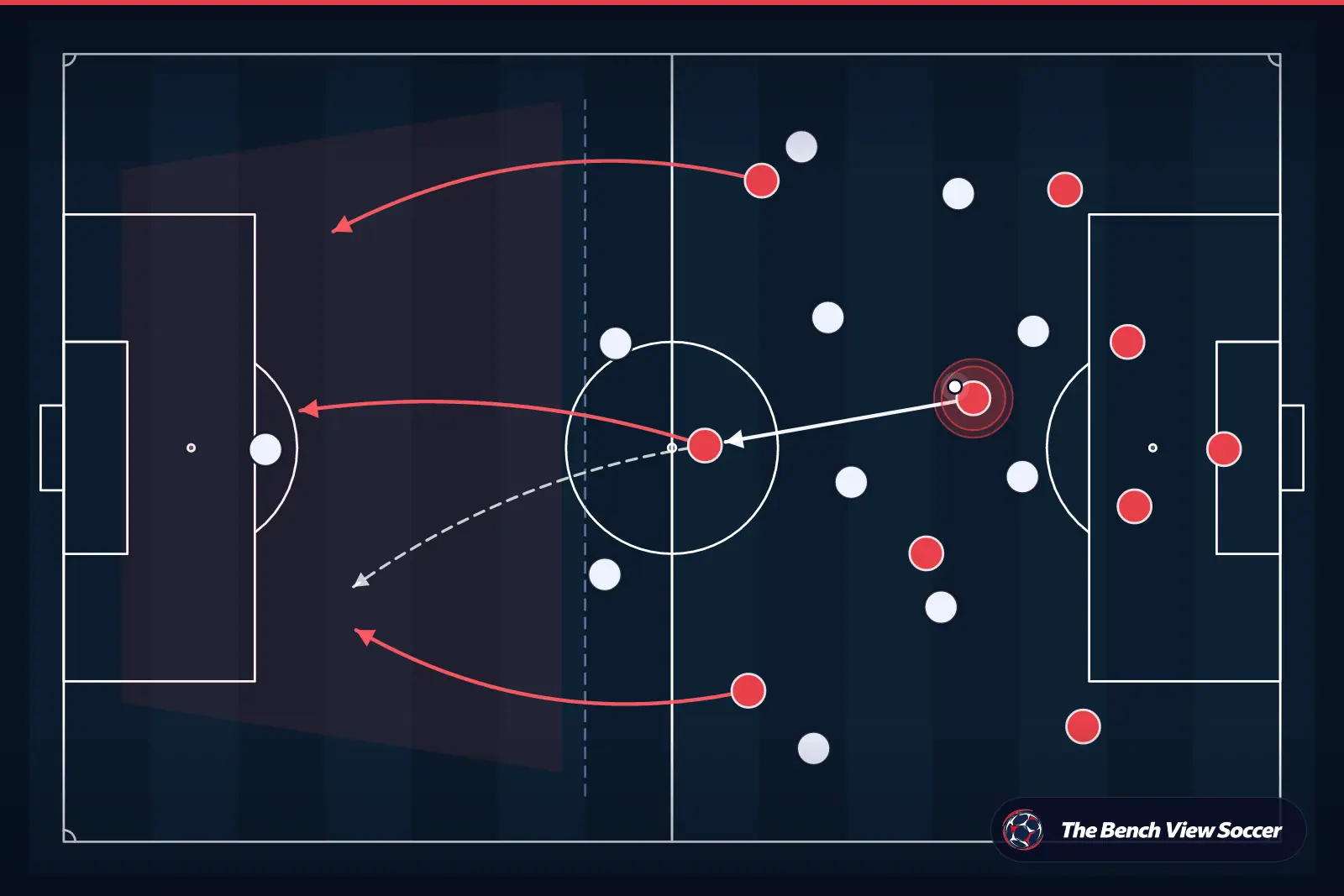
Real Madrid’s fast counter after a defensive turnover begins with how they defend and where they invite the opponent. Madrid often defend in a compact mid-block: the team shape stays connected, with lines close together, so passes through the middle are difficult. This compactness increases the chance of winning “dirty balls” (loose clearances, deflections, second balls) and it also ensures that when the ball is recovered, Madrid already have supporting options nearby. The trigger is simple: the first look is vertical. A midfielder like Toni Kroos (earlier) or Federico Valverde (now) immediately scans for the forward run of Vinícius Júnior, Kylian Mbappé, or Rodrygo. The ball-carrier tries to play early, because two seconds later the opponent’s full-backs recover and the central defenders re-set their spacing. Madrid also counter because it reduces the need for long possession sequences, which carry their own risk: if you lose the ball while building slowly, your team is spread out. Madrid prefer to be spread out while attacking at speed, not while circulating safely. Another key detail: Madrid’s defenders and goalkeeper (Thibaut Courtois when fit) are comfortable playing longer passes into space. This bypasses the opponent’s first counter-press (the immediate attempt to win the ball back after losing it). Finally, Madrid’s counters are not always “one pass and shoot.” Often it becomes a quick 6–10 second attack: carry the ball forward, fix defenders by running at them, then release to the free runner. The goal is to arrive in the box before the opponent regains its defensive structure.
Match Examples
A clear recent example is the 2023-24 UEFA Champions League semi-final, second leg: Real Madrid vs Bayern Munich at the Santiago Bernabéu. Madrid spend long phases without dominating the ball, but the moment they recover possession, they attack quickly into the space Bayern leave when they push their line up. Even when the final decisive moments come from pressure and rebounds, the repeated pattern is that Madrid’s first intention is forward and fast, not sideways and slow. Another strong reference point is the 2021-22 UEFA Champions League round of 16 second leg: Real Madrid vs Paris Saint-Germain at the Bernabéu. PSG try to control with possession and high positioning, but turnovers—especially when PSG play into midfield under pressure—create immediate counter opportunities. Madrid’s forward players run into the channels before PSG can reset, and the speed of the first pass or first carry changes the game’s rhythm. In La Liga, the 2023-24 Clásico (Real Madrid vs FC Barcelona, league match) also illustrates the logic: Barcelona often commit full-backs high and keep midfielders advanced to maintain control. When Madrid recover the ball, they attack those vacated wide spaces quickly, especially targeting the area behind the full-back. These matches show a consistent Madrid principle across competitions and opponents: the counter is planned, rehearsed, and triggered by the opponent’s shape at the moment of loss, not by Madrid simply “deciding to run.”
Related Concepts & Skills
Training Implications
If you want to train a Madrid-style fast counter after a defensive turnover—whether in an academy, a school team, or a weekend group—build sessions around speed of recognition, not just sprinting. Start with a 6v6 or 7v7 small-sided game in a 40x30 metre area. Rule 1: when a team wins the ball, it has 8 seconds to create a shot; if it fails, possession automatically goes to the other team. This forces the “forward first” habit. Rule 2: add two wide channels (about 3 metres each) where only wingers/full-backs can enter; this encourages immediate runs into the space behind advanced full-backs, like Madrid targeting the channel for Vinícius or Rodrygo. Coaching points: (a) the first pass after the regain should be forward when possible, (b) the ball-carrier should take the first touch out of feet toward goal, and (c) one runner attacks depth (behind the line) while another offers a shorter option for a layoff. Next, run a “3-phase transition drill”: Phase A is a possession box (5v3 rondo). When the 3 win it, they immediately break into Phase B, a 3v2 counter to goal. If the 2 defenders win it, they play into Phase C, a mini-goal counter in the opposite direction. This teaches players to switch mindset instantly, the biggest difference between average and elite transition teams. Finish with video-based learning: show 3 clips (even from YouTube highlights) and pause at the turnover moment. Ask players: Where is the space? Who is the first runner? Is the best option a pass or a carry? This builds the scanning and decision speed that makes Madrid’s counters feel inevitable.
The Bench View app
Don’t just read football — train it
Everything you read here, turned into training you can follow step by step.
Physical training at home
AI daily sessions adapted to your level and position. No equipment needed.
Tactical training courses
Step-by-step courses on positioning, pressing, build-up and decision making.
- 7 days free
- No commitment
- Cancel anytime
Free account: 2 physical sessions + the first tactical course. PRO: 7-day free trial — cancel before day 8 and you pay nothing.