Introduction
Real Madrid’s front three rarely stays in fixed lanes during transition moments. For fans used to the idea of a left winger staying left and a striker staying central, this can look like “chaos.” But under Carlo Ancelotti, the movement is organised: the forwards rotate roles to attack space faster than the opponent can recover shape. In modern European football, especially in the UEFA Champions League and La Liga, transition phases decide matches because teams press high and keep many players ahead of the ball. When Madrid win it, they often face a scattered defence and only a few seconds to punish it. Rotations between Vinícius Júnior, Rodrygo, and Jude Bellingham (often the highest runner) help Madrid avoid predictable passing lanes, create mismatches versus full-backs, and ensure at least one runner threatens the space behind the defence. The purpose is not “freedom”; it is to maximise speed, angles, and finishing quality before the opponent resets.
How It Works
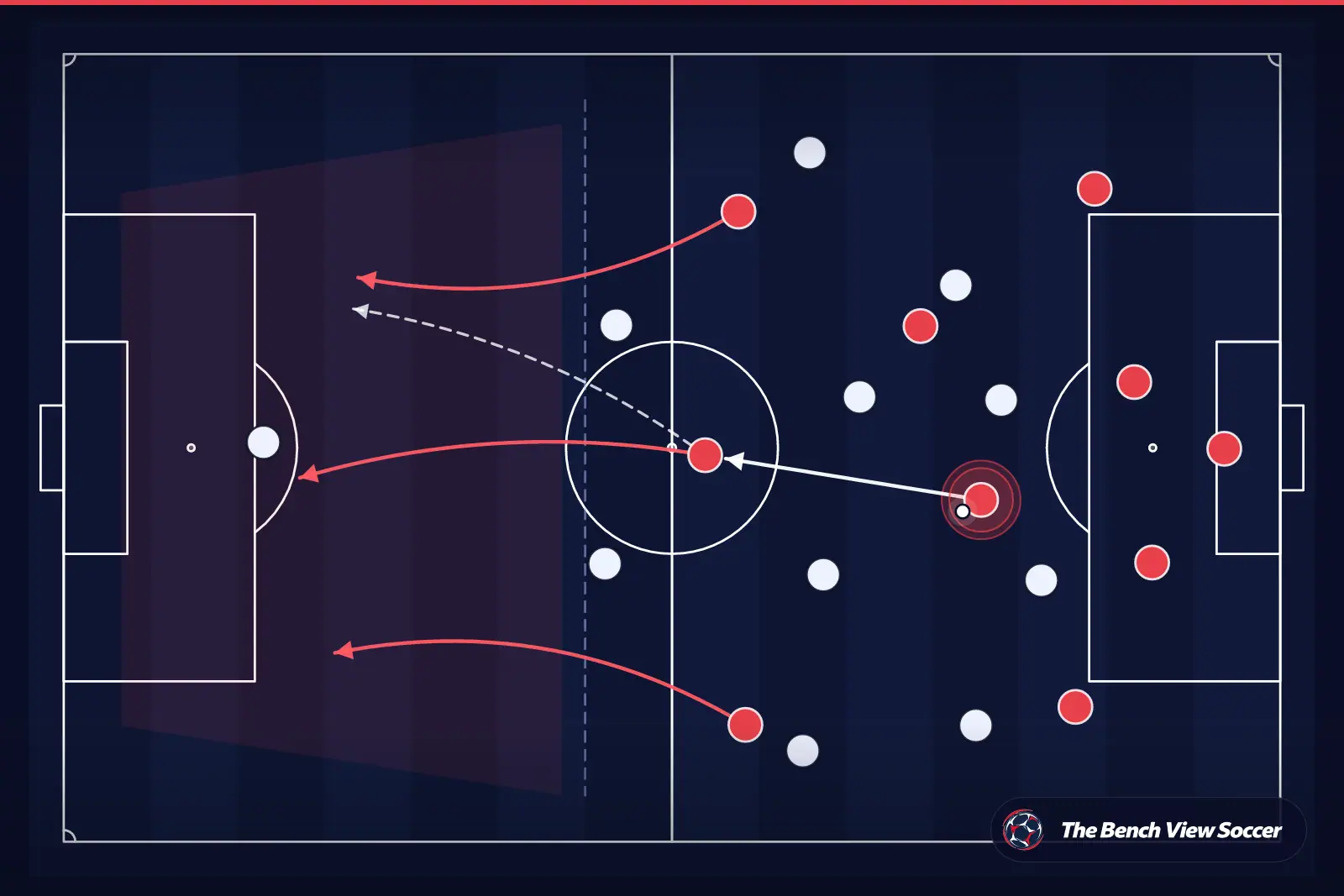
Real Madrid rotates their front three in transition to solve three problems at once: access to depth (space behind), access to the middle (best shooting zones), and protection against counter-press (the opponent trying to win the ball back immediately). In the moment Madrid regain possession, the nearest forward often checks short to offer a simple pass, while another sprints long to stretch the back line. This is why Vinícius may start wide-left but then drive inside as a “ball-carrier,” while Rodrygo moves into the left channel or even becomes the central runner. Bellingham often arrives as the late, central finisher because defenders focus on the wide dribbler and the deepest runner first. These rotations also manipulate full-backs: if the opponent’s right-back steps up to stop Vinícius, the space behind opens for Rodrygo’s diagonal run; if the centre-back shifts wide to cover, the central lane opens for Bellingham’s third-man run. Madrid’s midfield (Toni Kroos in 2023-24, Luka Modrić, Federico Valverde, Aurélien Tchouaméni) supports this by playing early vertical passes or switching quickly to the free side. The key is timing: one forward comes short, one goes long, one attacks the box, so the ball always has two progressive options and one finishing option.
Match Examples
A clear reference point is Real Madrid vs Manchester City in the 2023-24 UEFA Champions League quarter-final tie (both legs). Pep Guardiola’s City often commits players into the half-spaces and pushes full-backs high, so Madrid’s transitions become about punishing the space left behind. Madrid’s front line rotates to create an outlet: a forward drops to receive under pressure while another threatens depth, allowing a direct pass that bypasses City’s counter-press. Even when Madrid defend deep for long spells, the transition pattern stays consistent—one runner attacks the channel behind City’s advanced line, and another arrives centrally for the cutback or rebound. In La Liga 2023-24, Real Madrid vs Barcelona (the Clásico at the Santiago Bernabéu) also shows the same idea. Barcelona under Xavi Hernández often tries to control the ball and squeeze the pitch, but when Madrid regain possession, Vinícius does not simply stay wide; he carries the ball inside, Rodrygo shifts across to become a central threat, and Bellingham attacks the most dangerous pocket near the penalty spot. The rotation forces Barcelona’s defenders into quick decisions: follow the dribbler, cover the runner, or protect the middle. Against Atlético Madrid in 2023-24 (a team coached by Diego Simeone that is strong at blocking central areas), Madrid’s rotations in transition still matter: by swapping who runs into which channel, they prevent Atlético from locking onto fixed matchups and they create just enough uncertainty to play the first forward pass cleanly.
Related Concepts & Skills
Training Implications
Coaches and players can copy this idea with simple, repeatable rules rather than “free roaming.” First, train a 3-lane transition pattern: as soon as your team wins the ball, your front three must fill three jobs within two seconds—(A) one checks short for a safe pass, (B) one runs in behind, (C) one attacks the box for the finish. Rotate who does which job every repetition so players learn role-switching. Run this as a 6v6+2 neutral transition game on half a pitch: when a team wins the ball, they have 8 seconds to shoot; if they fail, possession switches. Second, coach “diagonal depth runs”: start with a winger receiving wide, then the opposite forward makes a diagonal run into the far channel while the central player arrives late. Use cones to mark the left channel, central lane, and right channel so players see the spaces clearly. Third, work on first and second passes: set a drill where the ball-winner must play forward within two touches, and the receiver must either set (one-touch layoff) or turn. This builds the speed Madrid show under Ancelotti. Finally, add decision cues: if the full-back steps up, trigger the channel run; if the centre-back steps out, trigger the central run. These cues turn rotations into predictable habits for your team, even under pressure.
The Bench View app
Don’t just read football — train it
Everything you read here, turned into training you can follow step by step.
Physical training at home
AI daily sessions adapted to your level and position. No equipment needed.
Tactical training courses
Step-by-step courses on positioning, pressing, build-up and decision making.
- 7 days free
- No commitment
- Cancel anytime
Free account: 2 physical sessions + the first tactical course. PRO: 7-day free trial — cancel before day 8 and you pay nothing.