

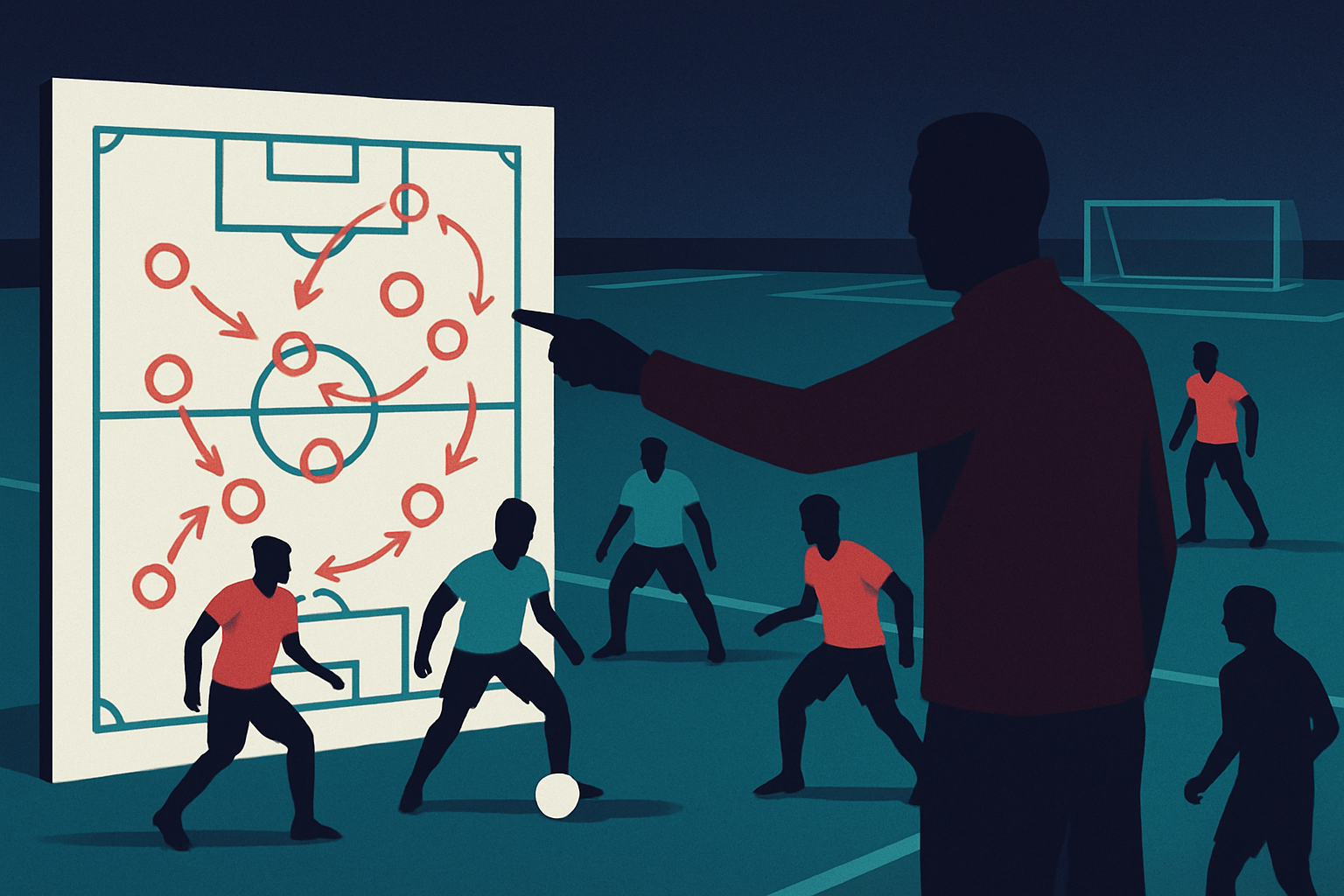
What Is Positional Play?
Positional play — or juego de posición as it is known in Spanish — is a tactical philosophy built on the belief that where your players stand before receiving the ball is more important than what they do with it once they have it. It is a system that prioritises structure over improvisation, spacing over pace, and collective intelligence over individual brilliance.
Developed and refined in Spain, particularly under Johan Cruyff's influence at Barcelona in the early 1990s, positional play was brought to global prominence by Pep Guardiola. His Barcelona side of 2008-2012 became the blueprint for how a team could suffocate opposition by constantly maintaining superior positioning across every zone of the pitch.
For Indian football fans, positional play explains why some teams always seem to have a passing option, why certain players seem to glide into space effortlessly, and why opponents often look helpless despite working extremely hard. It is the tactical foundation beneath some of the most beautiful football ever played.
- Players occupy positions to create passing lanes before the ball arrives
- The goal is numerical and positional superiority in every zone
- Space is created by intelligent off-ball movement and width
- Ball circulation forces the opposition to shift and expose gaps
How Positional Play Works
The core idea of positional play is simple but the execution demands enormous discipline. A team must divide the pitch into zones and ensure they always have numerical superiority — more players than the opposition — in whichever zone the ball is played into. This forces the opposition to commit defenders, which in turn opens space elsewhere.
Positional play relies on what coaches call 'third-man combinations' — two players combine to free a third who is in a superior position. The first player passes to the second, drawing an opponent; the second plays quickly to the third who arrives into the space vacated by that drawn opponent. This creates a chain reaction of positional advantages across the pitch.
Width is fundamental. Wingers in positional play systems must hug the touchlines even when they look isolated, because their presence pins back opposition fullbacks. This width stretches the opponent's defensive shape horizontally, creating channels in central areas for midfielders to exploit through vertical passes.
The half-spaces — the zones between the fullback and centre-back on each side — are the most prized territory in positional play. Getting a technically capable player into the half-space with their back to goal, or arriving in behind the fullback, creates the most dangerous attacking opportunities.
मूल सिद्धांत
All five vertical channels must be occupied at all times to stretch the opposition and create passing options across the full width of the pitch.
In every zone where the ball arrives, the team must have at least one more player than the opposition to guarantee a safe passing option exists.
Moving the ball quickly — often back-and-forth before going forward — forces the opposition defence to shift and opens gaps between defenders.
Short two-player combinations are used primarily to free a third player arriving into a superior position, not as ends in themselves.
The zones between fullback and centre-back are targeted constantly as they force defending choices and create natural overloads.
मैचों से उदाहरण
एलीट स्तर पर असली विरोधियों के खिलाफ़ यह कैसे काम करता है
In the 2011 Champions League semi-final, Barcelona's positional play was at its peak. Messi dropped into the space between Madrid's midfield and defence, Xavi and Iniesta circulated the ball from deep, and the wingers pinned the fullbacks. Madrid's midfield trio had no clear pressing trigger and spent the match chasing shadows.
मुख्य सीख: Width from Alves and Villa forced Marcelo and Arbeloa high, creating the half-space channels for Messi to operate as a false nine.
Guardiola's City used a 4-3-3 that morphed into a 3-2-5 in possession. De Bruyne and Bernardo Silva operated as free 8s who constantly found the half-spaces while the fullbacks stepped into midfield, overloading Liverpool's press and creating numerical superiority in central zones.
मुख्य सीख: When the fullback joins midfield in possession, the winger maintains width — this is the structural shift that defines Guardiola's positional system.
Nagelsmann adapted positional play for a team with less technical quality by using vertical passes into the striker as positional triggers. Where City slowly circulate, Leipzig exploded through zones by identifying the third man quickly and pressing immediately after losing possession.
मुख्य सीख: Positional play does not require endless possession. The principles of numerical superiority and half-space exploitation apply even at high tempo.
India's improved performances under Igor Stimac incorporated basic positional principles — width from wingbacks, a central midfielder dropping between centre-backs in possession to create a three-back build-up. The structure gave defenders a reliable short option and drew opposition pressure to release wingers.
मुख्य सीख: Even at international level with developing players, the structural principles of positional play improve ball retention and reduce panic-ball clearances.
How to Train Positional Play
कोचों और खिलाड़ियों के लिए प्रैक्टिकल ड्रिल्स और प्रगति योजना
Positional play requires players to understand the why behind their position before they can execute it consistently. Coaches must train spatial awareness, scanning habits, and decision-making speed — not just technical passing quality. Small-sided games with positional restrictions are the primary tool.
ट्रेनिंग ड्रिल्स
Standard rondo where the rule is that only one player per team can occupy any zone. After five consecutive passes, the team scores by completing a pass into a designated target zone. Develops spatial awareness and forces players to spread naturally.
कोचिंग पॉइंट्स
- Before receiving, scan to know your next action
- Create triangles — never line up behind a teammate
- The player without the ball must create the angle, not the player with it
प्रगति पथ
Week 1-2: Rondo fundamentals — creating triangles and scanning before receiving
Week 3-4: Positional rondos with zone restrictions to build spatial awareness
Week 5-6: Small-sided games with half-space scoring rules
Week 7-8: Full possession shape practice — 11v11 possession with zones
Week 9+: Match application — regular pauses to freeze and correct positioning
Frequently asked questions
What is positional play in football?
A way of attacking in which the pitch is divided into zones and lanes, and players spread across them so there are always passing options at different heights and widths. The team moves the ball until it reaches the free player.
What are the five lanes in positional play?
The pitch is split vertically into two wide lanes, two half-spaces and a central lane. A common rule is that no more than two players stand in the same lane, and never three in a line, so passing angles stay open.
What are the superiorities in positional play?
Numerical (more players in an area), positional (a better position, such as between the lines), qualitative (a better player in a duel) and socio-affective (players who understand each other).
Who uses positional play?
Pep Guardiola is its best-known coach, at Barcelona, Bayern and Manchester City. Juanma Lillo, Mikel Arteta, Roberto De Zerbi and Xabi Alonso also build their teams on its principles.
What is the difference between positional play and tiki-taka?
Tiki-taka describes a short-passing style. Positional play is the structure behind it: where players stand and why. A team can play positional football with long passes too.
The Bench View ऐप
सिर्फ़ फ़ुटबॉल पढ़ें नहीं — ट्रेन करें
यहाँ जो कुछ आप पढ़ते हैं, उसे कदम-दर-कदम ट्रेनिंग में बदला गया है।
घर पर फ़िज़िकल ट्रेनिंग
आपके स्तर और पोज़िशन के अनुसार AI डेली सेशन। किसी उपकरण की ज़रूरत नहीं।
टैक्टिकल ट्रेनिंग कोर्स
पोज़िशनिंग, प्रेसिंग, बिल्ड-अप और निर्णय लेने पर कदम-दर-कदम कोर्स।
- 7 दिन मुफ़्त
- कोई प्रतिबद्धता नहीं
- कभी भी रद्द करें
मुफ़्त अकाउंट: 2 फ़िज़िकल सेशन + पहला टैक्टिकल कोर्स। PRO: 7 दिन का मुफ़्त ट्रायल — 8वें दिन से पहले रद्द करें और कुछ भी भुगतान न करें।
संबंधित गाइड
The High Press
How modern teams win the ball high up the pitch and turn defence into attack in seconds
Striker Movement
The complete guide to runs, timing, and positioning that separates elite centre-forwards from the rest
Winger Play
The complete guide to wide attackers — from traditional touchline runners to modern inverted wingers