

Introduction
Overloads are one of the simplest tactical ideas to understand and one of the hardest to defend well: you put more attackers than defenders in a specific area, force a decision, and then exploit the free player. Australia’s recent national-team identity leans into this logic because it suits their profile—hard-running wide players, athletic full-backs, and forwards who can occupy centre-backs while midfielders arrive late. Under Graham Arnold (notably through the 2022 FIFA World Cup cycle and the AFC Asian Cup build-up), Australia often values territory and repeated wide attacks rather than long spells of possession like Pep Guardiola’s Manchester City. For Indian fans, think of overloads as “creating local advantages” to make crossing, cut-backs, or quick combinations easier. The goal is not just to flood an area, but to do it with structure so the team can either play through the crowded zone or switch play to the weak side (the opposite flank). When it works, Australia looks direct and methodical: drag defenders to one side, then strike with speed and timing.
How It Works
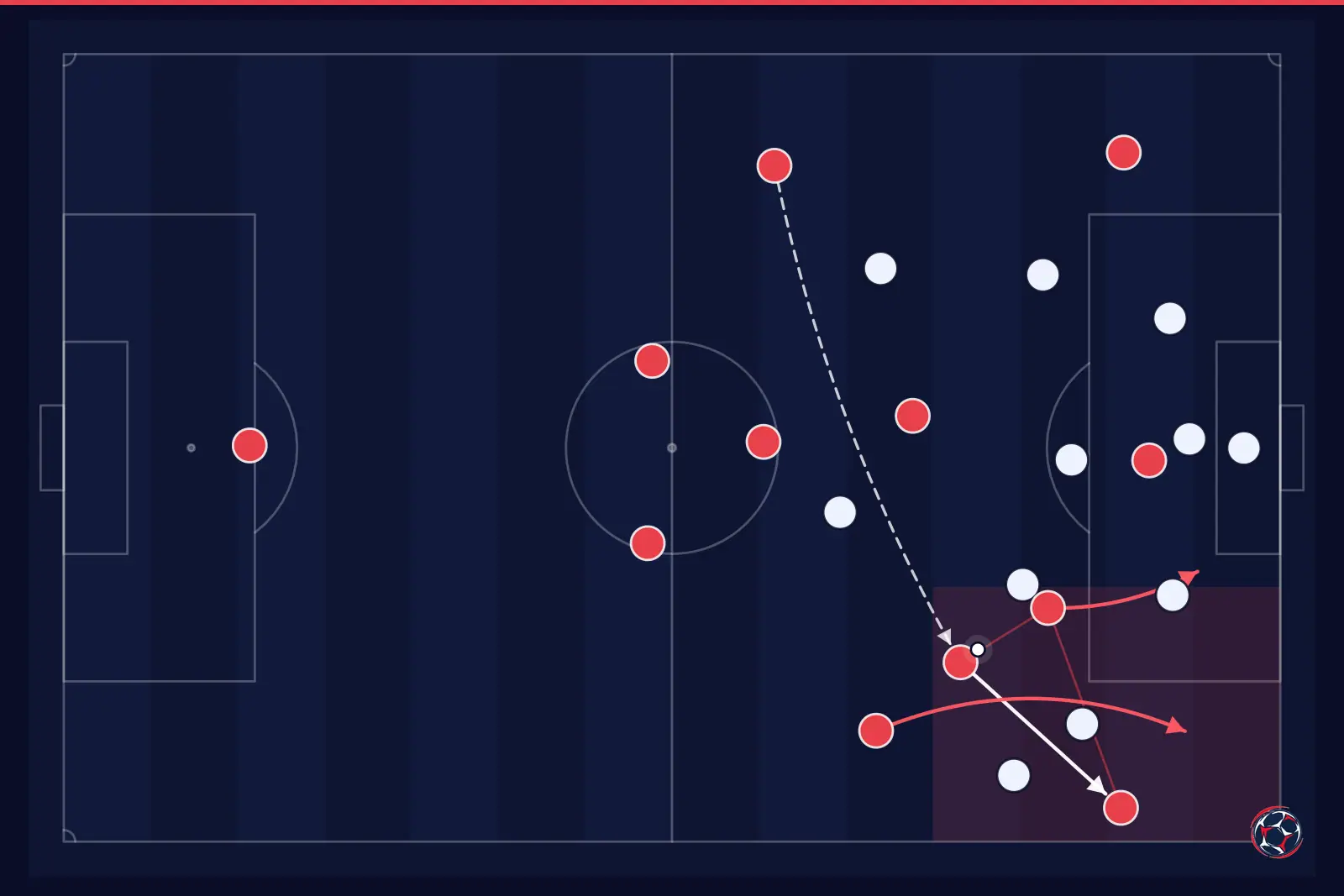
Australia typically builds overloads in two main zones: the flanks and the half-spaces (the channels between a full-back and a centre-back). On the flank, the most common overload is a 3v2: winger plus full-back plus a midfielder against the opponent’s full-back and wide midfielder/winger. The winger stays high and wide to pin the full-back, the full-back overlaps (runs outside) or underlaps (runs inside), and a central midfielder slides across to create the extra man. This third player is crucial: without them, it becomes a predictable 2v2. Australia also creates a “box” on one side—full-back, winger, near-side midfielder, and a forward drifting toward that channel—so they can play a quick wall pass and open crossing angles. Importantly, the far-side winger often holds width on the opposite side to punish teams that over-shift. When the defence collapses toward the overload, Australia looks for a fast switch: a diagonal pass into the far-side winger or a full-back arriving unmarked. In the box, the movement is layered: one striker occupies the near centre-back, a second attacker attacks the far post, and a midfielder arrives at the edge for cut-backs. This is why overloads are not only about numbers, but about roles and timing—who pins, who supports, who runs beyond, and who stays free for the next action.
Match Examples
A clear example comes from the 2022 FIFA World Cup group stage in Qatar: Australia vs Denmark. Australia defends compactly, but in attacking moments they still look for overloads on the right side, often pulling Denmark’s left-sided players across before releasing into space. The winning goal sequence in that match also shows the broader overload principle: Denmark’s shape shifts, a transition opens space, and Australia commits runners so defenders face multiple threats at once—once the defence is unbalanced, even a single pass can create a decisive advantage. Another reference point is the 2022 FIFA World Cup Round of 16: Australia vs Argentina. Even though Australia spends long periods without the ball, they repeatedly try to create right-side combinations when they regain it—winger and full-back engage Argentina’s wide defenders, while a midfielder supports to form a triangle. It is not constant domination, but the intent is consistent: manufacture a small numbers advantage to escape pressure and deliver into the box. At club level, you can see why this suits Australian players in Europe: a player like Harry Souttar (then at Stoke City in the EFL Championship before moving to Leicester City) gives Australia a target and security behind the ball, allowing the team to commit an extra body wide without collapsing centrally. In AFC competition contexts, teams that face Australia often defend deep; that makes flank overloads even more valuable because breaking a low block usually requires either (1) superior numbers on the wing to cross or cut back, or (2) a switch that finds the far-side attacker isolated.
Related Concepts & Skills
Training Implications
To train overloads in a practical way, build sessions around repeatable patterns and decision-making, not just passing drills. Start with a 3v2 wing game in a 20x15 metre channel: winger, full-back, and midfielder attack two defenders, with a mini-goal or crossing target at the end. Coaching points: the winger stays wide to stretch the line, the midfielder arrives on an angle (not flat) to offer a safe pass, and the full-back chooses overlap vs underlap based on the defender’s body position (if the defender shows outside, underlap; if they show inside, overlap). Add a rule that the attackers must create a shot or a cross within 8 seconds to mimic match tempo. Next, add a “weak-side finisher”: place a striker and far-side winger in the box, and reward goals from cut-backs or far-post runs to teach timing. Then introduce switching: set up two channels on each wing with a neutral pivot in the middle. The condition is that the team must create an overload on one side (three passes minimum in the channel) before they are allowed to switch through the pivot to attack the other side. This teaches players to draw pressure first, then exploit the free side. Finally, protect against counters with a rest-defence rule: when the full-back goes forward, one midfielder must hold a deeper position and one centre-back must be ready to cover the channel. Track outcomes with simple metrics: number of successful 3v2s, number of switches that lead to a cross within two passes, and goals created from cut-backs. These give Indian coaches and fans a clear way to see whether overloads are producing real advantage, not just extra passes.
Bunu Oyununuzda Uygulayın
Taktikleri okumak bir şeydir. Antrenman ünitelerimiz, bu kavramları gerçek maç durumlarında uygulamanız için size öğretir.