

Introduction
Indian fans often hear “false nine” used as a shortcut for “a forward who drops deep,” but the real value is how this role changes the geometry of the pitch. A classic number 9 stays high, pins centre-backs, and finishes moves. A false nine starts as the striker but repeatedly leaves the last line to receive between midfield and defence. That movement asks a brutal question: do the centre-backs follow into midfield (opening space behind), or do they hold their line (allowing the false nine to turn and connect)? This dilemma becomes a space-creation machine when the wingers or attacking midfielders are ready to attack the gaps the moment defenders hesitate. Pep Guardiola’s FC Barcelona in La Liga and the UEFA Champions League turns this into an art form with Lionel Messi. Later, managers like Vicente del Bosque with Spain, Joachim Löw with Germany, and modern club coaches in the Premier League and Serie A adapt the idea in different structures. With World Cup 2026 approaching, the false nine matters again because international football rewards compactness and teams need creative ways to unpick low blocks without losing defensive stability.
How It Works
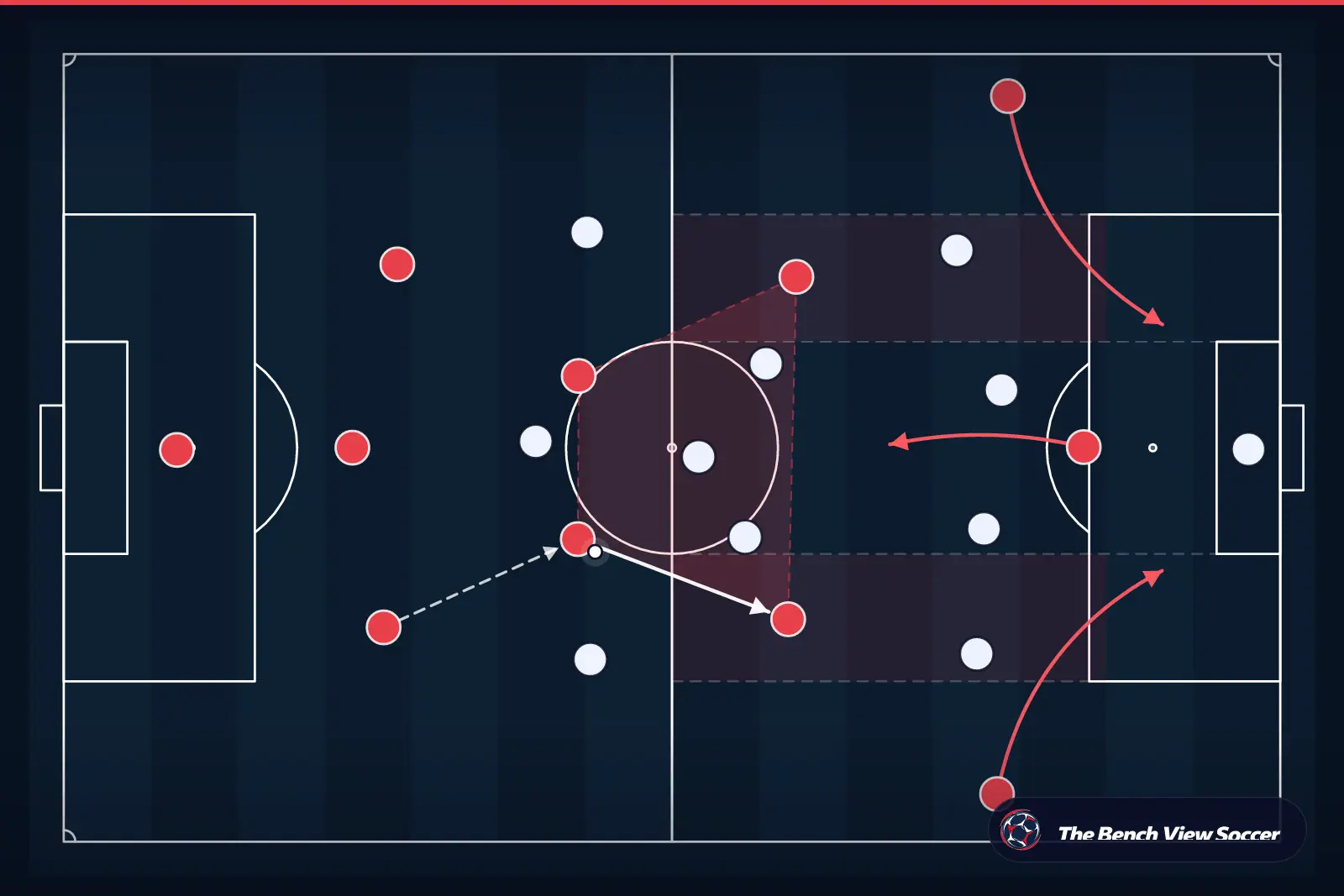
A false nine creates space through coordinated disruption of marking. In most defensive schemes, centre-backs are wired to track the opponent’s striker. When the “striker” keeps dropping into midfield, the centre-backs face three options. Option one: follow tight. This immediately stretches the back line vertically and creates a channel behind the defender’s back shoulder. If your winger stays wide and then runs diagonally into that channel, the defence becomes unbalanced. Option two: pass the false nine to a midfielder and keep the line. Now the false nine receives in the pocket (the space between midfield and defence), turns, and plays through-balls to runners. Option three: the defence compromises—one centre-back steps up while the other three try to hold the line. This creates asymmetry, which is where quick combinations hurt most. For the false nine to work, three supporting movements happen at the same time. First, “third-man runs” arrive: a pass goes into the false nine, and a teammate runs beyond to receive the next pass, beating the line without the false nine needing to dribble. Second, the wide players threaten depth: if wingers only come short, defenders are happy to squeeze up. If wingers threaten behind, the back line cannot step up as aggressively. Third, midfielders provide stability: a pivot (for example, Sergio Busquets at Barcelona) stays connected behind the ball so the team does not get countered when the striker vacates the highest zone. The false nine is therefore not a solo role; it is a trigger that makes the whole attacking structure more fluid while demanding disciplined spacing and timing.
Match Examples
The reference point is Pep Guardiola’s Barcelona in the 2008–09 and 2010–11 seasons, especially in the UEFA Champions League. In the 2009 final vs Manchester United in Rome, Lionel Messi starts centrally but repeatedly drops into midfield zones, pulling Nemanja Vidić or Rio Ferdinand into uncomfortable decisions. When United’s centre-backs hesitate, Barcelona’s wide threats and midfield runners occupy the space behind, and Messi’s ability to receive between the lines accelerates the attack. The same logic appears in the 2011 Champions League final at Wembley vs Manchester United: Messi frequently receives in front of United’s midfield line, forcing a centre-back to consider stepping out, while Pedro and David Villa attack different lanes. International football also shows why the concept travels well. Spain under Vicente del Bosque uses Cesc Fàbregas as a false nine at Euro 2012, notably in the final vs Italy, where Spain’s extra midfielder in the centre helps control possession and manipulates Italy’s defensive references. Germany under Joachim Löw uses a similar idea with players like Mario Götze at times, prioritising fluid rotations so runners from wide areas attack space behind. More recently, club football revives the role in different forms: Roberto Firmino at Liverpool under Jürgen Klopp functions as a connector who drops to link play and opens lanes for Mohamed Salah and Sadio Mané to run beyond, especially during Liverpool’s 2018–19 Champions League-winning campaign. Each example shows the same principle: the false nine is less about a “small striker” and more about forcing defenders to make impossible choices at full speed.
Related Concepts & Skills
Training Implications
To train a false nine system, you build timing, spacing, and decision-making, not just finishing. Start with a 4v4+3 rondo (four vs four with three neutrals) in a central grid: the “false nine” is one neutral who must receive on the half-turn and play a one- or two-touch layoff. Coaching point: scan before receiving and open your body so you can play forward immediately. Next, run an 8v6 “pocket-to-penetration” drill on half a pitch: the attacking team has a striker who must check into midfield before any through-ball is allowed. Wide players begin on the touchlines and are coached to hold width until the moment the false nine receives, then sprint diagonally behind the defence. Add a rule that a goal counts double if it comes from a third-man run (pass into false nine, layoff, runner in behind) to reward the right pattern. For defensive stability, add a transition condition: if the defending team wins the ball, they have 6 seconds to counter into two mini-goals. This forces your pivot and centre-backs to practise “rest defence” positioning while the false nine drops. Finally, use video and freeze-coaching in an 11v11: pause when the false nine drops and ask two questions—(1) Are the wingers threatening depth to stop the line stepping up? (2) Is there a midfielder ready to run beyond so the false nine is not isolated? If the answer is no, correct spacing on the spot: wingers higher and wider, one midfielder ready to break, pivot stays connected behind the ball.
Bunu Oyununuzda Uygulayın
Taktikleri okumak bir şeydir. Antrenman ünitelerimiz, bu kavramları gerçek maç durumlarında uygulamanız için size öğretir.