परिचय
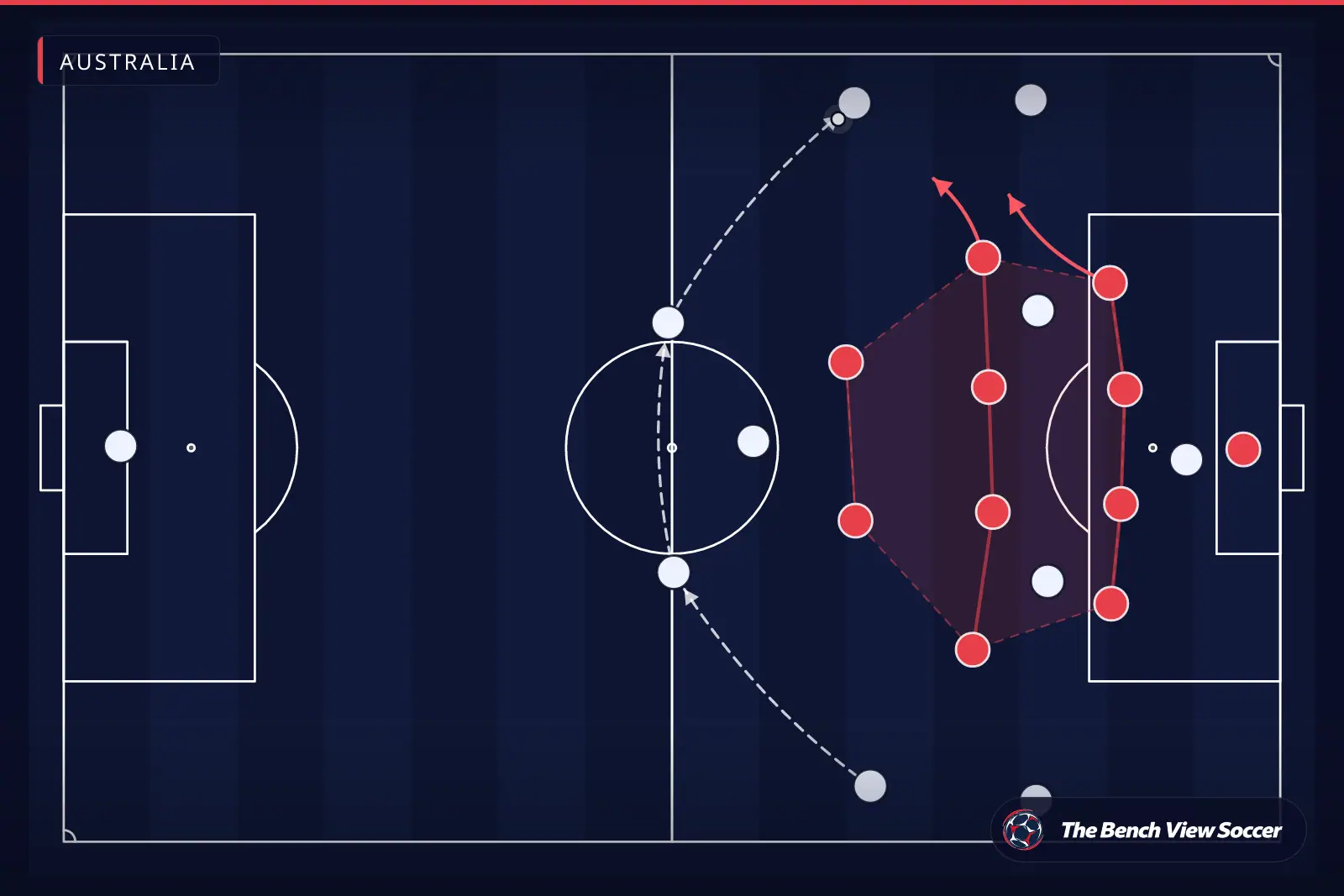
Australia’s best defensive moments rarely look spectacular—they look organised. Under Graham Arnold, the Socceroos build a रक्षात्मक ब्लॉक designed to protect the penalty area first, then attack the next ball. For Indian fans learning European tactics, think of Australia as a team that prioritises “box security”: they reduce clear शॉटिंग लाइन्स, force क्रॉस from less dangerous zones, and crowd the six-yard box to win second balls. This approach has roots in club football too—many Australian internationals play in systems influenced by the Premier League, Scottish Premiership and Serie A, where defending the box is a weekly requirement. When Australia face stronger opponents in competitions like the FIFA World Cup or AFC Asian Cup, their block becomes a tool to stay in the game and create moments on ट्रांज़िशन. The key is not just साथ बैठना; it is controlling space with घने लाइन, clear marking rules, and coordinated movement as the ball travels wide.
यह कैसे काम करता है
Australia typically defends in a medium-to-low block that resembles a 4-4-2 or a 4-5-1 depending on who steps out to press. The first principle is compactness: the back four and midfield line stay close vertically (front-to-back distance) so opponents cannot play easy passes between them. When the ball is central, the nearest midfielder or स्ट्राइकर applies controlled pressure—not to win the ball immediately, but to slow the attack and guide it wide. The wide areas are “accepted” because क्रॉस are easier to defend than थ्रू बोल. Once the ball goes to the flank, Australia’s shape shifts: the ball-side विंगर drops to help the फुल-बैक, the nearest केंद्रीय मिडफील्डर slides across to close the हाफ-स्पेस, and the far-side विंगर tucks in to protect the middle. In the box, Australia use clear reference points: केंद्रीय डिफेंडर protect the six-yard box and the near-post zone, the opposite फुल-बैक narrows in to defend cut-backs, and midfielders track runners arriving late at the edge of the area. The गोलकीपर’s role matters too: Mathew Ryan often positions slightly higher to claim floated क्रॉस and to organise the line. The block is not passive—Australia look for “प्रेसिंग मोमेंट्स” when a pass is played backwards, a receiver takes a heavy touch, or an opponent is forced to receive facing their own goal. When that happens, one player jumps to press, and the rest squeeze space behind him so the press does not open gaps.
मैच के उदाहरण
A clear example arrives in Australia’s 2022 FIFA World Cup campaign in Qatar under Graham Arnold. Against Denmark in the group stage (2022 World Cup), Australia spend long phases in a compact mid-to-low block, letting Denmark circulate in front but limiting clean access to the central channel. The विंगर drop to form a solid second line, and the central midfield stays narrow to block passes into the स्ट्राइकर’s feet. The key detail is how Australia defend the “cut-back zone” (the area around the penalty spot and edge of the box): when Denmark reach wide areas, Australian midfielders recover inside rather than chasing the ball blindly, so the most dangerous square pass is crowded out. Another strong reference point is the Round of 16 against Argentina at the 2022 World Cup. Australia defend with a disciplined block that keeps Lionel Messi away from constant central combinations, forcing Argentina to play around the outside more often than they prefer. The Socceroos’ back line stays compact, and the midfield screen focuses on blocking direct passes into the feet of forwards between the lines. Even when Argentina dominate possession, Australia’s shape repeatedly forms a “box around the box”: फुल-बैक narrow when the ball is on the far side, केंद्रीय डिफेंडर hold their line to protect the six-yard area, and midfielders track late runners—reducing the number of uncontested shots from prime locations. For a continental comparison, look at Australia’s approach in the AFC Asian Cup 2023 (played in 2024). In multiple matches, the Socceroos protect the centre early, then become aggressive only when the opponent plays into predictable wide zones. The pattern stays consistent: deny central access first, defend क्रॉस with numbers, then use the regained ball to attack quickly into space—often through direct passes into the स्ट्राइकर line rather than slow build-up.
संबंधित अवधारणाएँ & कौशल
प्रशिक्षण निहितार्थ
To coach or practise this style, start with spacing and roles. Run a 10v8 or 9v7 drill in the final third: attackers try to create a shot inside the box, while defenders score points for forcing wide passes, blocking shots, or clearing क्रॉस. Set a rule that the defending team must keep no more than 25–30 metres between the highest and deepest defender; pause the drill if the lines stretch and physically show players where to stand. Add a “ball goes wide” trigger: when the coach calls “wide,” the ball-side विंगर must drop next to the फुल-बैक within two seconds, and the near केंद्रीय मिडफील्डर must slide to the हाफ-स्पेस—this builds the automatic shift Australia rely on. For box protection, do a क्रॉसिंग-and-cut-back circuit: place a wide server, one attacker at the near post, one at the far post, and one arriving late at the edge. Defenders practise three jobs: केंद्रीय डिफेंडर protect six-yard and near-post zones, the far फुल-बैक narrows to defend the cut-back lane, and a midfielder tracks the late runner rather than watching the ball. Coach clear communication words like “near,” “screen,” and “edge.” Finally, include a ट्रांज़िशन rule: after a successful clearance, defenders have five seconds to play a forward pass into a target (simulating Australia’s quick exits). This trains the mental switch from deep defending to counter-attacking and makes the block feel purposeful rather than only reactive.
The Bench View ऐप
सिर्फ़ फ़ुटबॉल पढ़ें नहीं — ट्रेन करें
यहाँ जो कुछ आप पढ़ते हैं, उसे कदम-दर-कदम ट्रेनिंग में बदला गया है।
घर पर फ़िज़िकल ट्रेनिंग
आपके स्तर और पोज़िशन के अनुसार AI डेली सेशन। किसी उपकरण की ज़रूरत नहीं।
टैक्टिकल ट्रेनिंग कोर्स
पोज़िशनिंग, प्रेसिंग, बिल्ड-अप और निर्णय लेने पर कदम-दर-कदम कोर्स।
- 7 दिन मुफ़्त
- कोई प्रतिबद्धता नहीं
- कभी भी रद्द करें
मुफ़्त अकाउंट: 2 फ़िज़िकल सेशन + पहला टैक्टिकल कोर्स। PRO: 7 दिन का मुफ़्त ट्रायल — 8वें दिन से पहले रद्द करें और कुछ भी भुगतान न करें।