

Introduction
For many Indian fans, “full-back” still means an up-and-down runner who overlaps and crosses. But in modern European football, the position is changing fast: full-backs often invert, meaning they step inside toward central midfield when their team has the ball. This is not a fancy trend for highlight reels—it is a structural solution to two big problems: how to progress the ball through pressure, and how to create central access without losing protection against counterattacks. Brazilian players and Brazilian-influenced coaching give some of the best examples. Think of Dani Alves under Pep Guardiola at Barcelona in La Liga and the UEFA Champions League, or more recently Danilo as a tactical “inside full-back” for Pep’s Manchester City in the Premier League and Champions League. Even when these players still deliver wide, their first job in possession often becomes central: helping the team play through the middle, opening lanes for the attacking midfielders and forwards. This guide explains why teams do it, how it creates central channels, and what to look for when watching top clubs and Brazil’s national team cycles.
How It Works
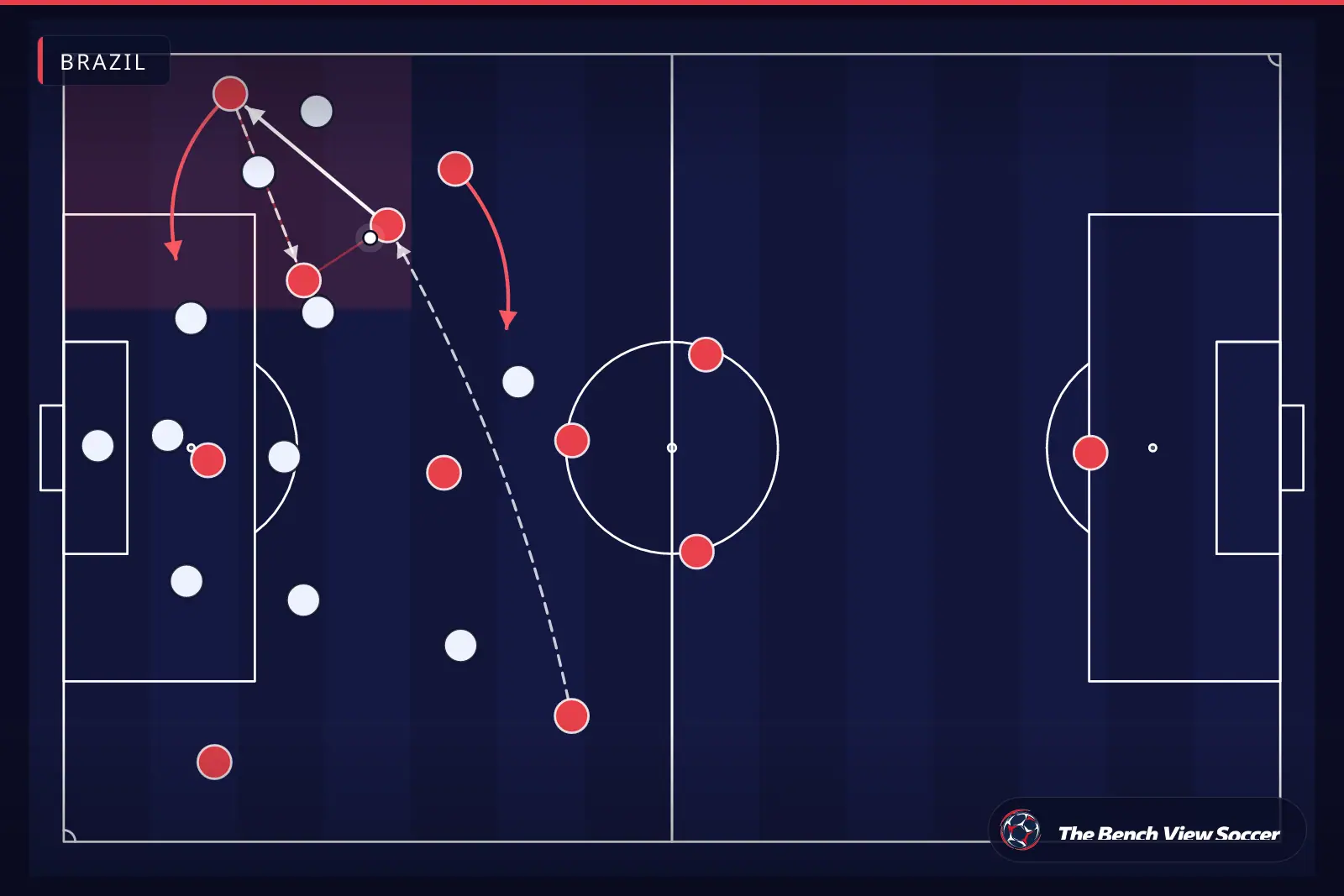
Inverting a full-back means that instead of hugging the touchline, the full-back moves into the centre—often into the space beside the defensive midfielder or just ahead of the centre-backs. The main tactical aim is to overload the midfield. When the full-back steps inside, the team often forms a “box” in midfield (two deeper players + two higher midfielders). That box gives multiple passing angles, so the ball carrier always has a short option and a forward option. It also changes the opponent’s defensive choices. If the opposition winger follows the full-back inside, the touchline becomes free for the winger to stay wide and receive. If the winger does not follow, the inverted full-back receives centrally and helps progress. How does this open central channels? Central channels are the lanes that lead into the attacking midfielders between the opponent’s midfield line and defensive line. Inverting helps in three ways. First, it pins an opposition midfielder: they must decide whether to step out and press the inverted full-back, which can open a pocket behind them. Second, it stabilises the “rest defence” (the players positioned to stop counters). With the full-back inside, the team can keep three or four players behind the ball even while attacking, reducing counterattacks—crucial in leagues like the Premier League where transitions are fast. Third, it creates better “third-man” patterns: the centre-back plays into the inverted full-back, who sets the ball to a midfielder facing forward, who then finds the striker or a runner. Brazilian full-backs who understand timing and body orientation—receiving on the half-turn and playing quickly—make this mechanism look smooth.
Match Examples
1) Barcelona under Pep Guardiola (2008–09 UEFA Champions League): Dani Alves often starts wide but moves inside depending on Lionel Messi’s position and the opponent’s press. In the 2009 UEFA Champions League Final vs Manchester United in Rome, Barcelona’s midfield control is the headline, but Alves’ positioning supports it: when United’s wide players hesitate to track him inside, Barcelona maintain central superiority and keep recycling attacks through Xavi and Andrés Iniesta. The key learning for fans: Alves does not invert every second—he chooses moments when the ball is secure and when the central lane into Messi or Iniesta becomes available. 2) Manchester City under Pep Guardiola (2022–23 season, Premier League and UEFA Champions League): Danilo plays the “inside full-back” role frequently, especially when City build from the back. In the 2023 UEFA Champions League Final vs Inter (played in the 2022–23 season), City often construct attacks with a back line that becomes three in build-up and a midfield box ahead. Danilo’s movement inside helps City keep control against Inter’s compact shape and prepares the counter-press (immediate pressure after losing the ball). Notice how City’s wide players stay wide to stretch Inter while the inverted full-back and Rodri occupy central zones to keep passing routes open. 3) Arsenal under Mikel Arteta (2022–23 Premier League): Gabriel Magalhães (Brazil) is a centre-back rather than a full-back, but his role helps you understand why inverting exists. Arsenal frequently use Oleksandr Zinchenko to invert into midfield, and Gabriel’s job is to cover the space left behind. Watch Arsenal vs Manchester City (Premier League 2022–23) and observe how the left-side structure changes: the inverted full-back’s central position demands the left centre-back to defend wider zones in transition. The Brazilian angle here is important for India-based learners: Brazilian defenders increasingly train to defend open grass, because inversion changes the defensive map. 4) Brazil national team context (Copa América cycles and World Cup preparation years): In multiple Brazil squads across the 2010s and early 2020s, coaches select full-backs like Danilo for tactical balance, not only for crossing volume. When Brazil face strong transition teams, the full-back’s inside positioning helps protect against counters and helps Brazil access central creators. The match-to-match instruction varies by coach, but the pattern is consistent: control the middle, then release wide attackers at the right time.
Related Concepts & Skills
Training Implications
If you are a coach, academy player, or even a serious watcher trying to understand the role, you can train inversion with simple, repeatable tasks. 1) Build-up pattern drill (15–20 minutes): Set up a 6v4 in two thirds of a pitch. Back line: two centre-backs, goalkeeper, and two full-backs. Midfield: one defensive midfielder. The rule: one full-back must invert into midfield before the team can pass into the attacking zone. Coach the inverted full-back to scan over both shoulders before receiving and to open their body to play forward. Progression: add a striker and allow the opposition to counter into mini-goals to teach rest defence. 2) Third-man combination circuit (10–15 minutes): Create three stations: centre-back (A), inverted full-back (B), and midfielder/10 (C). Practice A→B→C with one-touch from B, then C plays a through ball to a runner. Rotate roles so full-backs learn to be the “bounce” player and midfielders learn to receive on the half-turn. Add passive defenders, then active defenders, so players learn when the inverted lane is blocked and when to switch wide. 3) Transition protection game (20 minutes): Play 8v8 with a rule: whenever a team attacks, at least two players plus the inverted full-back must stay connected behind the ball (a rest defence line). If the attacking team loses the ball and concedes within 8 seconds, they lose an extra point. This forces realistic decision-making: invert when the ball is secure, and do not vacate both flanks at the same time. 4) Video homework for players: Pick one match clip of Manchester City (Guardiola) or Arsenal (Arteta) and freeze-frame every time the full-back steps inside. Ask three questions: What triggers the movement (centre-back has time, winger holds width, opponent presses)? Where is the defensive midfielder? Who covers the wide space if possession is lost? This builds tactical awareness, not just fitness.
Bunu Oyununuzda Uygulayın
Taktikleri okumak bir şeydir. Antrenman ünitelerimiz, bu kavramları gerçek maç durumlarında uygulamanız için size öğretir.