

The moment and the thesis
Argentina are celebrating progression to the World Cup 2026 final, and the hot-take economy will sprint toward the usual headlines: Lionel Messi’s latest last dance, Emiliano Martínez’s aura, another Scaloni masterclass. But the performance truth sits a layer deeper. Tactically speaking, the real story is how Argentina’s box midfield — a rotating square in the center that flexes between a 3-2 and 2-2 construction — has freed Messi to be a pure free 10 without bankrupting the team’s defensive balance. That structural choice, more than any single spark, is the reason Argentina can control games for 60–70 minutes and tilt the pitch toward inevitable moments of Messi-led incision.
In our view, this isn’t a cosmetic tweak. It’s a foundational bet on positional superiority: consolidate the center, layer the half-spaces, and manufacture third-man runs that repeatedly move defenses onto the back foot. It’s the same logic that elevated Argentina from survival mode in 2022 to superiority mode in 2026 — and it holds up under pressure because it stabilizes the two phases that decide tournaments: build-up under a press and rest-defense in transition.
Analytically, Argentina’s rotating box has done two jobs at once: it purchases Messi maximal freedom between the lines while over-insuring the team’s rest-defense behind the ball. That double dividend is why they’re in the World Cup final.
The shape: Argentina’s rotating box, explained
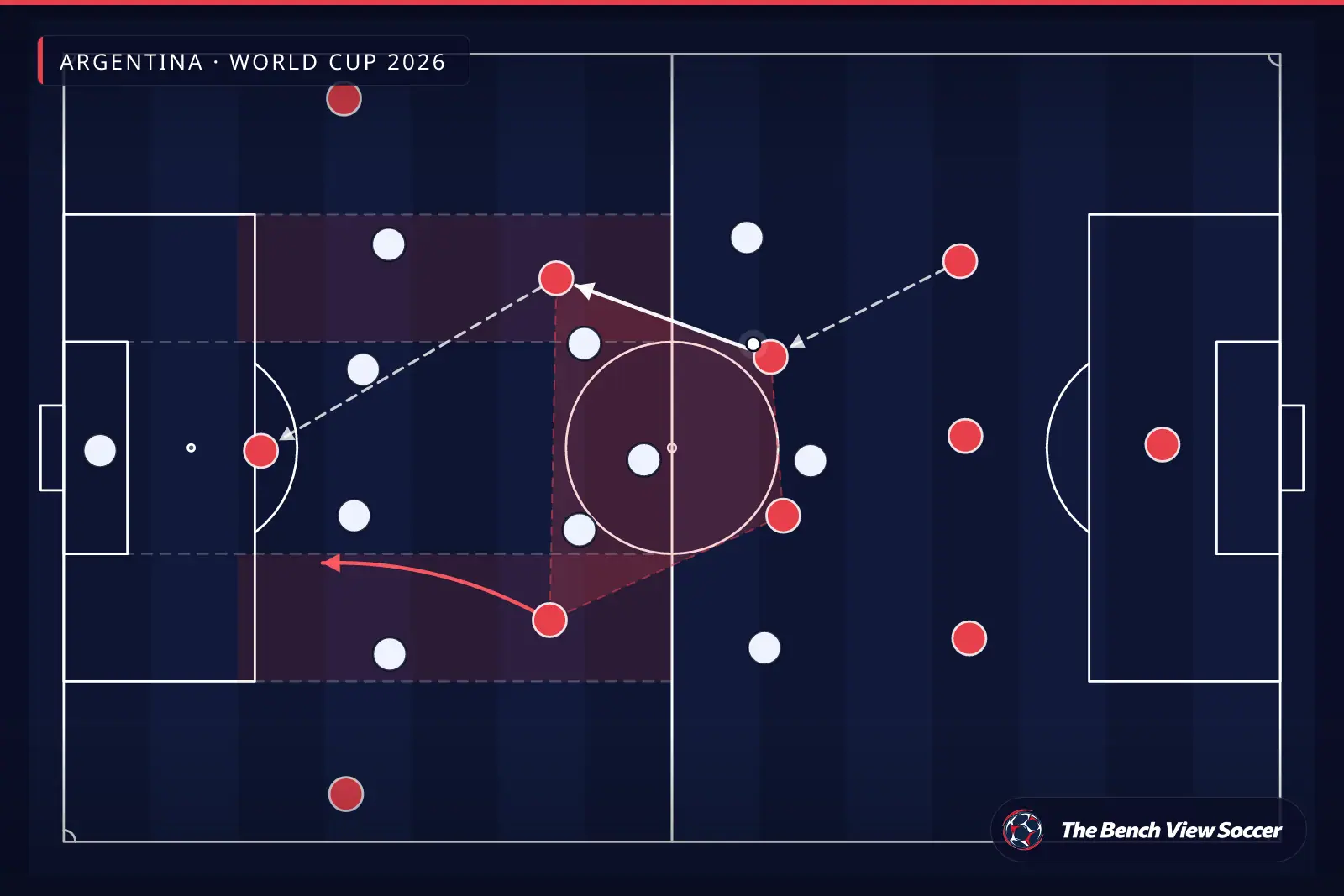
At first glance Argentina look familiar: a back four, Messi floating to the right interior, a striker who can press and run (often Julián Álvarez or Lautaro Martínez), and two hard-running eights. But watch the occupation of zones rather than the numbers on the lineup graphic, and the logic snaps into focus. Argentina engineer a central box midfield in possession by tucking one full-back inside (often the right-back stepping in as a situational pivot) to stand alongside the deepest midfielder. Ahead of them, two advanced interiors stagger in the half-spaces. The wide players then pin the back line and leave Messi free to hunt the seam where the defensive midfielder hesitates to jump.
Functionally, that’s a 3-2-5 or 2-3-5 in the first and second phases, then a 2-2-6 in sustained final-third pressure when the weak-side full-back underlaps. But the non-negotiable is the square in the center: two behind the ball, two between the lines. The box acts like a tactical airlock — pressure comes in, is absorbed and redirected, and exits as an angle that breaks a line.
Build-up: from 4-3-3 shell to 3-2-5 superiority
Argentina’s first trick is to make the first pass calm. When opponents press with two forwards, the goalkeeper and center-backs form the initial diamond, and the inverted full-back slides alongside the six to create a double pivot. This rebalances the press: if the opposition’s near winger tucks in to track the pivot, Argentina release the full width to the far side. If he stays high, the progressive pass into the six is on — and because the six already has a partner alongside, the first receiver never stands alone on an island.
That is the peace dividend of the box: the first vertical ball has an exit route even under heat. When the forward line cannot over-commit to both pivots, Messi can drop five meters into the right half-space, receive on the half-turn, and convert that calm into an immediate carry or wall-pass. The structure manufactures a spare man by design — and because the spare is Messi, the payoff is disproportionate.
Occupying the five lanes with intent
When Argentina settle, they reliably fill all five lanes: left wing, left half-space, center, right half-space, right wing. The detail that matters is where the pace arrives. If Lautaro stretches the last line centrally, one of the interiors (often the right interior) pins the near-side center-back by threatening a run beyond. This clears the shallow zone for Messi to show between the lines. The ball arrives late to the winger on the far side as an end product, not as a starting cue — a crucial reversal from the overly wing-centric patterns that once made Argentina predictable.
In this phase, the underlap has been as valuable as the overlap. By asking the weak-side full-back to slide inside the channel rather than ride the touchline, Argentina keep the wide center-back honest and prevent double-teams on Messi. That underlap is rarely the final pass; it’s the unglamorous decoy that freezes the help defender, buying Messi an extra touch or allowing Álvarez to spin inside the box.
Third-man runs: the lever that opens the press
The world knows the Messi-to-runner timeline — fix a defender with the dribble, release at the last second. But the reason it still works is Argentina’s insistence on third-man runs. The first receiver isn’t trying to play forward immediately; he’s often creating a wall-pass that beats not one but two lines. Example sequence type: center-back into inverted full-back; bounce into Messi; third-man dart from Álvarez beyond the blind shoulder. The defense’s trigger-happy pressers have jumped into a cul-de-sac, and the next frame is a cut-back chaos moment. The identity of the runner can change — sometimes the near eight, sometimes the weak-side winger flashing across — but the principle remains: one to draw, one to bounce, one to burst.
Pressing and rest-defense: the other half of the bargain
If freeing Messi was the only goal, many teams would simply suffer a broken block and gamble on outscoring. Argentina don’t. Their structure in possession is explicitly designed to pre-press the counter. When the ball is lost, the two at the base of the box and the near-side full-back immediately snap shut the middle, denying the most valuable transition lanes. It’s a preloaded rest-defense that reduces the need for emergency defending.
Pressing triggers: controlled heat, not chaos
Argentina rarely press for the badge; they press off triggers. Common ones in this tournament: a backward touch to a full-back facing his own goal; a square pass inside the opponent’s first line; and a miscontrolled aerial ball into midfield. The pressing shape is often a 4-4-2 with Messi forming the front two in shadow more than in sprints. Álvarez or Lautaro goes, Messi blocks the six, and the near winger squeezes in to intercept the inside lane. The aim is not to win the ball at the touchline; it’s to funnel the opponent into a pre-set trap in the interior, where Argentina’s square gives them two men to swarm the single pivot.
This matters for the final because late-tournament games get decided by who can control the type of turnover, not just the count. Argentina’s triggers are designed to create live-ball steals in the middle third — where one pass finds Messi already goal-facing — rather than scrambles wide, where chances turn into low-value crosses.
Why transitions look calmer
Personnel profiles help. Cristian Romero attacks aerials early; the far center-back holds a deeper starting position, deterring the first ball over the top. The inverted full-back is already in the corridor to contest the second ball. And because the two advanced interiors are staggered, one is always close enough to foul early if needed. The overall effect is optical as much as statistical: opponents get the feeling they must produce something perfect to escape — which in knockout football is often a psychological checkmate.
Messi 2026: the free 10 with economy of effort
At 39, Messi cannot be the pressing reference. He doesn’t need to be. In Argentina’s model, he’s the reference once the ball is stabilized. The free 10 role in this side is less about roaming and more about controlled gravity. He shows at predictable intervals in the right half-space, offering a diamond for the recycled possession to step forward. The predictability is a feature, not a bug, because it scaffolds the runs around him: Álvarez knows when to dart behind; the near interior knows when to hook a run outside to decoy the full-back; the winger knows when to delay on the far side to attack the back post later.
Tactically speaking, the economy is twofold. First, Messi’s touches come with opponents already stretched horizontally by the five-lane occupation. Second, his carries begin with a passing triangle constructed behind him — the inverted full-back and right interior ensure that a failed dribble doesn’t become an immediate transition against an empty middle. It’s the classic “insurance dribble”: freedom on the front foot, a blanket behind.
The set-piece layer is subtle but relevant. Rather than forcing Messi to contest the first contact zones, Argentina have optimized him for the second-action zone at the edge of the box. That allows them to lever his delivery and rebound finishing without asking him to wrestle in aerial duels. It’s another micro-efficiency in a tactical plan built around conserving his sharpest edges for the moments that matter.
What’s new versus 2014–2022
Argentina have flirted with versions of this story before. In 2014, they had a strong central spine and a front three built to spring transitions, but their positional play lacked the interior variety to live high up the pitch for long stretches. In the early Scaloni era, the Copa América 2021 team found defensive steel and a nasty set-piece edge, yet the non-Messi chance creation still leaned on wide-to-inside patterns that were easier to crowd out.
By 2022, Scaloni had evolved into a mid-block-and-burst posture. It was decisive and effective; the team took control of game states and found a rhythm in quick switches and punishing counters. But the 2026 shift is bolder: Argentina now seek to dominate the middle in slow possession and force opponents to suffer without the ball in their own third. The rotating box is the difference. It’s a structural embrace of interior overwhelm — not just being safe there, but being superior there.
Personnel and profile upgrades
This blueprint requires three things: a full-back who can pass in traffic, a six who can play as a lone anchor when the other pivot roams, and interiors whose first instinct is to receive between lines under pressure. Argentina have leaned into that profile set. The knock-on effect is that the striker can play as a pressure forward — sprinting to impede build-outs — or as a wall-pass nine, depending on the opponent. That flexibility kept opponents guessing all tournament.
England–France: the third-place game nobody wants — and the lab both teams need
England and France enter a third-place playoff that invites rotation and reduced emotional stakes. Traditionally, that turns into a loose exchange. But in our view, this is a live-fire laboratory. England’s staff can test-drive solutions to two problems that haunted their tournament: spacing around Harry Kane’s drops and how Jude Bellingham’s hybrid eight/ten role fits with a true winger on either side. France, meanwhile, can experiment with full-back heights and whether a narrower front three produces cleaner entries against a mid-block.
England’s box midfield trap: use the square to fix the Kane conundrum
When Kane drops, England often look elegant outside the box and toothless inside it. The antidote is a version of Argentina’s box — not to mimic the champions-elect, but to solve a structural math problem. If Kane comes short into the ten space, England must instantly create a new “nine” via a third-man run from the far interior or winger. A stable double pivot behind that movement guarantees the ball can be bounced into Bellingham or out to a winger on the move without exposing the counter. In other words, pre-assign the run that Kane’s drop requires, and protect it with the back of the square.
Practically, that means one full-back inverting into midfield and the other holding width to pin the far-side full-back. If Bellingham starts left interior, cue the right winger to knife across the line when Kane takes two steps toward the ball. The first pass may not find the runner; it rarely does. But it forces the center-backs to split responsibilities, producing the very hesitation England struggled to generate against compact blocks.
France’s full-backs and the high-line paradox
France’s high line can look unbeatable until a single off-timed step cracks the picture. The semi’s lesson was not that high lines fail; it’s that they demand synchronized triggers from the full-backs. The third-place game is a place to test a narrower back four in settled possession — tucking a full-back in earlier to guard the inside channel, making the press more of a 4-2-2-2 for central access. This yields quicker verticals to a front three who can then attack the second line on the half-turn rather than receiving pinned wide with two to beat.
France also have a choice to make about the role of their nominal right winger: hug the touchline to stretch or step inside early to form the top of a box with the ten. Against England’s double pivot, the latter may be smarter — especially if it coaxes England’s full-back to follow inside, opening grass for a delayed overlap and a pull-back that France have oddly underused.
The tournament-wide trend: half-space creators dictating terms
If one theme defines World Cup 2026 beyond Argentina’s mastery, it’s the supremacy of half-space creators. We’ve watched Lamine Yamal terrorize high lines with diagonal runs from the right interior channel — the earliest touch triggering a whole back four to swivel — and Jude Bellingham’s left half-space craft forcing defenses to pick a poison: step and get spun, or sit and concede progressive carries. This tournament has been a living clinic in how the half-space unlocks both width and depth with one action.
Why now? The meta has shifted. Teams are braver at building with an extra man in the first line (goalkeeper plus center-backs), and presses respond by committing a winger inside. That creates yawning gaps if the ball is punched through cleanly. The half-space creator sits in that vacuum. Give him one decoy run and one safety valve, and a defense that wants to be narrow is suddenly stretched diagonally. It’s the death by angle change, and 2026 has been a semester of it.
How high lines got punished
High lines were not exposed because they were high; they were exposed because they were lonely. When the distances between the back four and the next line ballooned, the best teams attacked the seam in front of the center-backs, not just the space behind them. That’s why the classic through-ball over the top shared billing with slide-rule passes into the channel for a cut-back. Argentina embodied this double-threat. So did Spain through Yamal’s gravity, and England in flashes when Bellingham and Kane timed the pendulum run-drop choreography.
Cause and effect: why Argentina’s approach travels
Scaloni’s plan doesn’t depend on one opponent type. Against mid-blocks, the box ensures patient progressions through the center without telegraphing wing overloads. Against high presses, the double pivot and adjacent support triangles make it difficult to trap the six. Against low blocks, the two advanced interiors give constant wall-pass options around the D, and the underlapping full-back keeps the center-backs from two-v-oneing Messi. It is not slick for slick’s sake; it is specific superiority in the zones that matter.
The effect is statistical and psychological. Opponents see less of the ball in stable spells, and when they do, they feel suffocated by Argentina’s ability to recover the second ball. The mind game kicks in: full-backs hesitate to jump, sixes check their shoulder before turning, center-backs delay the offside step — all micro-delays that make Messi’s slow-time reads lethal again.
Looking ahead: what this means for the final — and beyond
Two primary final scenarios beckon. The first is a possession-heavy opponent with strong counters (the Spain archetype). Here, Argentina’s double pivot must be clean under pressure; the inverted full-back cannot afford a turnover in the center circle. Expect even more deliberate occupation of the five lanes to widen the central seam and isolate Messi’s receiver. The winger on the far side becomes decisive, not for crossing volume but for the late-arrival finishes Argentina have timed so well this month.
The second is a transition monster (the France archetype over the last cycle, though they’re in the playoff here). In that case, Scaloni’s risk posture will matter. We would anticipate a slightly lower rest-defense line, with Romero less aggressive on early challenges and the near-side interior tasked with delaying counters rather than winning them. Expect the striker to do more honest work channeling build-outs toward the touchline — the kind of staple Álvarez performs quietly but expertly — with the pay-off arriving in minute 65 onward as fatigue stretches opponent compactness.
Bigger picture, the box midfield will outlive this tournament. Argentina are laying down a template for the Messi afterlife, too. Even when he’s no longer starting every knockout, the structure’s logic remains: dominate the center, protect transitions, empower the half-space creator — whether that’s a classic ten, a hybrid eight, or a winger who steps inside. It is the skeleton key for an era where the best defenders are taught to deny the wings and the best attackers still win games inside.
The counterargument — and our reply
There’s a fair pushback: Argentina’s path has included opponents who underperformed in key phases; the knockout margins were managed as much by tournament guile as by structural genius. In this view, the box midfield’s neatness flatters to deceive: against a top-tier counter or a super-aggressive press, the inverted full-back can be stranded, the six can be suffocated, and Messi’s freedom can turn into a hole out of possession.
We take the point, but tactically speaking the concern is more about execution than concept. The rotating box doesn’t promise immunity; it promises layers. When the six is marked, the other pivot can drop between the center-backs to re-draw the diamond. When the inverted full-back is trapped, the near interior can step down to re-form the square a line deeper. And when Messi’s zone is denied, the weak-side underlap pulls the spare defender across, reopening the lane two passes later. That’s the heart of it: the structure has built-in self-correction. It might bend under a storm, but it doesn’t snap.
The England–France takeaway for the elite tier
This playoff, often a shrug in schedule form, is a meaningful footnote for Europe’s heavyweights. England’s staff can validate whether a more formal interior square liberates Bellingham without neutering Kane’s penalty-box threat. France can stress-test a tighter back four and a front three that exchanges zones earlier to stop living in predictable channels. Both can leave with answers that matter in 2028 and beyond — because Argentina have raised the tactical bar, and the chasers must now prove they can own the middle, not just survive it.
Verdict
Strip away the romance and the memes and you land here: Argentina are in the World Cup 2026 final because they’ve modernized around their greatest ever. The box midfield is not a vanity mirror for Messi; it’s a winner’s machine that does two jobs: it grants him pure creative agency in the half-spaces and it short-circuits the counterattacks that used to terrify this team. That double function is the competitive edge. If the final tightens, expect the same mechanism to decide it: patient central progressions, a third-man burst, a cut-back or a disguised reverse from the right interior lane. It is the most repeatable pattern in the tournament — and repeatable patterns win finals.
Tactically speaking, that’s the story to take with you into the last whistle and beyond. Argentina have built a system that makes the extraordinary look inevitable. In tournament football, there is no bigger compliment.
The Bench View app
Don’t just read football — train it
Everything you read here, turned into training you can follow step by step.
Physical training at home
AI daily sessions adapted to your level and position. No equipment needed.
Tactical training courses
Step-by-step courses on positioning, pressing, build-up and decision making.
- 7 days free
- No commitment
- Cancel anytime
Free account: 2 physical sessions + the first tactical course. PRO: 7-day free trial — cancel before day 8 and you pay nothing.
More Analysis
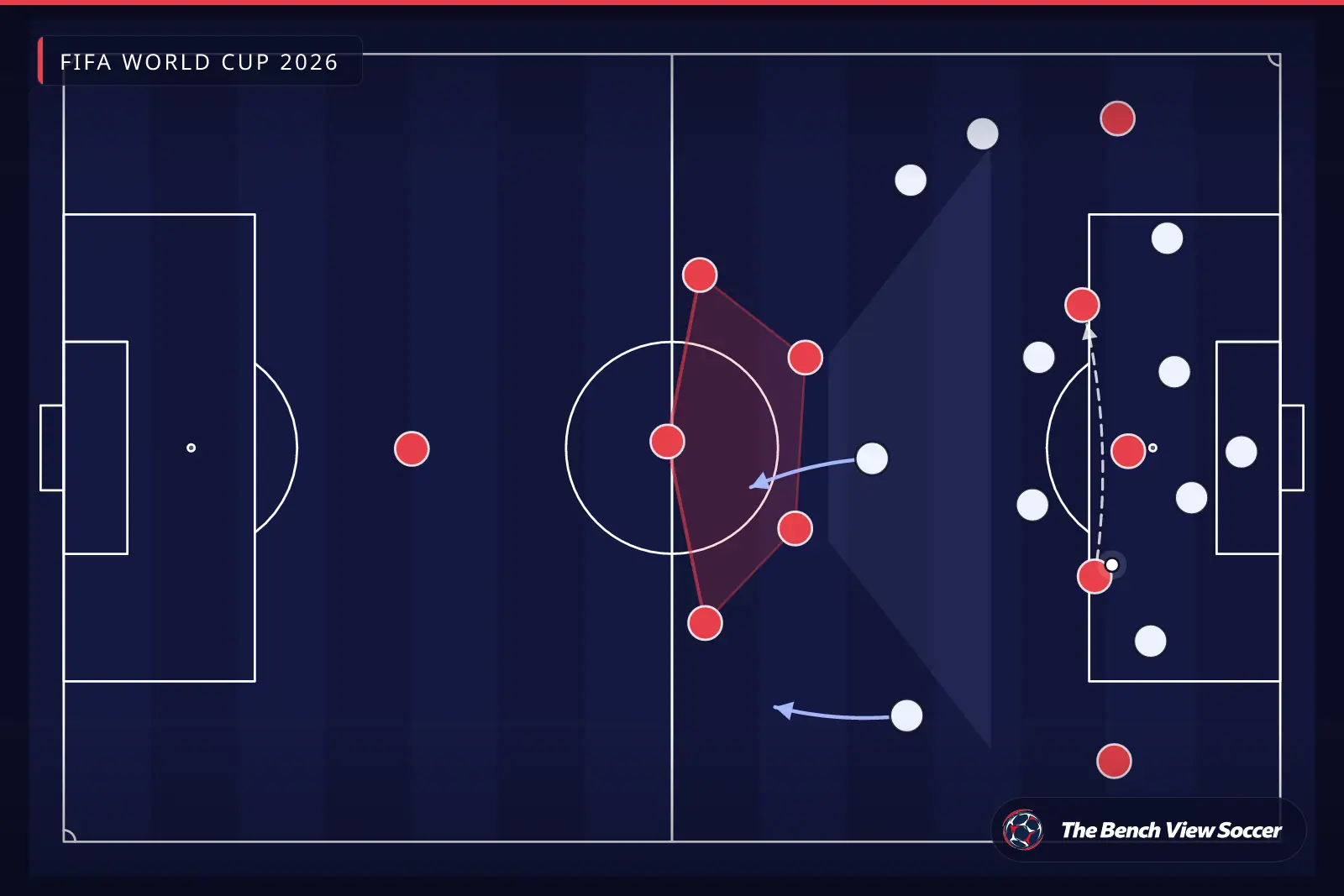
World Cup 2026: How Box Midfields and Back Threes Won Control
July 31, 2026
England 2026: How the Box Midfield Won World Cup Territory
July 26, 2026
England's Rest-Defense Gap at World Cup 2026: Ghana's VAR Scare
June 24, 2026
Netherlands' Diagonal Cutbacks Are Fueling World Cup 2026's Goal Boom
June 21, 2026