Introduction
Arsenal under Mikel Arteta build their identity around controlling space without the ball, and their high press is one of the clearest expressions of that. For fans watching Premier League and UEFA Champions League nights, it can look like “everyone runs at the goalkeeper,” but the best pressing sides are organised: they press in specific zones, wait for specific triggers, and set traps that force predictable passes. Arsenal’s press is especially interesting because it is both aggressive and structured—more like a net than a swarm. The aim is not only to win the ball high, but also to keep the opponent boxed in so Arsenal can attack quickly with short distances between players. This article breaks down how Arsenal’s high press works: who initiates it, what cues start it, where on the pitch it becomes most dangerous, and—equally important—how smart opposition teams can beat it through positioning, rotations, and brave passing.
How It Works
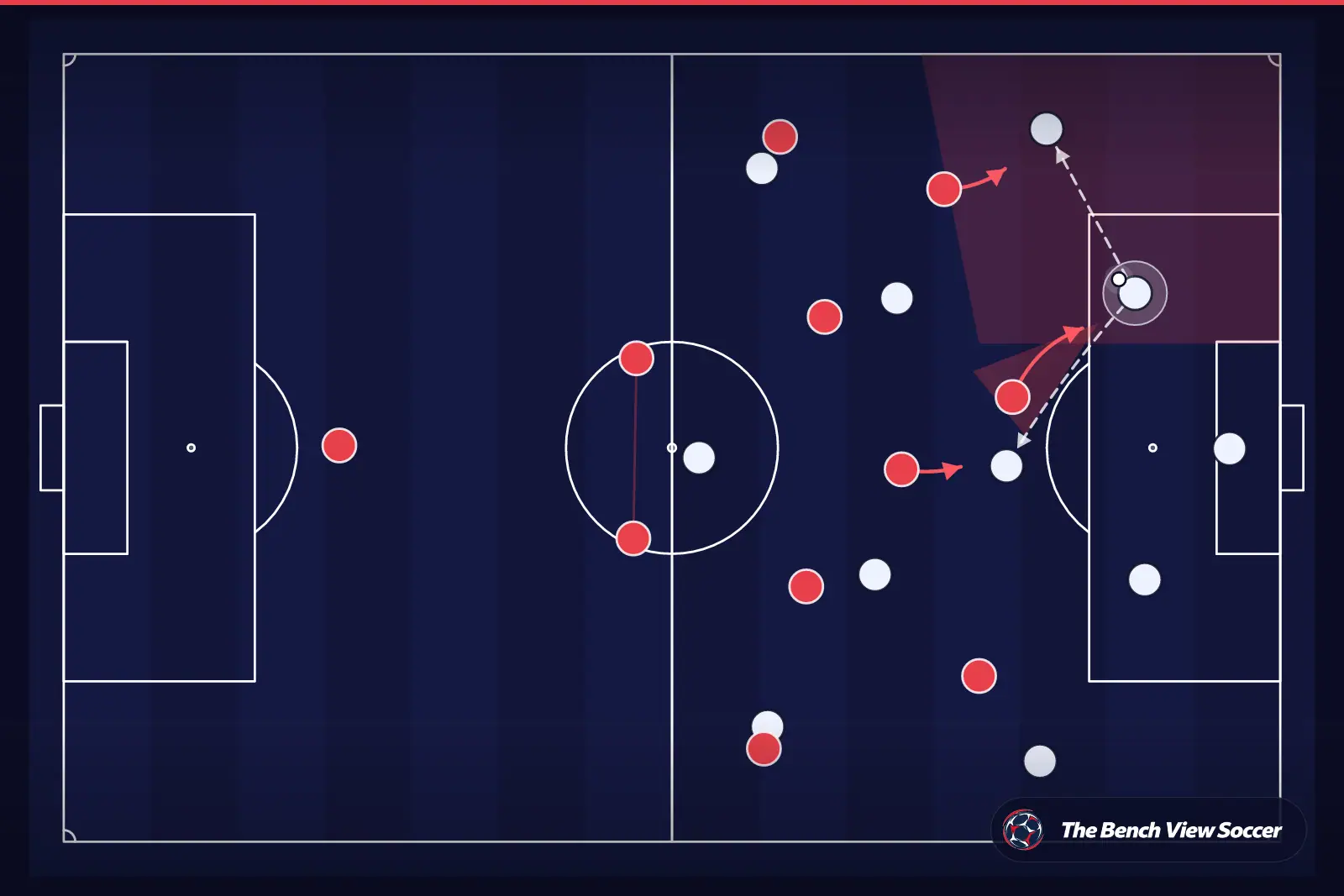
Arsenal’s high press usually begins from a compact 4-3-3 or 4-4-2 shape, depending on who steps up alongside the striker. The first job of the front line is not to tackle; it is to “show” the ball towards a chosen area. The central striker (often Gabriel Jesus or Kai Havertz) curves his run to block the pass into the opposition’s deepest midfielder, forcing play wide. The wingers then jump to press the full-back, but they press with an angle that blocks the line down the wing and funnels the ball inside into Arsenal’s midfield trap. Behind them, Martin Ødegaard leads the press like a conductor: he steps out to close the near-side central midfielder and points teammates into positions. Arsenal’s back line holds a high defensive line to squeeze space; William Saliba and Gabriel Magalhães defend large areas behind them and are ready to attack long balls. The most common pressing triggers include: a backwards pass to a centre-back, a slow or bouncing pass into a full-back, the goalkeeper receiving under pressure, or a midfielder receiving with his back to goal. When a trigger appears, Arsenal press in a coordinated “jump,” with the nearest player engaging the ball and others marking the next pass options. The key zone is often the wide channel just outside the opponent’s box: Arsenal aim to force a rushed pass there, win it, and immediately create a chance through cut-backs or quick combinations around the box.
Match Examples
A strong reference point is Arsenal vs Manchester City in the Premier League at the Emirates in 2023/24 (1-0). Against Pep Guardiola, Arsenal do not press blindly for 90 minutes; they choose moments. When City play into the full-back or the nearest central midfielder under pressure, Arsenal’s front line curves runs to block the “easy” return pass inside, and Ødegaard steps up to lock the near midfielder. The press becomes most intense after sideways passes across City’s back line, which act as a trigger for Arsenal to jump and compress space. Another useful example is Arsenal vs Liverpool in the Premier League at the Emirates in 2023/24 (3-1). When Liverpool try to build short, Arsenal’s first line forces play towards the touchline, and the near-side midfielder supports to create a 2v1. Arsenal also exploit poor body shape: when a Liverpool defender receives facing his own goal, Arsenal step up together, forcing hurried clearances and second-ball fights that Arsenal’s midfield is positioned to win. To understand how teams can beat the press, watch Bayern Munich vs Arsenal in the UEFA Champions League quarter-final second leg in 2023/24 at the Allianz Arena (1-0). Bayern create calmer exits by using rotations and quick support around the ball; when Arsenal jump, Bayern play first-time passes into the free man and then go long into the channel before Arsenal can reset. The lesson from these matches is that Arsenal’s press is at its best when the opponent’s spacing is poor and passes are slow, and it is most vulnerable when the opponent creates clear “third-man” options—passing to one player who then lays it off to a teammate running free.
Related Concepts & Skills
Training Implications
To train an Arsenal-style high press, start with clear roles and simple rules before adding complexity. First, run a 6v6+2 possession game in a 35x25m area: the two neutral players act as opposition midfielders, and the defending team scores a point by forcing the ball wide and winning it within five seconds. Coach the “pressing angle”: the nearest forward closes the ball carrier while blocking the inside pass. Second, add a trigger rule: the defending team is only allowed to press at full intensity when the ball goes backwards or when a player receives facing his own goal. This builds discipline so players do not sprint randomly. Third, use a channel-based trap drill: mark two wide corridors; the defending team is rewarded when they win the ball in those corridors, teaching them to funnel play wide rather than chase the ball centrally. Fourth, train the back line with a high line + recovery run exercise: defenders start on the halfway line, the coach plays a “long ball,” and defenders must decide whether to step up and compress or turn and sprint—this links directly to pressing because the high line is what makes the press feel suffocating. Finally, include communication constraints: assign one leader (like Ødegaard’s role) who must call the trigger (“back,” “bad touch,” “wide”) and the rest react. This creates shared understanding, which is the difference between a press that looks energetic and a press that actually wins the ball and creates chances.
The Bench View app
Don’t just read football — train it
Everything you read here, turned into training you can follow step by step.
Physical training at home
AI daily sessions adapted to your level and position. No equipment needed.
Tactical training courses
Step-by-step courses on positioning, pressing, build-up and decision making.
- 7 days free
- No commitment
- Cancel anytime
Free account: 2 physical sessions + the first tactical course. PRO: 7-day free trial — cancel before day 8 and you pay nothing.