Introduction
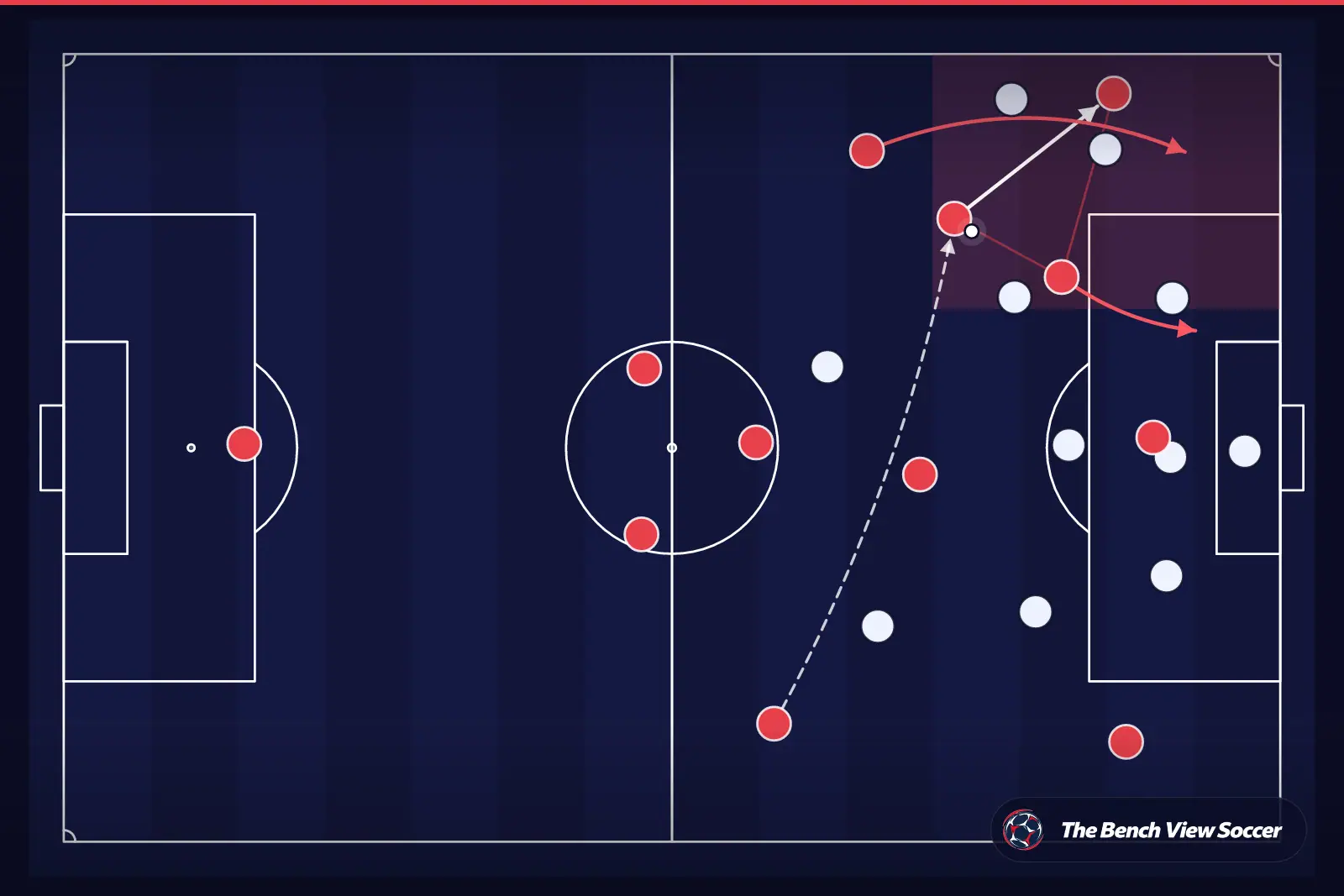
Manchester City under Pep Guardiola consistently build attacks by “overloading” one side of the pitch, especially the right flank. An overload simply means City place more players than the opponent in a small zone, so they can keep the ball, create passing triangles, and force defenders into difficult choices. For fans watching the Premier League or the UEFA Champions League, this is one of the clearest patterns to spot: City circulate the ball patiently, then suddenly create a 3v2 or 4v3 on the right with quick, short passes. The goal is not always to cross immediately. Often, the real target is to drag the opposition across, open space in the middle, and then play a “cutback” or a pass into the box from a better angle. Understanding City’s right-side overloads helps you read why players like Kevin De Bruyne, Bernardo Silva, John Stones, and the right winger (often Riyad Mahrez previously, now frequently Phil Foden or Bernardo) keep appearing in the same zones and why the opponent’s left-back often looks overwhelmed.
How It Works
City’s right-flank overload works because of roles and distances, not just individual skill. In many Guardiola setups, the right-back does not behave like a traditional full-back who hugs the touchline and crosses. Instead, City often ask the right-back to “invert,” meaning he steps inside toward midfield during possession. When John Stones plays the hybrid role in 2022–23, he moves into midfield next to Rodri, creating a stable base so the right side can push higher. Ahead of him, Bernardo Silva frequently comes inside from the right, while Kevin De Bruyne positions himself in the right half-space (the channel between the wing and the center). The winger can stay wide to pin the opponent’s left-back, or he can come inside to combine, depending on the opponent’s defensive shape. The striker (Erling Haaland in recent seasons) pins the center-backs, while the far-side winger holds width to prevent the defense from shifting too aggressively. The mechanics are simple to visualize. City create a triangle on the right: a deeper passer (Stones/Walker), a connector (Bernardo), and a penetrator (De Bruyne). If the opponent presses, City use a “third-man run”: Player A passes to Player B, but Player C is the one who benefits because B’s one-touch layoff breaks the pressure. If the opponent sits deep, City patiently recycle until the left-sided defenders are lured over, then De Bruyne slips a pass behind the left-back, or Bernardo dribbles inside to provoke a foul or force a central defender to step out. The end product is often a low cross or cutback to the penalty spot, which is harder to defend than a hopeful high cross.
Match Examples
A clear reference point is the 2022–23 UEFA Champions League semi-final second leg: Manchester City vs Real Madrid at the Etihad, managed by Pep Guardiola and Carlo Ancelotti. City repeatedly build down the right with Stones stepping into midfield, Bernardo Silva and De Bruyne combining, and Madrid’s left side (often Eduardo Camavinga at left-back) being asked to defend both wide threats and inside movements. City’s first goal comes from sustained pressure that keeps Madrid’s block shifting; the right-side occupation helps City win territory and attack the box with better angles. Even when the final action is not a “classic right-wing cross,” the overload ensures Madrid are constantly reacting rather than controlling. Another example appears in the 2020–21 Premier League when City frequently use Kyle Walker as a secure outlet on the right, with Riyad Mahrez holding width and De Bruyne or Bernardo operating inside. Against teams that defend in a compact 4-4-2 low block—common in the league—City’s right overload pulls the opponent’s left midfielder narrow, creating a dilemma: if the winger tracks Walker/Mahrez, the half-space opens for De Bruyne; if the winger stays inside, City access the wing and progress up the touchline. This pattern shows up repeatedly across that title-winning season, especially in matches where City dominate possession and need structured ways to create chances. A third modern reference is the 2023–24 Premier League run-in, where City often use Bernardo Silva and Phil Foden to rotate on the right. When the opponent’s left-back steps out to press, City immediately look for the ball into the channel behind him, with Haaland pinning the center-backs and creating a lane for an underlapping run (a run inside the winger, into the space between full-back and center-back). You can watch how quickly City switch from “keep the ball” to “attack the box” once that right-side triangle is set and the opponent’s line is stretched.
Related Concepts & Skills
Training Implications
To train City-style right-flank overloads, you need habits around spacing, scanning, and quick combinations—not just dribbling. Start with a 4v3 overload rondo on the right channel (about 20x15 meters): three attackers form a triangle (deep right-back, right-sided midfielder, right half-space playmaker) plus a wide winger on the line. The three defenders represent the opponent’s left-back, left midfielder, and a near-side center-back. Coaching points: keep 8–12 meter distances, take a quick look over the shoulder before receiving (scanning), and aim for one- or two-touch passes when pressured. Next, add the “third-man run” as a rule: the winger cannot receive directly from the deep player; the ball must go through the connector first, then be laid off to the winger or the half-space player. This forces realistic timing and angle creation. After 6–8 successful sequences, progress to an end product: a low cutback into a marked zone near the penalty spot, or a through ball into a channel behind a mannequin acting as the left-back. Finally, train the decision-making with a conditioned game (7v7 or 8v8). Give the right side a scoring bonus if the attack enters the box after at least three passes on the right flank. Also add a transition rule: if possession is lost, the nearest two players counter-press for five seconds while the rest drop to protect the center. This mirrors why City can commit numbers to the right: they are prepared to win the ball back immediately if the move breaks down.
The Bench View app
Don’t just read football — train it
Everything you read here, turned into training you can follow step by step.
Physical training at home
AI daily sessions adapted to your level and position. No equipment needed.
Tactical training courses
Step-by-step courses on positioning, pressing, build-up and decision making.
- 7 days free
- No commitment
- Cancel anytime
Free account: 2 physical sessions + the first tactical course. PRO: 7-day free trial — cancel before day 8 and you pay nothing.