

Introduction
Brazil’s identity in European football often gets reduced to “skillful wingers,” but the modern Seleção creates those winger moments through structure. One of the most repeatable structures is full-back rotation: the way the left-back and right-back change lanes and heights to open space for the wide forwards. In recent cycles under Tite and now Dorival Júnior, Brazil regularly fields elite full-backs developed in Europe—players like Danilo (Juventus/Manchester City), Alex Sandro (Juventus), Renan Lodi (Atlético Madrid/Nottingham Forest), and more recently Yan Couto (Girona/Manchester City pathway) and Guilherme Arana (Atlético Mineiro). These aren’t just “overlapping runners.” They rotate with midfielders and wingers to shift the opponent’s defensive line, especially the opposition full-back and winger. For Indian fans learning tactics, the key idea is simple: Brazil uses the full-back’s movement to decide whether the winger attacks 1v1, receives in the half-space, or runs behind—often without Brazil needing risky central passes.
How It Works
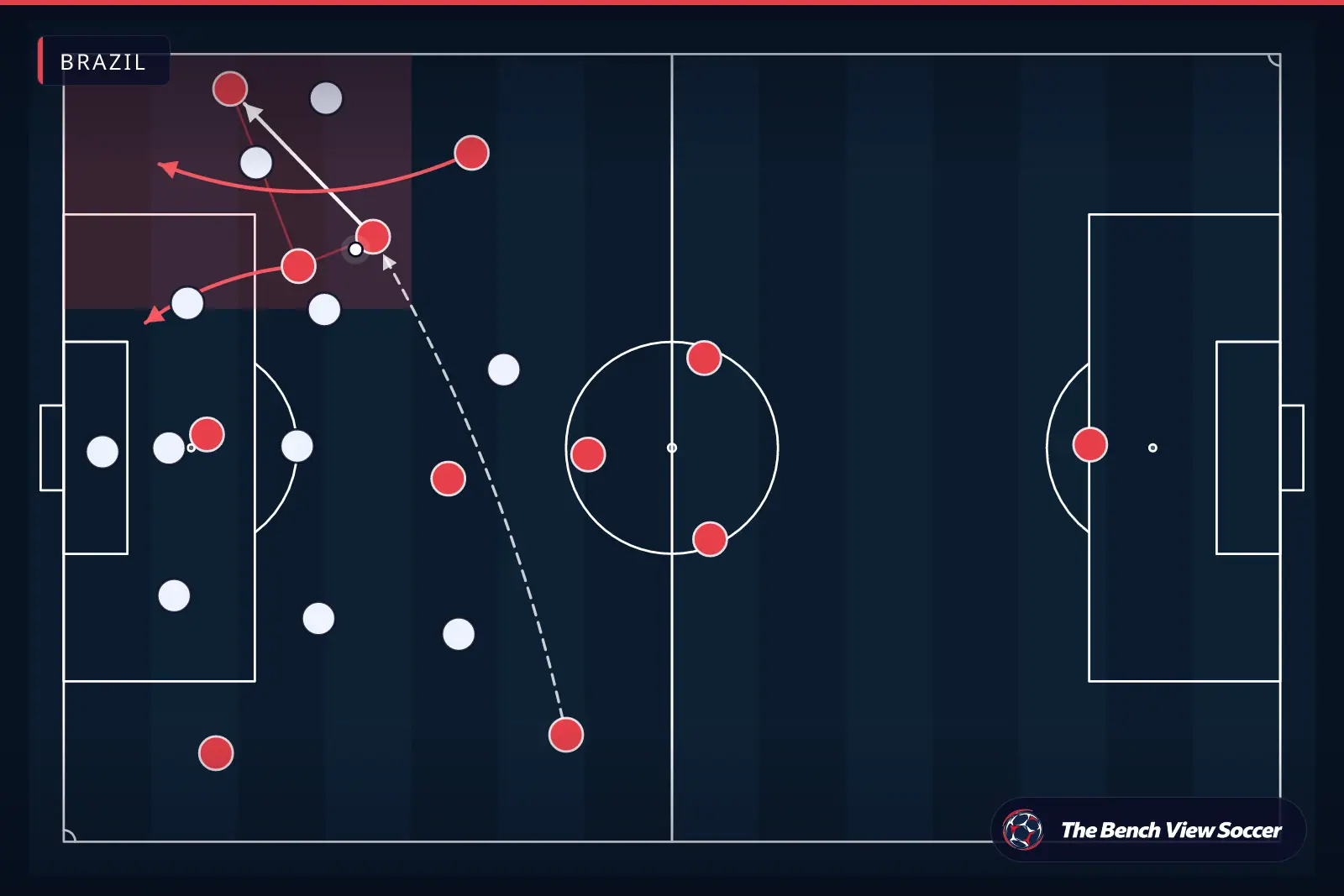
Full-back rotation means the full-back does not always stay wide and overlap. Instead, Brazil uses three main patterns that change depending on the winger profile and the opponent’s shape. Pattern 1 is the classic overlap: the winger (like Vinícius Júnior) stays high and wide to pin the opposing full-back, while the Brazilian full-back times an outside run to receive a pass beyond pressure. This works when the opponent winger does not track back, creating a 2v1 on the flank. Pattern 2 is the underlap: the full-back runs inside the winger, attacking the channel between the opponent’s full-back and centre-back. This is powerful because defenders are trained to “show wide,” so the inside run is harder to pass on. Pattern 3 is the inverted full-back: the full-back steps into midfield during build-up, becoming an extra central player. This helps Brazil progress against pressing teams in UEFA-level competitions because it creates an extra passing option near the ball and frees a midfielder (often Lucas Paquetá-type) to move higher. Across these patterns, the rotation’s purpose is to manipulate the opponent’s wide defender: if the opponent full-back steps out to the winger, the space behind opens for the full-back; if the opponent full-back holds his line, the winger gets time to face up 1v1. Brazil also uses the “third-man” idea: winger lays the ball inside to a midfielder, who then releases the full-back or the winger into the newly opened space. The rotation is not random running—it is coordinated spacing to stretch the opponent horizontally and then attack the gaps that appear.
Match Examples
A clear reference point is the 2022 FIFA World Cup in Qatar under Tite. In the group stage match Brazil vs Serbia (24 November 2022), Brazil’s right side shows how rotations support wide attackers: Danilo often holds a slightly deeper, stabilising position in build-up while Raphinha stays high to pin the Serbian left-back; when the ball shifts, the supporting angles allow quick combinations that lead to crossing and cutback situations. In Brazil vs South Korea (Round of 16, 5 December 2022), the spacing on both flanks helps Brazil isolate defenders; the full-backs do not simply sprint forward every time, but choose moments to join when South Korea’s wide midfielder is pulled inward by Brazil’s central players. Another useful example is Copa América 2019 (hosted in Brazil), especially Brazil vs Peru in the final (7 July 2019). Tite’s team repeatedly creates wide overloads where the winger stays high to fix the defender and the full-back arrives as the free man, making it easier to deliver low crosses or cutbacks—high-value chances in modern football. For club parallels that shape these Brazil players, look at Pep Guardiola’s Manchester City in the UEFA Champions League 2022-23, where full-backs often invert into midfield; Danilo’s earlier experience under Guardiola informs similar “don’t always overlap” decision-making when he plays for Brazil. These references help you spot the same rotation logic across international and European contexts.
Related Concepts & Skills
Training Implications
To train Brazil-style full-back rotation, start with clear rules and repeatable pictures rather than “freedom.” Run a 7v7+3 possession game (two teams of 7, plus 3 neutrals) in a 40x30m area split into five vertical lanes. Rule 1: wingers must start in the wide lanes; full-backs start behind them. Coach three cues: (a) If the winger receives to feet with time, the full-back overlaps to stretch the outside; (b) If the winger is pressed from outside-in, the full-back underlaps into the half-space; (c) If the opponent presses with two players on the flank, the full-back inverts into the inside lane to create a new passing angle. Add a scoring condition: a goal counts only if the attack includes a third-man action (e.g., winger plays inside and the next pass releases the full-back or winger behind). For coaching points, insist on timing: the full-back starts the run as the winger’s first touch travels forward, not after the winger stops the ball. Also train communication: a simple call like “inside” or “over” reduces confusion. Finally, include transition defence: after any turnover, the nearest three players must counter-press for five seconds while the far-side full-back tucks in to form a back three. This teaches the real-world trade-off Brazil faces—creating winger space without getting exposed on counters, a constant issue in international tournaments and top European competitions.
Apply This in Your Game
Reading about tactics is one thing. Our training units teach you to execute these concepts in real match situations.