Introduction
Pressing looks like a simple idea—run at the opponent and win the ball—but the best European teams treat it like a dial, not a switch. The intensity changes minute by minute depending on the scoreline, fatigue, substitutions, and even the emotional temperature of the match. For fans learning tactics, this is an important step: stop asking “Do they press?” and start asking “When, how hard, and why now?” Managers like Jürgen Klopp, Pep Guardiola, Mikel Arteta, and Simone Inzaghi build match plans where pressing rises in short bursts, drops into controlled mid-blocks (a compact shape around the middle third), and spikes again after set-pieces or turnovers. The UEFA Champions League and Premier League show this clearly because opponents are strong enough to punish reckless pressing. Understanding these shifts helps you read a match like a coach: you see why a team suddenly traps an opponent near the touchline, or why they stop pressing to protect space behind. Pressing intensity is not only about effort; it is about risk management and timing.
How It Works
Pressing intensity changes because the pitch is full of trade-offs. When a team presses high (near the opponent’s goal), it tries to win the ball close to goal, but it also leaves space behind the first press. When a team drops into a mid-block or low block, it protects space behind but gives the opponent more time on the ball. Top teams constantly adjust three levers: (1) the height of the defensive line, (2) the number of players committing to the first press, and (3) the aggression of the “second line” stepping up to intercept passes. A common pattern is “burst pressing”: intense 5–10 minute phases after losing control, after halftime instructions, or right after substitutions. Another pattern is “contain then strike”: the team invites a pass into a predictable zone, then accelerates to trap. This is why pressing can look calm and then suddenly violent. Coaches also use scoreline management: if leading, they often reduce high presses to avoid getting played through; if trailing, they push the line up and accept more one-vs-one risk. Fatigue matters too—pressing requires repeated high-speed runs and coordinated angles. If the front line presses but the midfield cannot support, gaps open and the press collapses. So intensity changes are usually planned, not random: they are tied to field position, opponent build-up shape, and the team’s ability to keep distances short between lines.
Match Examples
Manchester City under Pep Guardiola often vary intensity within the same half. In the 2022–23 UEFA Champions League semi-final second leg vs Real Madrid at the Etihad (City win 4–0), City press hard early with a high line and aggressive midfield jumps, forcing Madrid into rushed clearances. After taking control and leading, City sometimes shift into a more patient press—still high, but less “all-in”—using possession to rest with the ball and reducing the need for constant sprinting. Liverpool under Jürgen Klopp show a different rhythm: in the 2018–19 Champions League semi-final second leg vs Barcelona at Anfield (Liverpool win 4–0), intensity spikes after moments of belief—especially after goals—because the crowd energy and scoreline demand rapid ball recoveries. The press becomes more man-oriented in short spells, then resets to keep distances compact. Arsenal under Mikel Arteta provide a modern Premier League example of “selective pressing.” In the 2023–24 Premier League match vs Manchester City at the Emirates (Arsenal win 1–0), Arsenal do not press at maximum intensity for 90 minutes; they often sit in a disciplined mid-block, then jump to press when City play into wide areas or when a backward pass signals a vulnerable moment. Inter Milan under Simone Inzaghi show how intensity changes with game state in the 2022–23 Champions League semi-final vs AC Milan (Inter win 3–0 on aggregate): Inter press sharply in the opening phases to unsettle Milan’s build-up, then manage the tie by dropping into compact lines and pressing mainly on specific cues, protecting central lanes while still threatening counters. These matches show the same lesson: the best teams do not chase constantly; they choose pressing moments to maximize reward and reduce risk.
Related Concepts & Skills
Training Implications
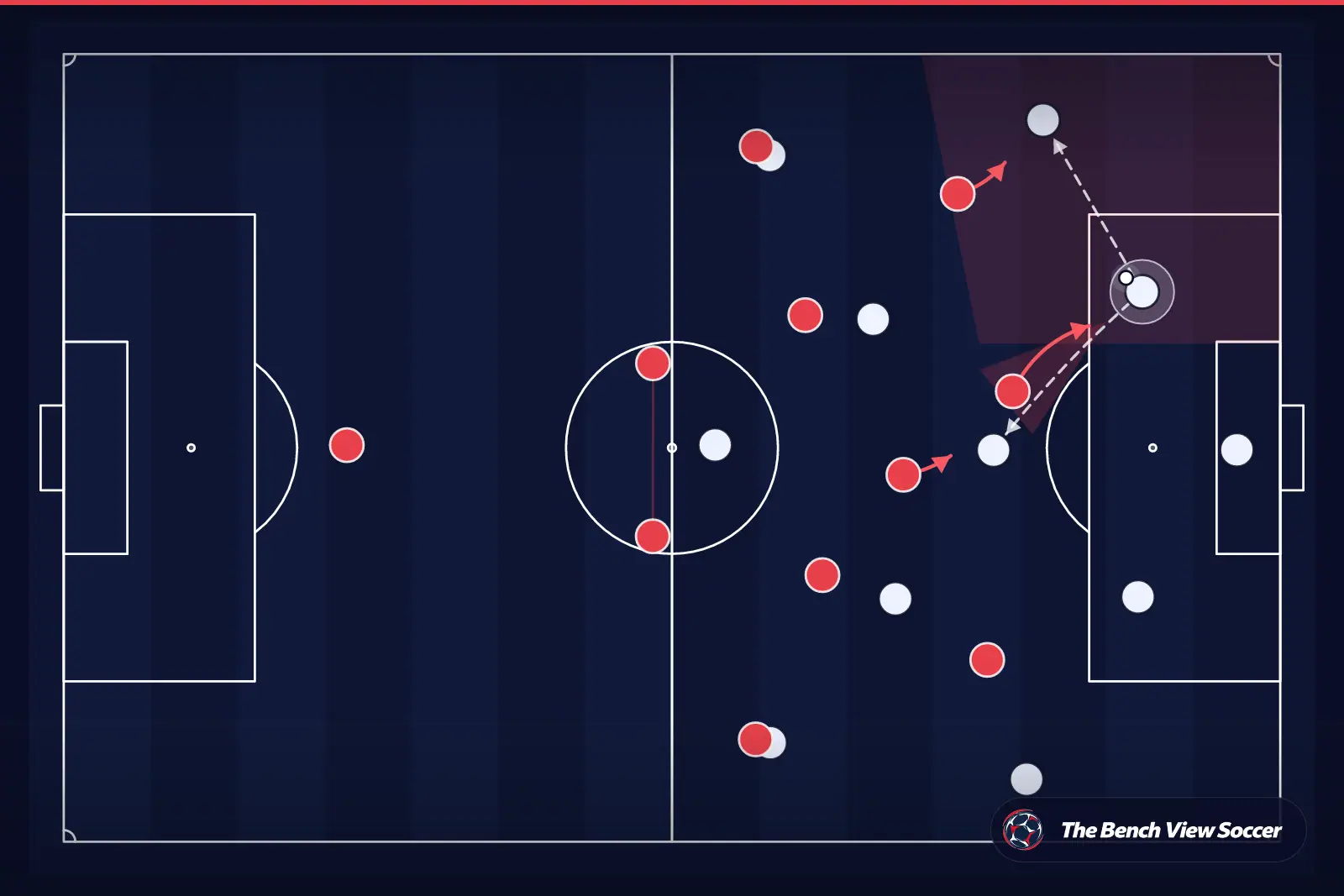
To train variable pressing intensity, build sessions around “when to press” as much as “how to press.” First, run a 6v6+2 possession game where the two neutral players help the team in possession; add a rule that a team can only win points if it regains the ball within 6 seconds after losing it. This teaches short counter-press bursts. Next, add a second condition: after one successful 6-second regain, the team must drop into a mid-block for 30 seconds (coach counts) before it can press high again. Players learn intensity changes as a shared habit, not individual chasing. Second, coach pressing angles: set a 3-lane pitch (left, centre, right). Tell the forward to curve the run so the opponent is forced toward the touchline (where passing options reduce). Award extra points for wins in wide traps. Third, train “line connection” with a simple spacing rule: the distance between the pressing forward line and midfield line stays under 12–15 metres during a high press. If it stretches, stop the drill and reset—this is how presses fail in matches. Fourth, rehearse game-state scenarios: play 10-minute blocks where one team leads 1–0 and must protect central space with selective pressing, while the trailing team must increase press intensity and accept risk. Finally, make roles clear: assign one player as the “press caller” (often a midfielder) who shouts the trigger. The biggest improvement for amateur teams is not fitness alone; it is synchronized decisions, repeated in realistic constraints.
The Bench View app
Don’t just read football — train it
Everything you read here, turned into training you can follow step by step.
Physical training at home
AI daily sessions adapted to your level and position. No equipment needed.
Tactical training courses
Step-by-step courses on positioning, pressing, build-up and decision making.
- 7 days free
- No commitment
- Cancel anytime
Free account: 2 physical sessions + the first tactical course. PRO: 7-day free trial — cancel before day 8 and you pay nothing.