Introduction
When fans first hear “low block,” it can sound like a defensive trick that simply kills entertainment. In reality, it is a very organised, very intelligent way for teams to protect the centre of the pitch and force you into low-quality chances. Real Madrid, across different eras and managers, repeatedly faces this problem in La Liga because many mid-table and smaller sides prefer to defend deep at the Santiago Bernabéu and hope for set pieces or counterattacks. The challenge is not “how to have more possession,” but how to turn possession into penetration without losing control of transitions (the moment the ball is lost). Under Carlo Ancelotti, Madrid’s attacking approach balances structure and freedom: they stretch the opposition horizontally with wide players, occupy the half-spaces with runners and passers, and use quick combinations to create shots inside the box rather than settling for hopeful crosses. This article breaks down how Madrid tries to beat the low block and what fans can look for on matchday.
How It Works
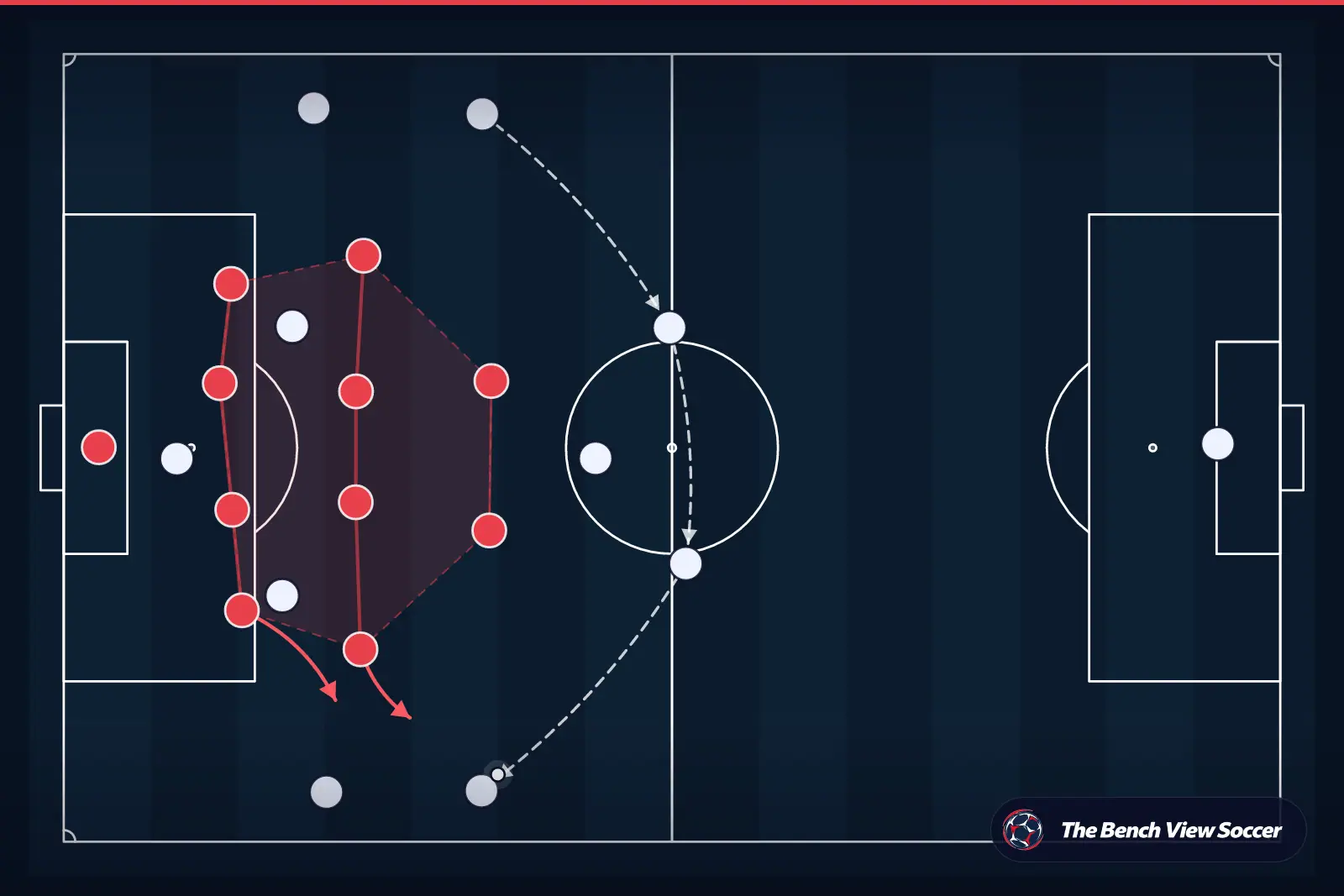
A low block usually means the defending team keeps most players behind the ball, often in a 4-5-1 or 5-4-1 shape, staying compact in front of their penalty area. The key idea is “compactness”: they reduce the space between defenders and midfielders so passes into the striker or the attacking midfield zone become difficult. Real Madrid’s solution begins with spacing. Madrid uses width to stretch the back line: the wingers (like Vinícius Júnior or Rodrygo) hold wide positions to force full-backs to defend the touchline, which naturally opens tiny gaps inside. At the same time, midfielders and full-backs rotate to create different passing angles. One common pattern is an “overload-to-isolate”: Madrid overloads one side with multiple attackers and short passes, baiting the low block to shift across, then quickly switches the ball to the far side where a winger receives 1v1. Another tool is the third-man run: instead of forcing a pass into a marked player, Madrid plays to a nearby teammate who then immediately sets the ball for a runner arriving from deeper (often Jude Bellingham’s late box entries or Federico Valverde attacking the edge of the area). Madrid also uses the “cut-back” as a main chance-creation method: rather than crossing high to tall centre-backs, they attack the byline and pull the ball back to the penalty spot zone, where defenders often lose track of runners. Importantly, Madrid keeps rest-defence behind the ball—typically two centre-backs plus a midfielder—so they can stop counters, because low-block teams often rely on the first counterattack to win the match.
Match Examples
A clear example arrives in the 2023–24 La Liga season when Real Madrid faces teams that defend deep at the Bernabéu. Against UD Almería (La Liga, January 2024), Almería spends long phases in a low block after taking a shock lead. Madrid increases their width and uses quicker switches to move the block side-to-side, then looks for combinations around the box rather than endless aerial crosses. Jude Bellingham’s role as a late runner into the box becomes a repeated problem for a compact defence: even if the centre is crowded, defenders focus on the ball and can lose track of a midfielder arriving at the last moment. Another reference point is Real Madrid vs Cádiz (La Liga, May 2024), a classic “small club at the Bernabéu” low-block scenario. Cádiz sits extremely deep, and Madrid’s answer is patience plus tempo changes: slow circulation to pull defenders out, then sudden vertical actions—dribbles, wall passes, and cut-backs. You also see an earlier Champions League example in Real Madrid vs Chelsea (UEFA Champions League quarter-final second leg, April 2022). Chelsea presses higher at times, but when they drop into deeper phases, Madrid’s most dangerous moments come from quick, decisive actions in the half-spaces and direct entries into the box, not from slowly looping crosses. Across these matches, the pattern is consistent: the low block does not get “broken” by one magic pass; it gets weakened by repeated stretching, switching, and timed runs until one defender steps out late or one runner arrives untracked.
Related Concepts & Skills
Training Implications
If you coach or play, beating a low block is less about fancy skills and more about rehearsed habits. Start with a 7v6 or 8v7 low-block drill in a 35x40 metre area: defenders sit compact in two lines, attackers aim to create a shot within 20 seconds. Give attackers two rules: one player must stay wide on each side at all times, and at least one midfielder must make a late run into the box on every attack. This forces width and timing rather than ball-watching. Add a “switch bonus”: if the team completes a cross-field switch (from left to right) and creates a shot within five seconds, it counts double—this trains overload-to-isolate and quick tempo changes. Next, practice cut-backs: create a channel to the byline and mark a “cut-back zone” around the penalty spot; goals only count if the final pass is a pull-back into that zone, teaching players to attack the byline and finish from central areas. For third-man runs, run a simple pattern: winger plays inside to a midfielder, who one-touches into a forward or advancing full-back, while a second runner attacks the space behind the line. Finally, include transition protection: if attackers lose the ball, defenders get 6 seconds to counter into two mini-goals; attackers must keep two players plus one midfielder behind the ball when attacking. This mirrors Real Madrid’s need to create chances without being punished by the first counter.
The Bench View app
Don’t just read football — train it
Everything you read here, turned into training you can follow step by step.
Physical training at home
AI daily sessions adapted to your level and position. No equipment needed.
Tactical training courses
Step-by-step courses on positioning, pressing, build-up and decision making.
- 7 days free
- No commitment
- Cancel anytime
Free account: 2 physical sessions + the first tactical course. PRO: 7-day free trial — cancel before day 8 and you pay nothing.