Introduction
In La Liga and the UEFA Champions League, Real Madrid often face opponents who defend deep, narrow, and patient—what fans call a “deep block.” For viewers used to end-to-end highlights, these games can look slow, but they are actually chess matches. A deep block means the defending team keeps many players behind the ball, protects the centre, and dares you to cross or shoot from distance. Real Madrid’s challenge is not just “attack more,” but to create high-quality chances without giving away counter-attacks. Under Carlo Ancelotti, Madrid vary their solutions depending on personnel: Luka Modrić and Toni Kroos (in recent seasons) offer control; Jude Bellingham gives vertical runs; Vinícius Júnior provides 1v1 threat; and full-backs like Dani Carvajal supply width. This article breaks down the main plans Madrid use to open tight defences, why those plans work, and how small positional details—spacing, timing, and angles—decide whether a low block survives or collapses.
How It Works
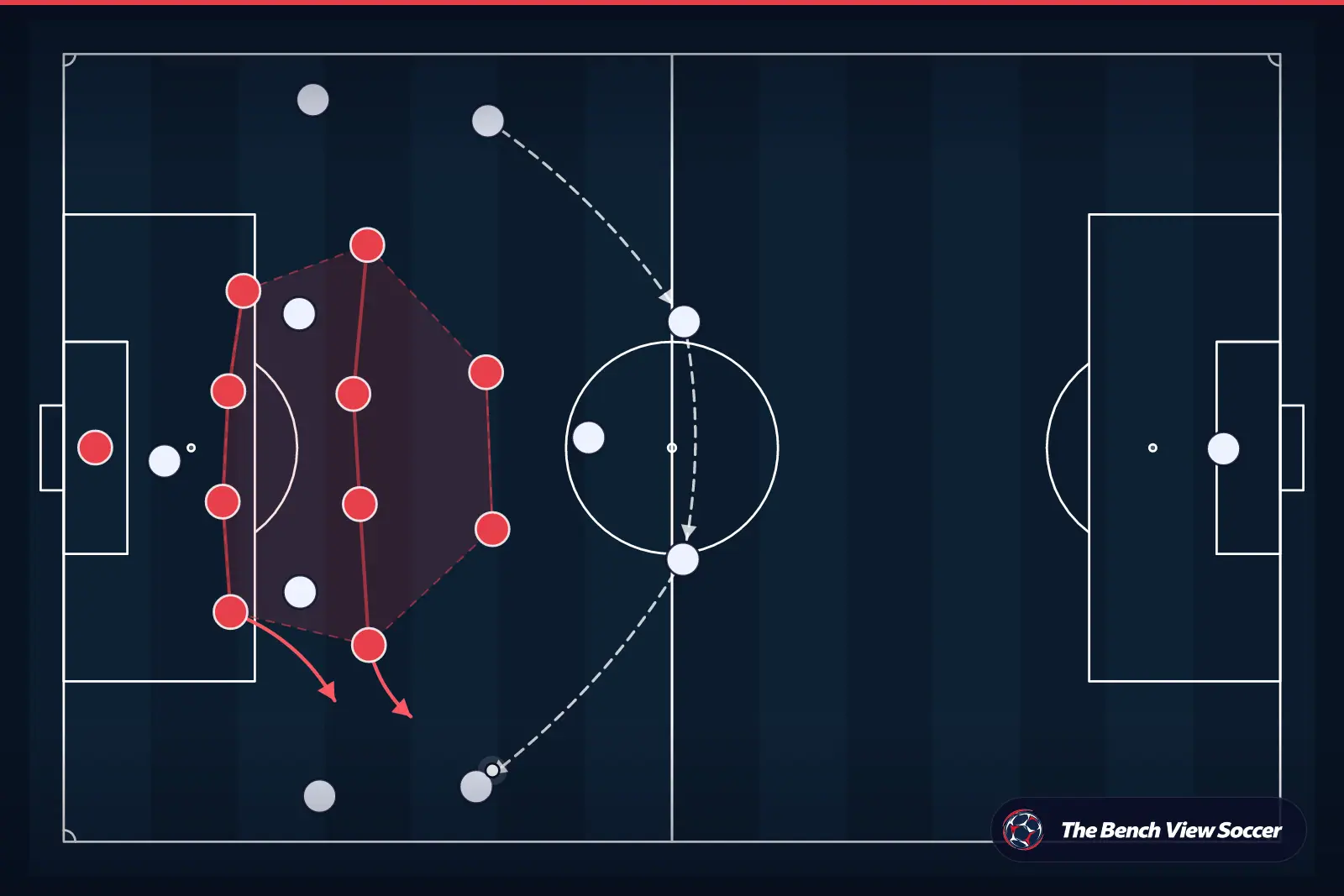
Real Madrid’s first principle against a deep block is to stretch the defence horizontally and vertically. Horizontally, they keep width with a winger or full-back on each side so the opponent’s back line cannot stay compact. Vertically, they threaten runs behind the last line—often through Vinícius attacking the outside channel or Bellingham arriving late—so defenders cannot step out freely. Madrid then try to create overloads: they bring an extra player into one side (for example, a midfielder drifting wide) to make a 3v2, forcing the opponent to choose between doubling the dribbler or protecting the central passing lane. When the block shifts, Madrid look for the “third-man” pattern: Player A passes to Player B (often with his back to goal), who lays it off to Player C running beyond or into space. This is how they bypass a packed midfield without needing risky dribbles through the centre. Another key plan is using the half-space (the corridor between the wing and the centre). A player receiving there can pass across the box, slip a through ball, or shoot. Finally, Madrid manage rest defence—meaning they keep enough players positioned to stop counters. Against deep blocks, losing the ball is dangerous because the opponent breaks into open space. Madrid therefore stagger their midfield and keep at least two defenders plus a holding midfielder ready to delay transitions while the attack resets.
Match Examples
A clear example is Real Madrid vs RB Leipzig in the 2023–24 UEFA Champions League Round of 16. Leipzig do not sit as deep as a classic La Liga low block, but when Madrid attack settled phases, the same principles appear: Madrid use Vinícius to pin defenders wide, then look for inside combinations and late arrivals. In the second leg at the Santiago Bernabéu (1–1), Madrid’s chance creation comes from moving Leipzig’s midfield line side-to-side, then finding pockets for quick releases rather than forcing constant crosses. A more “pure” deep-block test is Real Madrid vs Chelsea in the 2022–23 Champions League quarter-final first leg at the Bernabéu (2–0). Chelsea defend with a compact shape after the red card and before it too they protect the centre; Madrid open them with patient circulation, wide pressure to fix the full-back, and then sharp entries into the box—especially via the right side with Carvajal’s timing and the midfield’s positioning to support second balls. In La Liga, matches against Atlético Madrid under Diego Simeone often show how hard it is to break a compact unit; Madrid’s better moments typically come when they move Atlético’s block with quick switches, attack the far post with late runners, and use dribbling to force a second defender to step out. Across these examples, the pattern is consistent: the goal is not to “shoot more,” but to create a defensive decision—make the block move, make a defender leave his line, then exploit the gap immediately.
Related Concepts & Skills
Training Implications
For coaches and players trying to copy Real Madrid’s ideas, focus training on timing, spacing, and decision-making rather than just finishing. Drill 1: “Two-lane width + half-space pocket” (8v7). Set up a 44x35m area with wide channels. The attacking team must keep one player in each wide channel and one player in each half-space before they can play into the box. This teaches stretching the block and finding inside lanes. Coaching points: wingers stay high to pin full-backs; the half-space player checks shoulders and receives on the half-turn. Drill 2: Third-man combination circuit. Create a triangle with a mannequin/defender: A passes to B (back to goal), B sets to C, C plays through to a runner. Repeat on both sides with different body orientations. Key detail: B’s set must be one touch and angled away from pressure. Drill 3: “Overload to isolate” (6v6+2 neutrals). Encourage building a 3v2 on one flank, then switching quickly to isolate the far-side winger 1v1. Score only from a cutback (pass from near the byline to the penalty spot area) to teach high-quality chance creation. Drill 4: Rest-defence transition rule. In all small-sided games, if the attacking team loses the ball, they have five seconds to stop a counter by delaying, tackling, or forcing play wide—while two players are designated to stay connected behind the ball at all times. This builds the habit Madrid rely on: attack with structure, lose the ball with protection, then attack again.
The Bench View app
Don’t just read football — train it
Everything you read here, turned into training you can follow step by step.
Physical training at home
AI daily sessions adapted to your level and position. No equipment needed.
Tactical training courses
Step-by-step courses on positioning, pressing, build-up and decision making.
- 7 days free
- No commitment
- Cancel anytime
Free account: 2 physical sessions + the first tactical course. PRO: 7-day free trial — cancel before day 8 and you pay nothing.