Introduction
Real Madrid is often described as a team of stars, but their attacking structure under Carlo Ancelotti is extremely deliberate. One of the most important details is how they use a deep-lying forward (a striker who drops away from the defensive line rather than staying high). In recent seasons, this role appears in different forms: Karim Benzema drifting into midfield before his departure, and now Jude Bellingham frequently arriving from deeper zones while Vinícius Júnior and Rodrygo attack the space ahead. The reason is simple: LaLiga and UEFA Champions League opponents increasingly defend with compact blocks, protecting the central lane and forcing play wide. When the forward drops, defenders face an uncomfortable choice—follow and open space behind, or hold the line and allow a free receiver between the lines. For fans learning tactics, this is a great example of how movement without the ball can be as powerful as dribbling, because it reshapes the opponent’s entire defensive map.
How It Works
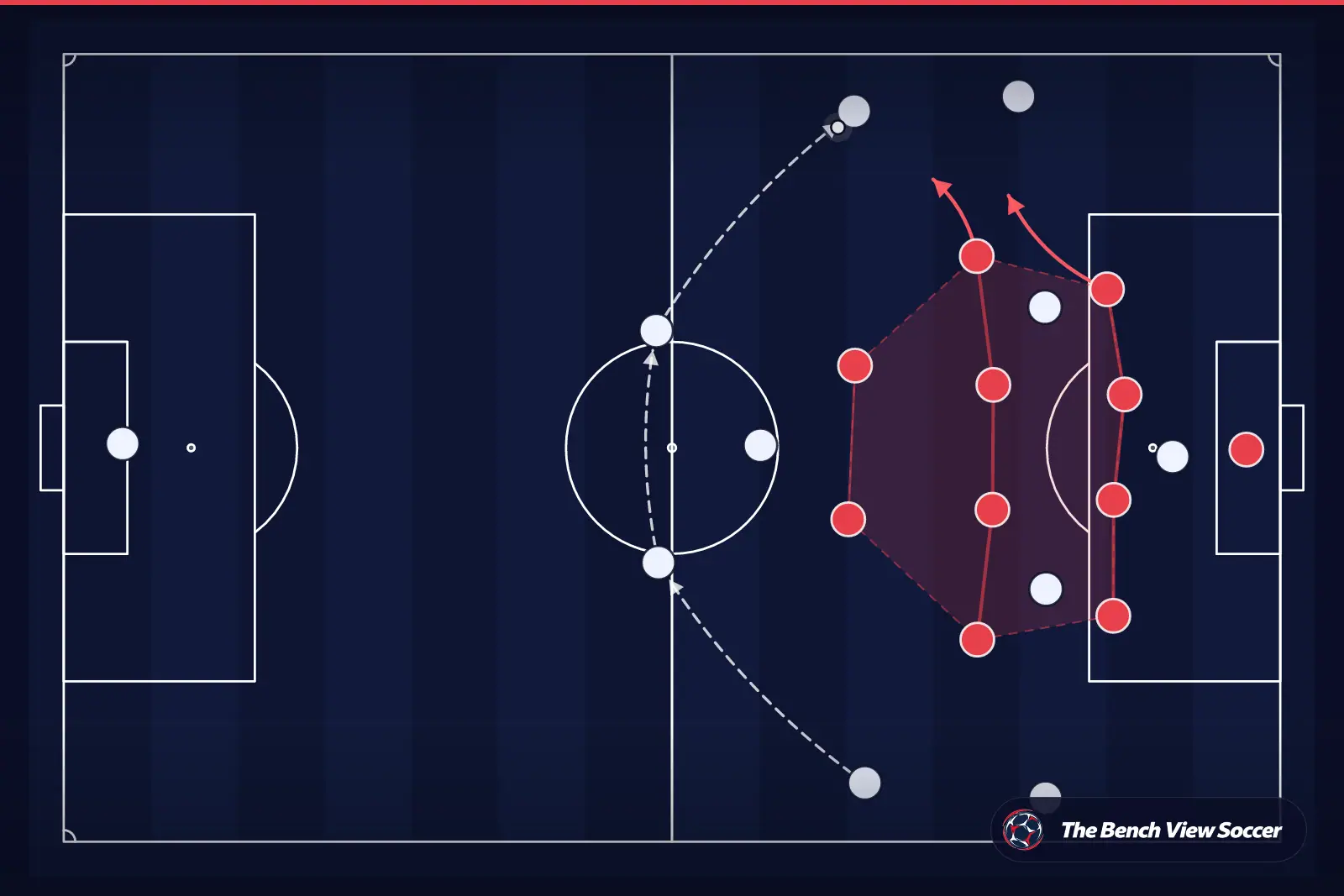
Real Madrid uses a deep-lying forward to stretch defenses in two directions at once: vertically (front-to-back) and horizontally (side-to-side). When the forward drops into the space between the opponent’s midfield and defense, he becomes a “connector” for quick combinations. This movement often pulls a centre-back forward. If that centre-back follows, the space behind him becomes available for a runner like Vinícius Júnior, Rodrygo, or Federico Valverde to attack. If the centre-back does not follow, the deep-lying forward receives on the half-turn and can play forward passes, switch play, or draw a midfielder out, which opens the central lane for a third-man run (Player A passes to Player B, who sets it to Player C running beyond). Ancelotti’s Madrid also uses wide threats to make this drop even more dangerous. Because Vinícius stays ready on the left and the right winger pins the full-back, the opponent’s back line hesitates to step out. That hesitation is exactly what Madrid wants: it creates a “decision delay,” giving the receiver time to turn. Importantly, the deep-lying forward does not drop randomly; he drops when Madrid has stable possession, when a midfielder like Toni Kroos or Luka Modrić can find him, and when wide runners are already preparing to sprint into depth. The goal is not only to create a shot immediately, but to force the defense to constantly reset its spacing, which eventually leads to gaps.
Match Examples
A clear example arrives in the 2021–22 UEFA Champions League run under Carlo Ancelotti, especially the semi-final against Manchester City. In the first leg at the Etihad (April 2022), Karim Benzema frequently drops toward midfield, and City’s centre-backs must decide whether to step out. When they hold, Benzema links play and allows Madrid’s wide attackers to receive in better positions; when they step, the space behind becomes a target for runs and quick through balls. Another strong reference is the 2022–23 Copa del Rey semi-final second leg at Camp Nou against Barcelona (April 2023). Madrid wins 4–0, and Benzema repeatedly comes short to combine, drawing Barcelona defenders and opening lanes for Vinícius Júnior’s transitions and cut-backs. Moving into the 2023–24 LaLiga season, the role evolves because Jude Bellingham plays as a high midfielder who still drops like a forward during build-up. In matches where opponents defend deep—against compact sides like Getafe or Real Sociedad—Bellingham’s movement toward the ball pulls markers out, and then Madrid’s wide pace attacks the channels. Even when the opponent does not “bite” and step out, Madrid benefits because the receiver between the lines forces midfielders to collapse inward, which frees the full-backs to advance and deliver dangerous balls across the box. Across these competitions—LaLiga, Copa del Rey, and the Champions League—the pattern stays consistent: the dropping forward is the trigger that makes Madrid’s wide speed and late runs feel unstoppable.
Related Concepts & Skills
Training Implications
If you coach or play in India—school teams, academies, or local 7v7/11v11—the deep-lying forward idea is practical and trainable. Start with a simple constraint game: 6v6 plus 2 neutral midfielders. The rule is that a goal counts only if the team completes one pass into a “pocket zone” (a marked rectangle between midfield and defense) before finishing. Rotate one player as the deep-lying forward whose job is to check toward the ball, receive, and set the ball back or turn. Coach three details: (1) body shape—receive side-on so the player can see forward; (2) timing—the forward drops only when a teammate has time to pass; (3) scanning—look over the shoulder before the ball arrives. Next, add the “runner rule”: every time the forward drops, one winger must sprint in behind immediately. This teaches the partnership that Real Madrid uses: short movement plus long threat. For finishing, run a pattern: centre-back to midfielder, midfielder into the dropping forward, one-touch set to an onrushing midfielder, then a through ball wide to a runner for a cut-back. Keep repetitions high and demand speed after the set pass. Finally, teach defenders too: in a shadow-play drill, practice the centre-back’s decision—step out or hold—and have the coach freeze the play to discuss spacing. This makes your attackers understand why their movement creates the real advantage: it forces defenders into uncomfortable choices.
The Bench View app
Don’t just read football — train it
Everything you read here, turned into training you can follow step by step.
Physical training at home
AI daily sessions adapted to your level and position. No equipment needed.
Tactical training courses
Step-by-step courses on positioning, pressing, build-up and decision making.
- 7 days free
- No commitment
- Cancel anytime
Free account: 2 physical sessions + the first tactical course. PRO: 7-day free trial — cancel before day 8 and you pay nothing.