Introduction
Liverpool’s high press is one of the clearest “team identities” in modern European football, especially across Jürgen Klopp’s years at Anfield. For fans trying to read tactics, pressing can look like pure intensity—players sprinting at defenders and forcing mistakes. But Liverpool’s best pressing is not random running. It is organised around triggers (the exact moments they decide to jump), channels (the lanes they use to funnel the ball into traps), and recovery (what they do the second the press is broken). Understanding these three ideas helps you watch any Liverpool match with a coach’s eye: you begin to notice why one pass invites pressure and another pass gets ignored, why the ball keeps getting pushed toward the touchline, and why Liverpool can attack quickly after winning it. In the Premier League and UEFA Champions League, this structure turns defence into attack in seconds, which is why Liverpool so often creates big chances without long build-up play.
How It Works
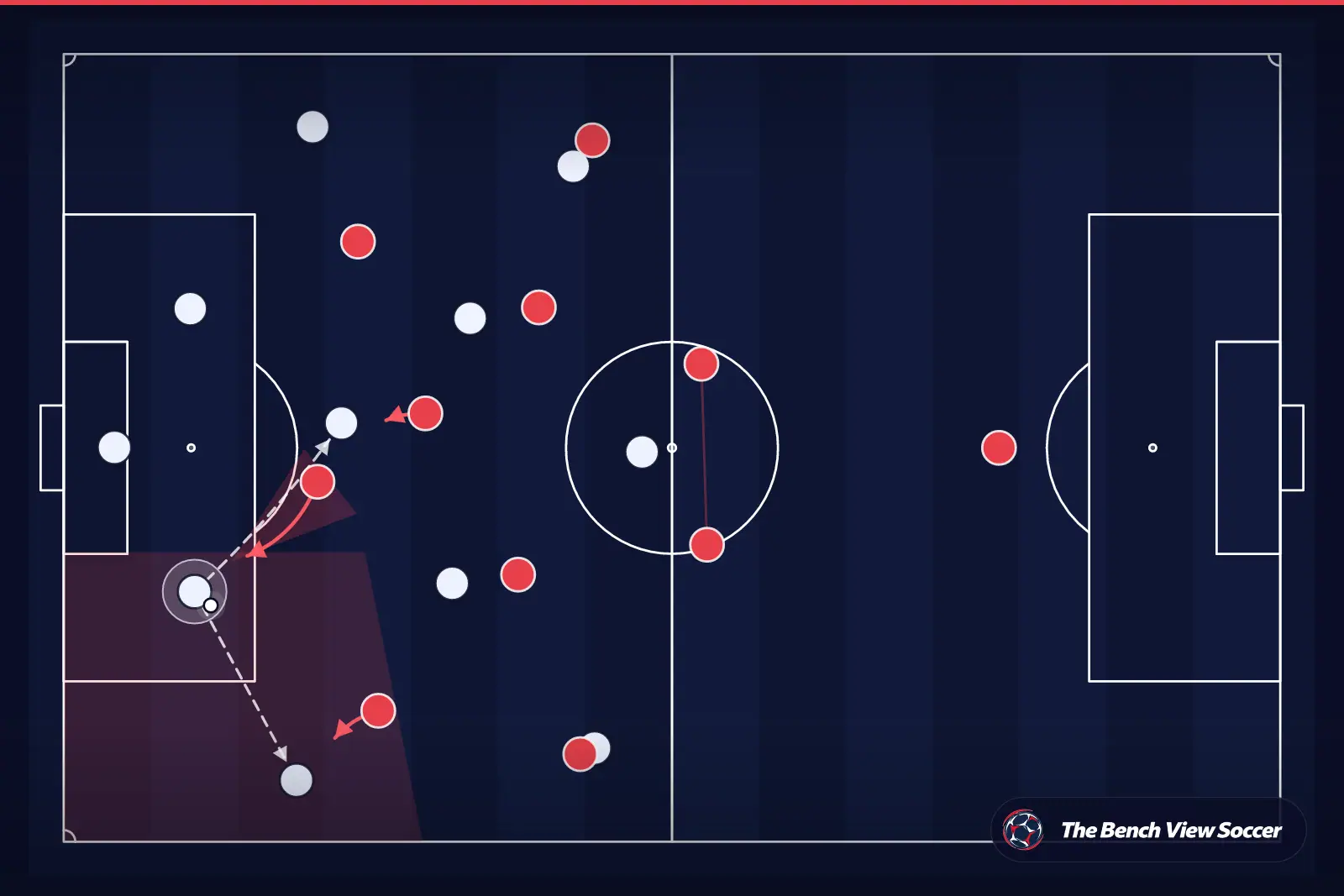
Liverpool’s high press starts from the front, but it is really a full-team system. The first key is pressing triggers: Liverpool jumps when an opponent plays a slow or bouncing pass, when a centre-back receives on his weaker foot, when the goalkeeper takes an extra touch, or when a full-back receives facing his own goal. At that moment the nearest forward sprints to close the ball while curving his run to block the easy pass back inside. That curve is important: it “shows” the ball into a specific channel—usually toward the sideline—because the touchline acts like an extra defender. In these wide channels, Liverpool creates pressing traps: the winger presses from outside-in, the full-back steps up to lock the wide receiver, and a central midfielder (often the No.8) arrives to win the second ball or intercept the inside escape pass. Behind the first wave, Liverpool maintains a high defensive line so the team stays compact (short distances between lines). This compactness allows counter-pressing: immediately after losing the ball, nearby players swarm the ball carrier to prevent a clean outlet pass. If the press is broken, recovery becomes the next phase: the closest players delay the attack by blocking forward lanes, while the back line drops only enough to protect space behind them, often guided by Virgil van Dijk’s positioning and scanning. The key detail is that Liverpool does not chase everywhere; they protect the centre first, force play wide, and then attack the ball with numbers. When it works, the opponent’s “exit” options disappear, and Liverpool regains possession high up the pitch with the opponent facing their own goal—perfect for quick attacks.
Match Examples
A classic example appears in the 2019–20 Premier League season under Jürgen Klopp, especially Liverpool’s 4–0 win over Leicester City at Anfield (Boxing Day, 26 December 2019). Brendan Rodgers’ Leicester tries to play out, but Liverpool presses with clear triggers: back passes to Kasper Schmeichel and square passes across the back line. Roberto Firmino often curves his run to block the central pass into Wilfred Ndidi, forcing play wide. Once the ball travels to the full-back area, Liverpool’s winger and full-back lock the sideline while the nearest midfielder steps up to intercept the inside option. The result is Leicester struggling to progress cleanly, and Liverpool winning the ball in advanced zones that lead to sustained pressure and high-quality chances. Another strong reference is Liverpool vs Manchester City in the 2019–20 Premier League at Anfield (10 November 2019), a match that shows how pressing is adjusted to opponent quality. Pep Guardiola’s City has elite ball security, so Liverpool picks moments rather than pressing nonstop. The triggers remain similar—goalkeeper involvement, awkward body shape, or a receiver facing his own goal—but the “trap” is even clearer: Liverpool encourages passes to the full-back or wide centre-back, then jumps aggressively with support arriving behind. You can see the recovery principle too: when City breaks the first wave, Liverpool’s midfield collapses toward the ball to delay, while the defence protects the space behind, avoiding a straight sprint race. These matches illustrate that the press is not just intensity; it is timing, direction, and a rehearsed plan for what happens next.
Related Concepts & Skills
Training Implications
To train a Liverpool-style high press in an academy or local team, start by making the ideas simple and repeatable. First, define 3–4 pressing triggers for your group and write them down: (1) back pass to goalkeeper, (2) sideways pass between centre-backs, (3) receiver’s first touch toward his own goal, (4) aerial or bouncing ball. In small-sided games (6v6 or 7v7), pause play whenever a trigger occurs and demand an immediate press from the nearest player plus one supporting presser—this builds the habit of pressing as a unit, not as a lone runner. Second, coach “pressing runs with shadows”: the presser must curve his run so he closes the ball while also blocking one passing lane (for example, the inside pass). Use a simple constraint: award 2 points for a regain that happens within 6 seconds after forcing the ball to the sideline. This teaches channeling and traps rather than chasing. Third, train recovery with a transition rule: if the pressing team is beaten with one pass, the nearest two players must sprint back to protect the centre (delay and block), while the rest recover to a compact shape before pressing again. Run a drill where the attacking team scores extra points for switching play quickly; this forces your press to improve its weak side recovery. Finally, track one measurable KPI each session—like “regains in the final third” or “forced long balls”—so players see progress and understand the purpose behind the running.
The Bench View app
Don’t just read football — train it
Everything you read here, turned into training you can follow step by step.
Physical training at home
AI daily sessions adapted to your level and position. No equipment needed.
Tactical training courses
Step-by-step courses on positioning, pressing, build-up and decision making.
- 7 days free
- No commitment
- Cancel anytime
Free account: 2 physical sessions + the first tactical course. PRO: 7-day free trial — cancel before day 8 and you pay nothing.