Introduction
Manchester City under Pep Guardiola build their dominance on more than star players and possession numbers. A key reason they look so hard to press is rotation: players swapping positions at the right moment, in the right zones, to unbalance the opponent without losing structure. For fans learning European tactics, think of City’s rotation as “planned improvisation.” It is not random roaming; it is a coordinated system where one movement creates space for the next pass, and one player’s shift protects another player’s risk. In the Premier League and UEFA Champions League, opponents often prepare a pressing plan for City’s usual shape (like a 3-2-5 in possession). City then rotate—full-back steps into midfield, winger comes inside, midfielder runs beyond—to break that plan. This article breaks down the timing (when the swap happens), positioning (where it happens), and how rotations disrupt opponents while keeping City protected against counter-attacks.
How It Works
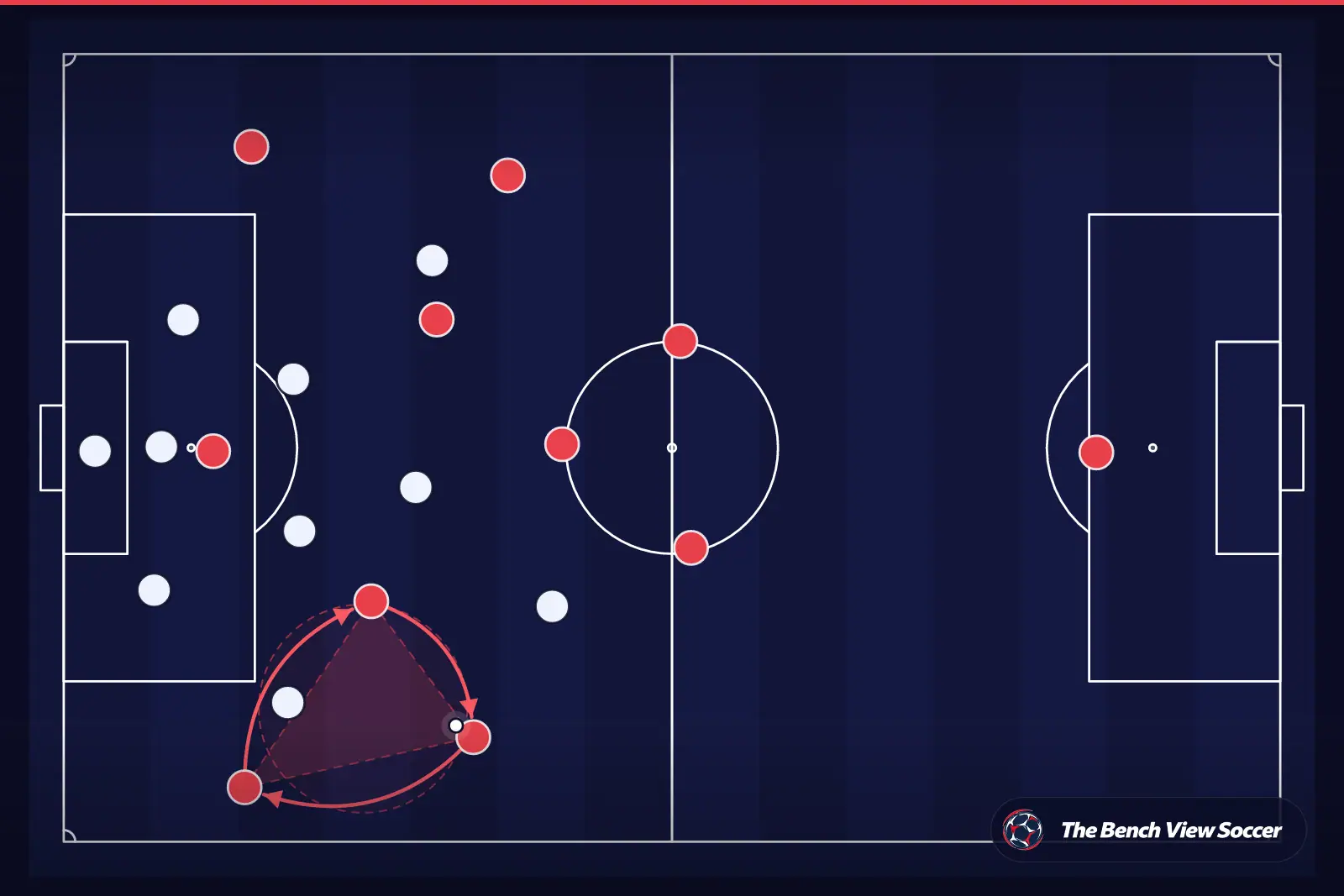
City’s rotation works because it respects a simple rule: keep the team’s spacing while changing the individuals who occupy each space. In possession, City often create a “rest defence” with 3 players behind the ball (to stop counters), 2 midfielders controlling the centre, and 5 attackers stretching the last line. The rotation starts when the ball travels, not when it stands still. As a centre-back like Rúben Dias passes into midfield, a player like John Stones (when used as an inverted full-back) steps inside to form a double pivot. That movement attracts a marker, opening the touchline for a winger to stay wide, or freeing a midfielder like Bernardo Silva to drift into the half-space (the channel between full-back and centre-back). Timing matters: if the winger comes inside too early, the opponent’s full-back passes him on and stays compact; if he comes inside as the ball arrives in the half-space, the defender must decide instantly. City also rotate to create a “free man,” meaning a player who is not directly marked and can receive facing forward. For example, when Kevin De Bruyne drops slightly, he drags a midfielder, and a third-man run arrives behind—often a full-back or a No. 8 sprinting beyond the press. The key is that City do not rotate everywhere; they rotate around the ball-side triangle (full-back, winger, No. 8) and the central box (two pivots plus two advanced midfielders). Guardiola’s best rotations also include counter-pressing preparation: as one player leaves a zone, another occupies it so City can immediately press after losing the ball. The opponent feels like they are always one step late, because their marking references keep changing while City’s shape stays stable.
Match Examples
A clear reference point is Manchester City vs Inter Milan in the 2022–23 UEFA Champions League final. Inter defend in a 5-3-2 block under Simone Inzaghi, trying to protect the centre and force City wide. City respond with rotations that change who plays in the central lanes. Stones steps into midfield next to Rodri, which pulls Inter’s midfield line forward. Bernardo Silva often tucks inside, then pops out again, which forces Inter’s wing-back to decide: follow and open the flank, or stay and allow an interior receive. The goal sequence itself shows how City’s positioning pins defenders: wide players hold width, midfielders arrive between lines, and the final action is not a hopeful cross but a controlled cutback/central finish, with Rodri arriving into the space created by constant movement. Another strong example is Manchester City vs Real Madrid in the 2022–23 Champions League semi-final second leg at the Etihad (4-0). Carlo Ancelotti’s Madrid try to press with Vinícius Júnior and Karim Benzema jumping to City’s build-up, but City’s rotations keep creating a spare player. As Stones inverts, Madrid’s first line cannot cover both the centre-backs and the new midfielder. De Bruyne and İlkay Gündoğan rotate in the right half-space, dragging Eduardo Camavinga and Toni Kroos into uncomfortable zones. The result is repeated “fix and release”: City fix Madrid centrally, then release Bernardo or De Bruyne to receive facing goal. Finally, in the Premier League 2023–24 season, City frequently use Manuel Akanji or Josko Gvardiol to invert from full-back while Phil Foden drifts inside. Opponents set up to block Haaland and De Bruyne, but the rotation creates new passing lanes and isolates defenders in 1v1s on the outside or 2v1s in the half-space.
Related Concepts & Skills
Training Implications
If you coach, play, or even analyse matches in India, you can train City-style rotation without needing elite facilities. Start with a simple rule: rotate only when the ball moves. In a 5v5 or 7v7 game, mark three vertical lanes (left, centre, right) with cones and instruct players that the team must always occupy each lane, but players can swap lanes after a pass. This teaches “shape stays, names change.” Next, use a triangle drill: full-back, winger, and midfielder on one side. The winger starts wide, the midfielder starts in the half-space, and the full-back starts deeper. On the coach’s call, the full-back steps inside, the midfielder drifts out, and the winger comes inside only when the ball is traveling. Add a defender and award points for receiving on the half-turn (facing forward), because timing is the main skill. For disruption training, practice “fix and release.” Set up 6 attackers vs 4 defenders in a rectangle with two mini-goals. The attackers must complete a central pass that draws a defender (“fix”), then immediately switch or slip a pass into the released space (“release”). Rotate roles every two minutes. To build the counter-pressing habit, add a rule: if attackers lose the ball, they have five seconds to win it back; if they do, they keep possession and score a bonus point. Finally, use video: record a small-sided game on a phone and review just two questions—did we rotate on the pass, and did someone replace the space we left? This makes rotation practical, not theoretical.
The Bench View app
Don’t just read football — train it
Everything you read here, turned into training you can follow step by step.
Physical training at home
AI daily sessions adapted to your level and position. No equipment needed.
Tactical training courses
Step-by-step courses on positioning, pressing, build-up and decision making.
- 7 days free
- No commitment
- Cancel anytime
Free account: 2 physical sessions + the first tactical course. PRO: 7-day free trial — cancel before day 8 and you pay nothing.