Introduction
Press resistance is the ability to keep possession and progress up the pitch when opponents press aggressively. For fans watching the Premier League or UEFA Champions League, it often looks like “calm under pressure,” but it is actually a repeatable set of structures and behaviours. In modern European football, Arsenal under Mikel Arteta and Manchester City under Pep Guardiola are two of the clearest case studies because both teams invite pressure on purpose to create space elsewhere. When the press arrives, they do not only rely on dribblers; they rely on spacing, angles, body orientation, and quick decision-making. This article breaks down how both sides build out from the back under pressure, why it works, and what to watch for on broadcasts: the goalkeeper’s positioning, the distances between defenders and midfielders, and the timing of the “third-man” pass that escapes the first wave.
How It Works
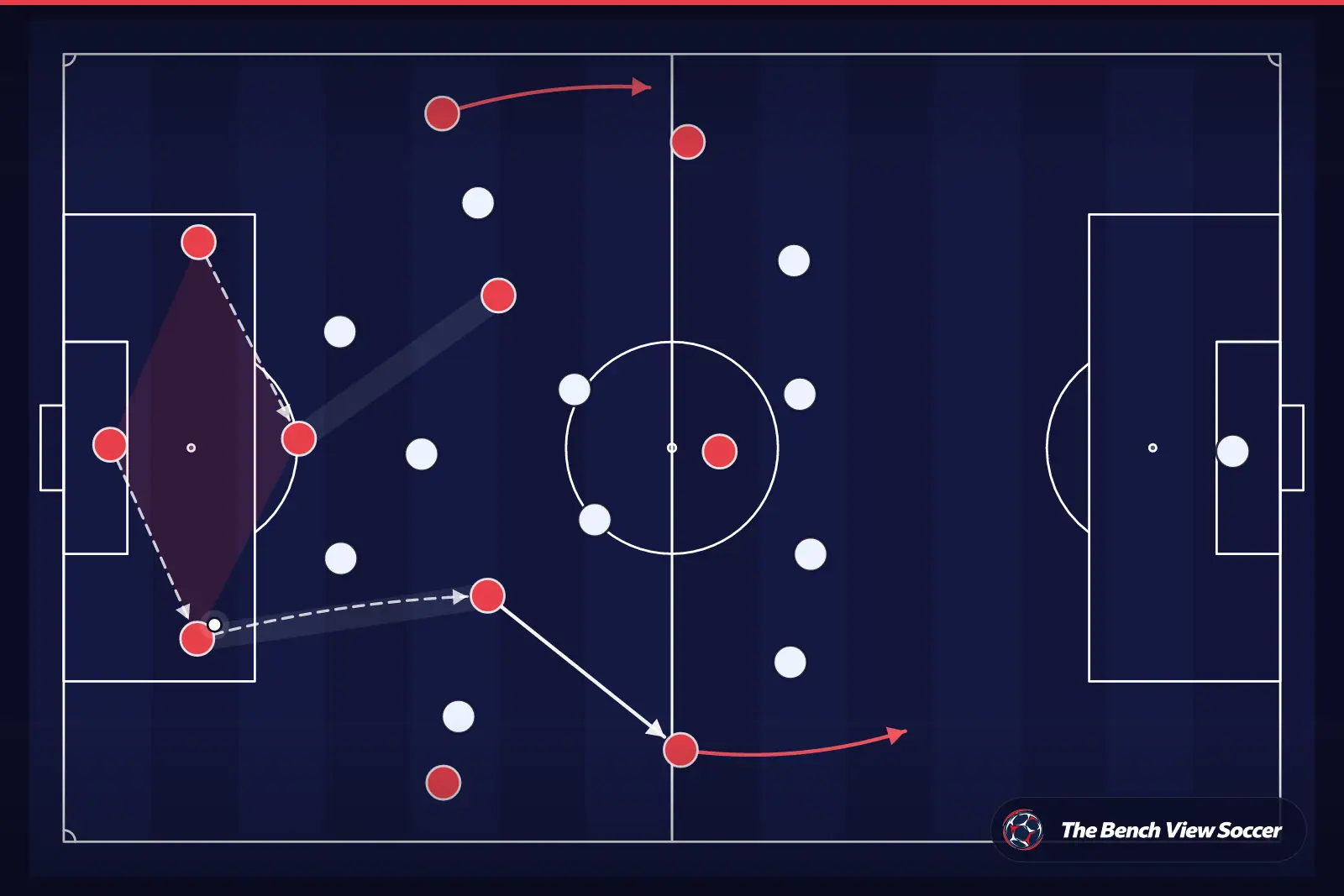
Press resistance begins before the ball is even played: both City and Arsenal shape the pitch to create safe passing lanes and to tempt the opponent into predictable pressing routes. Manchester City in Guardiola’s system often forms a 3–2 base in build-up: one full-back steps into midfield (like John Stones in 2022–23), the other holds width, and the centre-backs split to stretch the first pressing line. The key is the “free man” concept: City positions one player behind the press so the first pass attracts pressure and the next pass breaks it. They keep distances short so a player on the ball always has at least two options: one safe (recycle) and one progressive (break a line). Arsenal under Arteta uses similar principles with different details. Arsenal’s goalkeeper (often Aaron Ramsdale or later David Raya) plays as an extra outfield player, and the centre-backs plus the No.6 (like Thomas Partey or Jorginho) create triangles to play through pressure. Arsenal frequently uses the right side to bait a press and then switches quickly to the left, where a wide player and an advanced midfielder can attack the space. In both teams, the most important individual habits are: receiving with an open body (so you can see both sides), using one-touch “bounce” passes to set a teammate, and recognising when to dribble out to force an opponent to commit. Press resistance is not always about beating a man; it is about making the press run at the wrong time and in the wrong direction.
Match Examples
A clear Manchester City example comes from the 2022–23 Premier League, especially big games where opponents press with intensity. Against Arsenal at the Emirates (Premier League, 15 February 2023), City repeatedly uses Ederson and the back line to tempt Arsenal’s first press, then finds the spare player in midfield to progress. When Arsenal jumps to mark City’s pivot, City switches the point of attack quickly, often using a centre-back stepping in or a full-back inside to create a new passing angle. Another strong reference is Manchester City vs RB Leipzig in the UEFA Champions League 2023–24 group stage (at the Etihad, 28 November 2023). Leipzig presses with speed and man-orientations, and City responds by moving the ball to the goalkeeper and back into midfield to break the first wave, then finding wide players after the press collapses inward. For Arsenal, watch the 2023–24 Premier League match Arsenal vs Liverpool at the Emirates (4 February 2024). Liverpool’s press is one of Europe’s most aggressive under Jürgen Klopp, and Arsenal shows improved composure: the goalkeeper stays involved, the centre-backs split wider, and the midfield offers “staggered” support (one player close for safety, another higher to receive beyond pressure). Arsenal also uses quick wall passes on the flank to escape traps, then plays forward into the channels once Liverpool’s midfield is drawn out. Another useful Arsenal reference is Arsenal vs Manchester City at the Emirates (Premier League, 8 October 2023). City applies controlled pressure, and Arsenal responds by building patiently, then choosing moments to go longer into the forwards when short options are blocked. These matches highlight that press resistance is not a single trick; it is a set of repeatable solutions: playing through, playing around, or playing over—chosen based on the opponent’s pressing shape.
Related Concepts & Skills
Training Implications
To train press resistance at academy or amateur level in India, focus on habits and simple constraints that force the right decisions. First, run a 4v2 or 5v2 rondo (keep-away) with a rule: the receiver must take their first touch “across the body” to face the far side. This teaches open body shape and scanning. Second, progress to a positional rondo: 6v3 with two “target” players outside. Coach the idea of creating a free man by moving the ball quickly, not by forcing risky passes. Third, build a small build-up game: set up a 7v7 on half a pitch where one team must play out from a goalkeeper and score by dribbling or passing through a marked midfield gate. Give the pressing team a clear trigger (for example, they can press only after the first pass from the goalkeeper) so the build-up team learns to recognise pressure moments. Fourth, add an actionable coaching checklist: before receiving, scan twice (once when the ball travels to the passer, once as it travels to you); keep passing distances of 8–15 metres to maintain support; always provide a “bounce” option behind the ball; and if the forward pass is blocked, recycle quickly rather than forcing it. Finally, include a transition rule: if possession is lost in build-up, the team has five seconds to win it back. This connects press resistance with the reality of elite football—mistakes happen, but structure and reactions reduce damage.
The Bench View app
Don’t just read football — train it
Everything you read here, turned into training you can follow step by step.
Physical training at home
AI daily sessions adapted to your level and position. No equipment needed.
Tactical training courses
Step-by-step courses on positioning, pressing, build-up and decision making.
- 7 days free
- No commitment
- Cancel anytime
Free account: 2 physical sessions + the first tactical course. PRO: 7-day free trial — cancel before day 8 and you pay nothing.