Introduction
Real Madrid’s counter-attack is not just “run fast and score.” It is a repeatable pattern built on spacing, decision-making, and timing. Across different eras—Carlo Ancelotti’s Champions League-winning sides and even the more controlled phases under Zinedine Zidane—Madrid consistently turn defensive moments into clear chances within a few passes. For fans learning tactics, the key idea is this: a counter-attack works when the team already has good positions before the ball is won. Madrid’s forwards and midfielders prepare “exit routes” (safe passing options out of pressure), and their wide players stretch the pitch so the first forward pass actually hurts the opponent. When the ball is recovered, the carrier does not dribble blindly; he reads numbers, distances, and teammates’ runs. This article breaks down Madrid’s counter through three lenses—positioning, pass choices, and runs—so you can recognize the patterns in La Liga and the UEFA Champions League.
How It Works
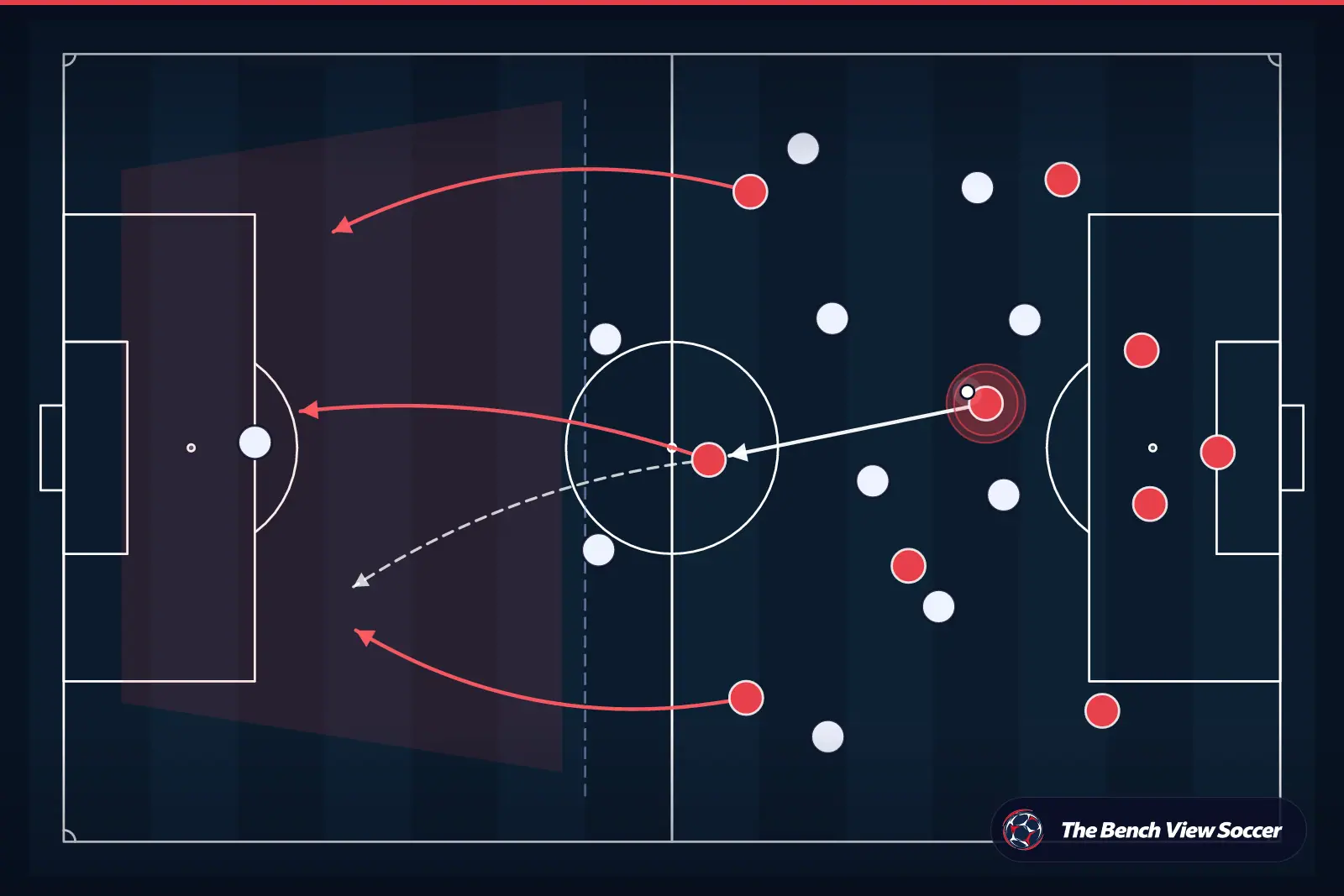
Real Madrid’s counter-attack begins with how they position themselves without the ball. Even when they defend deep, they keep at least two players ready to sprint into space, often one central (a striker like Karim Benzema in earlier seasons) and one wide (Vinícius Júnior on the left, or a right-sided runner like Rodrygo). This creates immediate “verticality,” meaning the team attacks forward quickly rather than circulating sideways. The ball-winning action often comes from a midfielder (Toni Kroos or Luka Modrić stepping in) or a defender (Éder Militão or Antonio Rüdiger) anticipating a loose touch. The first pass is usually the most important: Madrid prefer a pass that escapes pressure and turns the opponent around. If the opponent’s fullbacks are high, the pass goes into the channel behind them; if the opponent’s midfield is spread, the pass goes into the feet of a forward who can bounce it off quickly. Pass choice follows a simple hierarchy: (1) forward pass into space if a runner is free, (2) pass into feet to set a “third-man run” (Player A passes to B, B lays off to C running beyond), (3) carry the ball only if passing lanes are blocked. The runs are layered: one runner goes long to pin defenders, one comes short to connect, and one arrives late at the edge of the box for a cutback. This is why Madrid’s counters often end with a low cross or square pass rather than a hopeful shot—because the structure is designed to create a high-quality finish.
Match Examples
A clear example appears in the 2021–22 UEFA Champions League semi-final, Manchester City vs Real Madrid (first leg at the Etihad). When Madrid recover the ball, they immediately look for Vinícius Júnior into the left channel, targeting the space behind City’s advanced right side. The counter works because Modrić and Kroos offer calm exit passes, while Benzema’s movement gives a central reference: he either pins a centre-back or drops to connect so Vinícius can run beyond. Another strong reference point is the 2022–23 Copa del Rey semi-final, Barcelona vs Real Madrid (second leg at Camp Nou). Madrid win the ball and attack quickly into the spaces Barcelona leave during their build-up. The key pattern is a direct release into the front players followed by a quick square or cutback, punishing Barcelona’s rest-defence (the players left behind the ball). A third example is the 2023–24 UEFA Champions League knockout stage run under Carlo Ancelotti, where Madrid repeatedly use Jude Bellingham as the “bridge” on transitions: he receives under pressure, turns if possible, or plays a one-touch set that releases a winger. Notice how Madrid do not counter every time; they choose moments when the opponent’s shape is stretched and the first pass can eliminate multiple defenders at once. These matches show that Madrid’s counters are not random bursts—they are rehearsed decisions triggered by opponent positioning.
Related Concepts & Skills
Training Implications
If you want to train Real Madrid-style counter-attacks at a local academy or even in a college team, focus on repeatable habits rather than only speed. First, train the “first pass forward” decision. Set up a 6v6 game in a 40x30m area with two mini-goals on each end. Rule: within three seconds of winning the ball, the team must attempt a forward pass (into space or into feet). This forces players to scan and choose quickly. Second, rehearse the three-lane run structure: place three attackers against two defenders starting from the halfway line. On ball recovery, the left runner goes long into the channel, the central player offers a short option, and the right runner attacks the far post. Rotate roles so everyone learns timing. Third, add a “third-man run” drill: midfielder passes into a forward’s feet, forward sets one-touch into a second midfielder or winger running beyond; finish with a cutback to the edge of the box. Coach the cue: the runner starts moving as the first pass travels, not after the layoff. Fourth, build calm under pressure: play a rondo (keep-away) where the exit pass must break a line into a target player, simulating Modrić/Kroos escaping the press. Finally, review video clips: after each session, pick two transitions and ask players three questions—Where is the space? Who is the first forward pass? Who makes the late run for the cutback? This makes counter-attacking a team skill, not an individual sprint.
The Bench View app
Don’t just read football — train it
Everything you read here, turned into training you can follow step by step.
Physical training at home
AI daily sessions adapted to your level and position. No equipment needed.
Tactical training courses
Step-by-step courses on positioning, pressing, build-up and decision making.
- 7 days free
- No commitment
- Cancel anytime
Free account: 2 physical sessions + the first tactical course. PRO: 7-day free trial — cancel before day 8 and you pay nothing.