Introduction
Wolverhampton Wanderers (Wolves) often sit in that interesting Premier League middle zone: not always dominating the ball like Manchester City, but rarely passive. One of the most teachable ideas in their game is the counter-press—what a team does in the few seconds immediately after losing possession. For fans learning tactics, this is a great entry point because it connects effort, structure, and decision-making. Counter-pressing is not simply “run at the ball”; it is an organised attempt to win the ball back quickly or, if that is not possible, to slow the opponent’s counter-attack so Wolves can reset their shape. Under managers like Julen Lopetegui and later Gary O’Neil, Wolves show different flavours of this idea depending on game state, opponent quality, and where the ball is lost. This article breaks down the logic behind Wolves’s counter-press: when it activates, who leads it, what angles matter, and how it links to their broader identity in competitions like the Premier League and the FA Cup.
How It Works
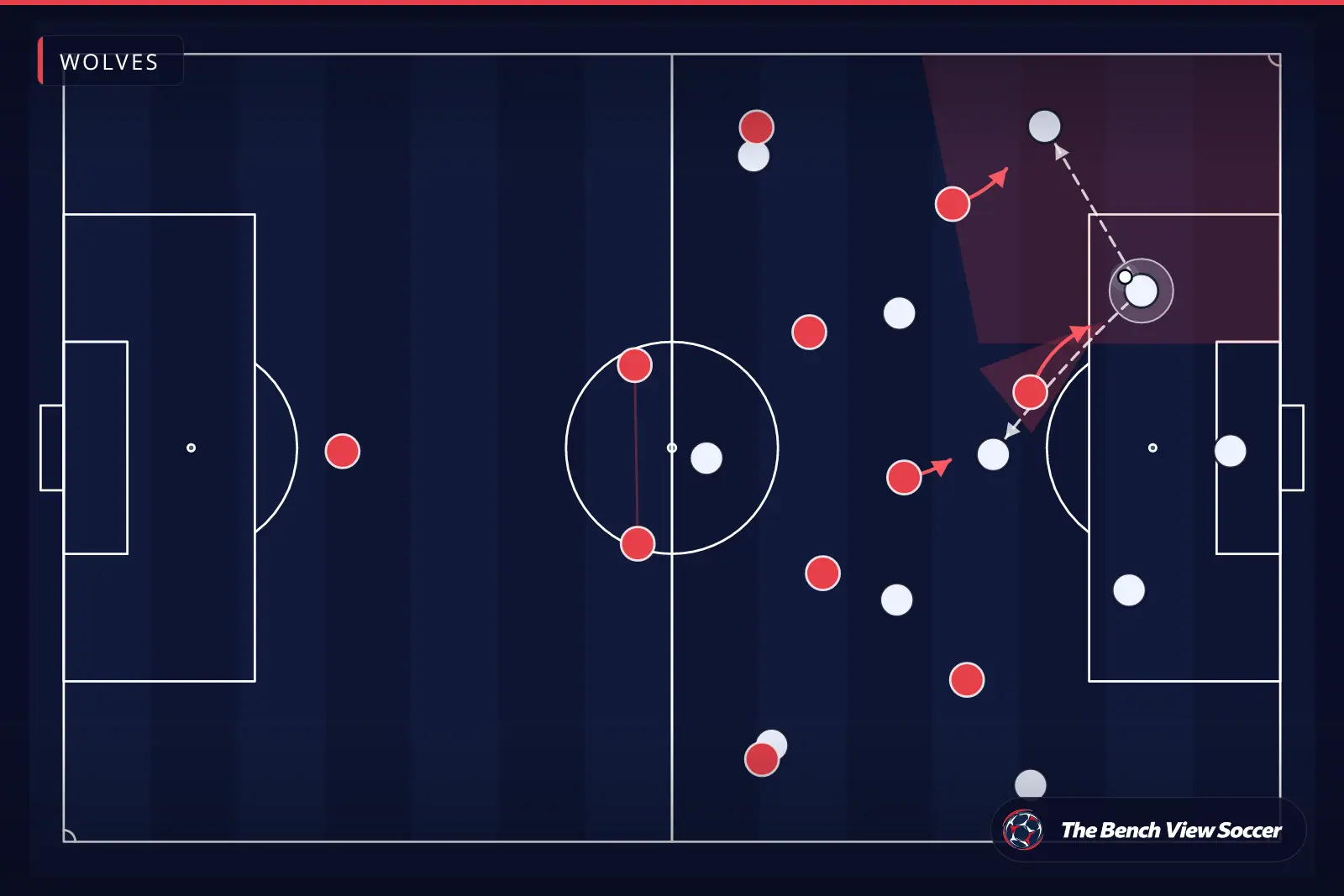
A counter-press begins the moment Wolves lose the ball. The key detail is that Wolves try to react as a unit, not as isolated players. The nearest player to the loss point becomes the “first presser”: he immediately closes the ball carrier to stop a forward pass. The second and third players do not just sprint; they close passing lanes by curving their runs so the opponent cannot easily play into the middle. Wolves often prefer to force play wide because the touchline acts like an extra defender. When the ball is lost in central areas, Wolves’s midfielders (often a ball-winner plus a passer) step in to block the “vertical lane” into the striker, while a forward screens the pass back into the pivot. When the ball is lost near the wing, the full-back/wing-back and wide forward squeeze together to trap the opponent near the line. Importantly, Wolves balance aggression with safety: one defender (usually a centre-back) holds a slightly deeper position to protect against a direct ball in behind. In practical terms, Wolves’s counter-press aims for one of three outcomes within roughly 5–8 seconds: (1) win the ball back cleanly, (2) force a rushed clearance or long ball, or (3) delay the counter long enough to retreat into their mid-block. The quality of the counter-press depends on distances—if Wolves are too stretched in possession, they cannot arrive quickly enough after the turnover.
Match Examples
To see Wolves’s counter-press in a clear, high-intensity context, look at their Premier League meeting with Tottenham Hotspur under Ange Postecoglou in the 2023–24 season (Wolves 2–1 Spurs at Molineux, November 2023). Spurs often build with brave central passes, so Wolves’s counter-press focuses on blocking the first inside pass after a turnover. When Wolves lose the ball in the attacking half, the nearest forward presses the receiver’s back shoulder while a midfielder jumps to cut the lane into Spurs’s central midfielder. This forces Spurs to play outward, buying time for Wolves to collapse around the ball. Another useful reference point is Wolves vs Manchester City in the Premier League during 2023–24 (Wolves 2–1 Man City at Molineux, September 2023). City are the hardest opponent to counter-press because they escape pressure with quick triangles. Wolves do not try to “out-City City”; instead, they counter-press with disciplined angles. The first presser prevents the immediate bounce pass, while the next players mark City’s nearest outlets rather than chasing the ball. This turns the counter-press into a short “freeze” moment: even if Wolves do not win it back, they slow City down and can fall into a compact shape. A third lens is Wolves vs Liverpool in the Premier League 2023–24 at Molineux (Wolves 1–3 Liverpool, September 2023). Liverpool under Jürgen Klopp are famous for counter-pressing themselves, so the game becomes a battle of transitions. Wolves’s best counter-press moments come when they lose the ball near the wing: they immediately surround the receiver and force a hurried pass down the line. When Wolves lose it centrally, Liverpool’s speed through the middle punishes any hesitation, showing why Wolves sometimes choose the safer option—delay and reset—rather than over-commit to a risky counter-press.
Related Concepts & Skills
Training Implications
If you want to coach or practise Wolves-style counter-pressing—whether in an Indian school team, a local turf group, or an academy setting—train reactions and spacing, not just fitness. First, use a “5-second rule” game: play 6v6 in a 40x30m area; when a team loses the ball, they must try to win it back within 5 seconds. If they do, they get 2 points; if not, play continues normally. This builds the instant mindset shift that defines counter-pressing. Second, coach pressing angles: set up 3v3+2 neutral players. When possession changes, freeze the play for two seconds and ask: who is first presser, who blocks the inside lane, who covers the pass back? Restart and demand curved runs that show the ball outside. Third, train “rest defence” habits so counter-pressing is possible. In an 8v8 half-pitch game, require the attacking team to always keep two players behind the ball (one central, one slightly wider). If they break this rule, it’s a turnover. This teaches players not to all run ahead and then complain they cannot counter-press. Fourth, build wide-trap coordination: create a channel on each wing (5m wide). Award a bonus point if the defending team wins the ball in the channel after a turnover, encouraging players to squeeze the touchline and communicate. Finally, add a simple language system: call “GO” when the ball is lost and Wolves would counter-press, and “DROP” when the safe choice is to retreat. The biggest improvement for amateur teams is learning when not to press—counter-pressing is powerful, but only when distances are short and cover exists.
The Bench View app
Don’t just read football — train it
Everything you read here, turned into training you can follow step by step.
Physical training at home
AI daily sessions adapted to your level and position. No equipment needed.
Tactical training courses
Step-by-step courses on positioning, pressing, build-up and decision making.
- 7 days free
- No commitment
- Cancel anytime
Free account: 2 physical sessions + the first tactical course. PRO: 7-day free trial — cancel before day 8 and you pay nothing.