Introduction
Arsenal under Mikel Arteta in the Premier League and UEFA Champions League is often described as a “pressing team,” but the more useful lens for learning tactics is how they choose when to press. Arsenal do not sprint at the ball all the time; they wait for specific midfield press triggers—moments when the opponent’s body shape, passing option, or spacing makes a turnover likely. For fans watching on late nights, this is a great entry point into modern European football: the press is not just effort, it is a coordinated plan. In Arsenal’s system, the midfield unit (typically Declan Rice as the main controller, with Martin Ødegaard and another No. 8 like Kai Havertz or Jorginho/Thomas Partey depending on the match) acts like a net. They tempt a pass into an area they can trap, then collapse around it. This article breaks down the triggers Arsenal look for, how the midfield coordinates with the front line and back line, and why these choices create clean, repeatable turnovers rather than chaotic chasing.
How It Works
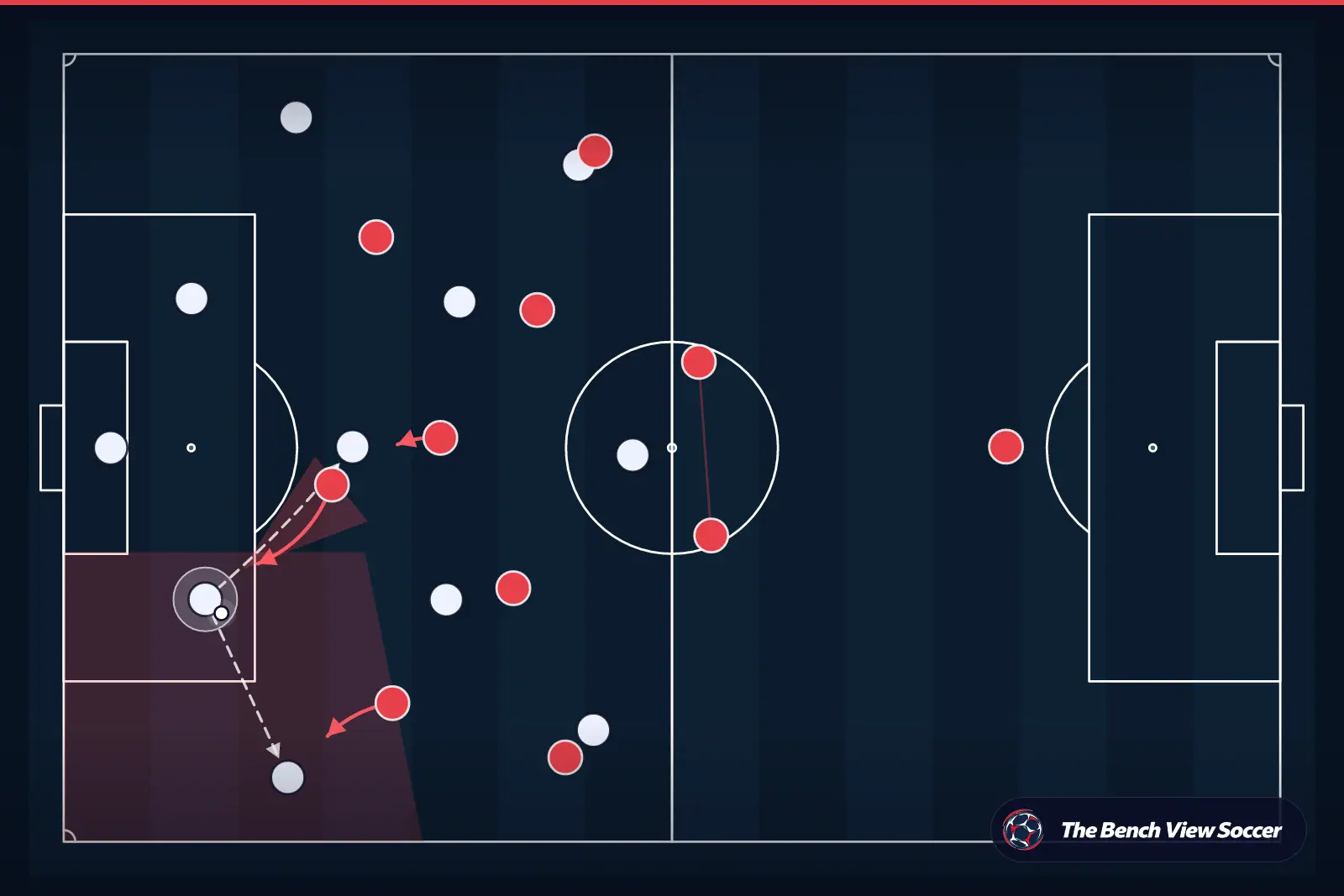
A “press trigger” is a pre-agreed cue that tells the team to jump forward and hunt the ball. Arsenal’s midfield triggers usually revolve around forcing the opponent into a predictable, risky pass. One common trigger is the pass into the opponent’s pivot (the central midfielder who receives from the centre-backs). Arsenal often allows the centre-back to hold the ball, but once that centre-back plays into the pivot with his back to goal, Ødegaard and the nearest No. 8 step in aggressively while Rice covers behind them. The key detail is body orientation: if the pivot receives facing his own goal or side-on with no open turn, Arsenal presses hard because the receiver’s next touch is likely backward or sideways. Another trigger is a “telegraphed” pass into the wide channel. When Arsenal’s winger and full-back guide play toward the touchline, the midfield shifts across early so the opponent’s wide midfielder or full-back receives with limited options. The press is then a three-layer action: the winger closes from outside-in to block the line, the midfielder attacks the inside passing lane, and Rice screens the central escape route. A third trigger is a bouncing pass (a short pass that forces the receiver to take a heavy first touch), especially on wet pitches or under pressure. Arsenal’s midfield reads these moments and accelerates, because a heavy touch creates a 50–50 duel that becomes a 70–30 if two Arsenal players arrive together. Importantly, Arsenal’s midfield press is connected to their back line’s high position. William Saliba and Gabriel Magalhães hold a line that compresses space, meaning the opponent has less room to play through the press. This is why the triggers matter: Arsenal press when the opponent cannot easily go long into space. If the opponent has a fast striker ready to run in behind (for example, against Liverpool or Tottenham), Arsenal is more selective, using Rice to protect the central channel while still hunting specific bad receptions in midfield.
Match Examples
In the 2023–24 Premier League, Arsenal’s 3–1 win over Liverpool at the Emirates (February 2024) is a strong example of midfield triggers creating decisive turnovers. Liverpool tries to build through their midfield line, but Arsenal’s press activates when a Liverpool player receives with his back turned near the centre-left corridor. Ødegaard and Rice step up together, and the nearby winger pinches in to remove the easy outlet. The result is not just “pressure,” but forced mistakes: Arsenal wins second balls in midfield and turns them into immediate attacks, including situations where Liverpool’s defenders are forced to play hurried passes under the threat of a central trap. Another clear case appears in the 2023–24 Premier League match Arsenal 0–2 Aston Villa at the Emirates (April 2024), where the contrast helps learning. Villa under Unai Emery uses deliberate lures: they invite pressure, then find a third-man pass (a quick pass to a teammate who then releases a runner) around the first wave. Arsenal still uses their triggers—jumping on the pivot reception and on wide-line passes—but Villa’s spacing gives the receiver a cleaner “exit.” This match shows that triggers only work if the distances between pressers are right; if Arsenal arrives one step late, Villa’s midfield escapes and Arsenal’s high line is exposed. In the 2024–25 season (early Champions League group-stage fixtures and big Premier League away games), Arsenal’s approach remains consistent: they press hardest on backward-facing receptions and on passes into crowded central pockets, rather than chasing every centre-back touch. When you rewatch any Arsenal match, pause when the opponent’s pivot receives with a closed body shape—Arsenal’s midfield line usually tightens instantly, and the front line curves their runs to block the safe return pass. That split-second is the trigger becoming a turnover.
Related Concepts & Skills
Training Implications
To train Arsenal-style midfield press triggers at an academy or amateur level in India, make the cues simple and repeatable. Start with a 6v6 + 2 neutral players rondo (possession game) in a 25x25 metre grid. Give the defending team a rule: they only press aggressively when (1) the receiver takes a touch back toward his own goal, or (2) the pass goes into the central “pivot zone” marked by a small square in the middle. Coach the defenders to shout the trigger word (“pivot!” or “back!”) so the whole unit moves together. Add structure with roles: assign one player as the “screen” (Rice role). His job is not to chase the ball first; he stands between the ball and the most dangerous forward pass, then steps in to win loose balls. Two players act as “hunters” (Ødegaard/No. 8 roles): when the trigger happens, they press from two angles—one attacks the ball, the other blocks the escape pass. Measure success with a simple target: can the defending team win the ball within 5 seconds of the trigger? If not, reset and correct spacing. For the wide-trap trigger, run a channel game: split the pitch into three vertical lanes. Award the defending team 2 points if they win the ball in the wide lane within 6 seconds of the ball entering that lane. Coach the winger to press outside-in (to trap against the line) and the near midfielder to arrive on the inside shoulder to block the pass back into midfield. Finish each drill with a transition: after the win, the team must make a forward pass within 3 seconds. This builds the Arsenal habit of turning a midfield turnover into an immediate attack rather than just clearing the ball.
The Bench View app
Don’t just read football — train it
Everything you read here, turned into training you can follow step by step.
Physical training at home
AI daily sessions adapted to your level and position. No equipment needed.
Tactical training courses
Step-by-step courses on positioning, pressing, build-up and decision making.
- 7 days free
- No commitment
- Cancel anytime
Free account: 2 physical sessions + the first tactical course. PRO: 7-day free trial — cancel before day 8 and you pay nothing.