Introduction
Arsenal under Mikel Arteta in the Premier League and UEFA Champions League uses full-backs as more than touchline defenders. They are key pieces that let the team attack with control while still being ready for transitions (the moment the ball changes team). For fans who are used to thinking “full-backs overlap and cross,” Arsenal offers a different lesson: a full-back can become an extra midfielder, a third centre-back, or a pressing trap-setter depending on the phase. This article explains how Arsenal’s full-backs—think Ben White, Oleksandr Zinchenko, Takehiro Tomiyasu, and sometimes Jurriën Timber—balance two jobs that often clash: adding numbers to Arsenal’s build-up and final third, but also protecting the back line when possession is lost. The focus is not on individual talent alone; it is on how Arteta’s structure, spacing, and decision-making rules guide each full-back’s movement.
How It Works
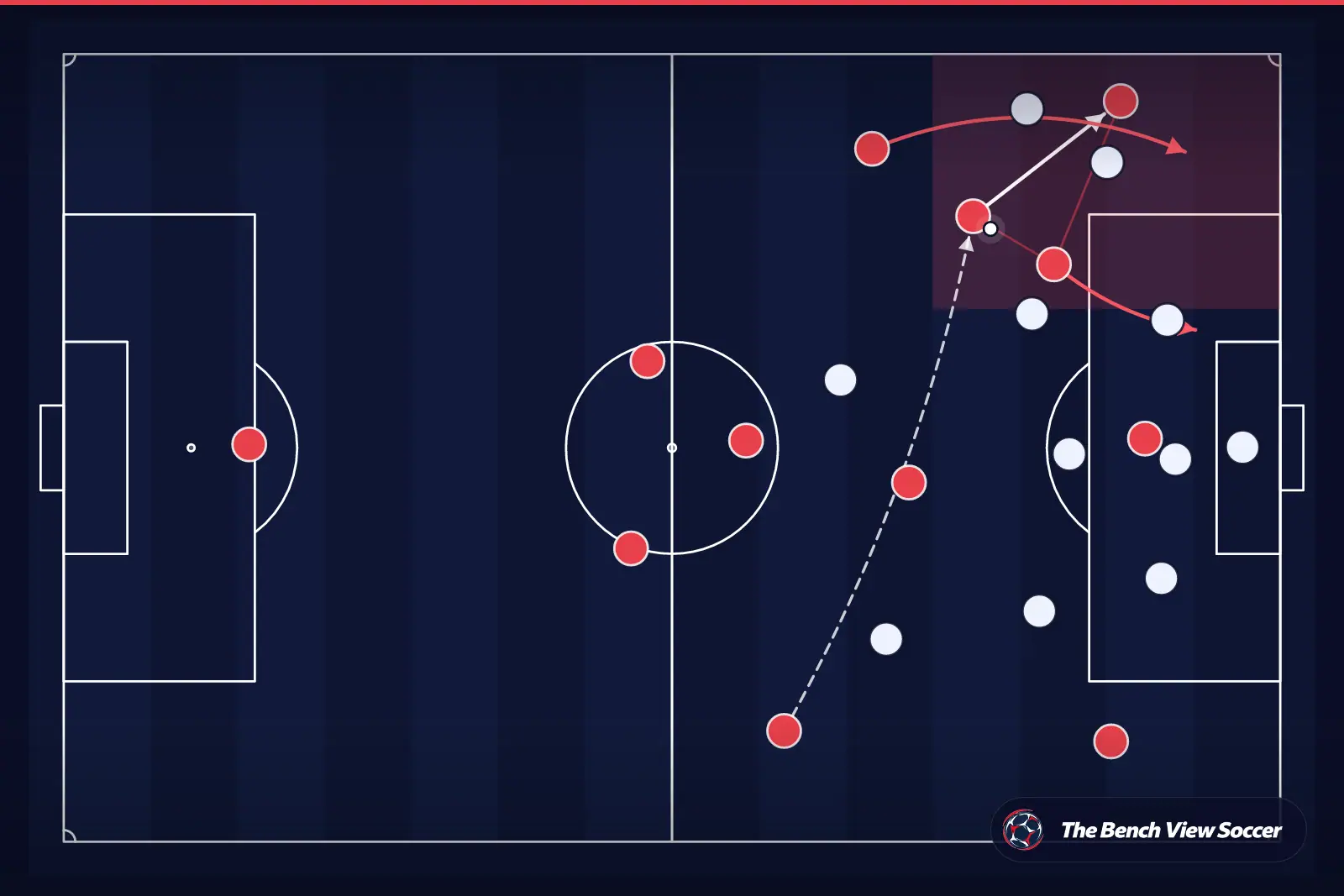
Arsenal’s default idea is to create a stable “rest defence,” meaning the players left behind the ball are positioned to stop counter-attacks. The full-backs are central to that stability. On the right, Ben White often plays a conservative-attack role: he supports Bukayo Saka with underlaps (runs inside) or overlaps (runs outside), but he also stays connected to William Saliba so Arsenal does not get split by one long pass. This connection matters because Arsenal’s right winger (Saka) stays high and wide, so White’s timing is about supporting without leaving a big gap behind him. On the left, Arteta often uses an “inverting” full-back like Oleksandr Zinchenko, who steps into midfield in possession to help progress play and create a midfield overload. This turns Arsenal’s shape into something like a 2-3-5 in attack: two centre-backs, three players across the middle line (often including the inverted full-back), and five attackers occupying the front line. But the trade-off is clear: if Zinchenko moves inside and loses the ball, the space behind him can be attacked. Arsenal solves this by shifting cover: the left centre-back (Gabriel Magalhães) becomes more aggressive in defending wide areas, while the nearest midfielder (often Declan Rice) slides across to protect the channel. The other full-back may also “tuck in,” narrowing to form a back three. In short, Arsenal’s full-backs do not attack freely; they attack with rules about distance to centre-backs, the position of the ball, and the risk of the next pass.
Match Examples
A helpful reference is Arsenal vs Manchester City at the Emirates Stadium in the 2023–24 Premier League (the 1–0 Arsenal win in October 2023). Arsenal’s full-backs play a careful game because City under Pep Guardiola punishes open transitions. Ben White supports Saka but rarely abandons the connection to Saliba; his positioning helps Arsenal defend City’s wide rotations without being dragged into constant 1v1s. On the left, Zinchenko’s inside positioning helps Arsenal circulate the ball, but Arsenal also shows the defensive adjustment: Gabriel defends wider, and Rice protects the space in front of the centre-backs so Erling Haaland does not get direct running lanes. Another clear example is Arsenal vs Liverpool at the Emirates in the 2023–24 Premier League (Arsenal win 3–1 in February 2024). Liverpool under Jürgen Klopp presses aggressively, so Arsenal’s full-backs make build-up choices that are about safety as much as creativity. When Zinchenko steps inside, he offers a central passing option to escape pressure; when the risk is higher, Arsenal uses more “third-man” combinations (pass to one player to set up the next pass) to avoid losing the ball in the middle. White’s right-side support is timed so Arsenal can keep Saka high to threaten in behind, while still being ready to defend quick counters through Mohamed Salah’s channel. For a European reference, look at Arsenal in the 2023–24 UEFA Champions League knockouts, especially against Bayern Munich. Bayern’s wide threats and transition speed force Arsenal’s full-backs to think first about structure: one full-back can support the attack, but the other often holds a deeper, narrower position to prevent a counter into open grass. These matches show the core lesson: Arsenal’s full-backs change their attacking height and width based on opponent strengths, not just on Arsenal’s own desire to dominate the ball.
Related Concepts & Skills
Training Implications
If you coach or play in India—school teams, local academies, or amateur leagues—you can copy Arsenal’s principles without needing Premier League-level athletes. Start with a simple rule set for your full-backs: (1) if the ball is on your side and your winger is high, you support underneath first; overlap only when a midfielder covers your space. (2) if the ball is on the opposite wing, you tuck in to become a third centre-back or a narrow full-back, reducing the chance of a counter through the middle. To train this, run a 7v7 or 8v8 game with marked zones: wide channels and central corridor. Give the full-back two “points” for successful underlaps or inverted receptions in midfield, but subtract a point if the opponent counter-attacks into the space he vacates. This creates decision-making pressure. Add a transition drill: 6 attackers build from the back against 4 pressers. If the pressers win the ball, they have 6 seconds to counter into mini-goals placed in the wide channels. Coach the near-side full-back to choose between overlapping and holding based on whether a holding midfielder is behind the ball. Finally, do a video habit: after matches, clip three moments where the full-back attacked and three moments where he stayed. Ask: was there cover? was the centre-back exposed? did we lose compactness (distance between defenders)? This is how Arsenal’s “rules” become repeatable behaviours, not random running.
The Bench View app
Don’t just read football — train it
Everything you read here, turned into training you can follow step by step.
Physical training at home
AI daily sessions adapted to your level and position. No equipment needed.
Tactical training courses
Step-by-step courses on positioning, pressing, build-up and decision making.
- 7 days free
- No commitment
- Cancel anytime
Free account: 2 physical sessions + the first tactical course. PRO: 7-day free trial — cancel before day 8 and you pay nothing.