Introduction
Australia’s best counter-attacking moments rarely look like slow, patient “build-up.” They look like a sprint: win the ball, face forward, and hit space before the opponent can reset. For Indian fans watching European football, this style is a useful “gateway” to tactics because the cause-and-effect is clear. Australia often defends with numbers, then attacks with speed and direct balls that break multiple lines at once. A “line” here means an organised row of opposition players—usually the first pressing line (forwards), the midfield line, and the defensive line. Breaking lines quickly is how a team turns one tackle into a big chance. Under managers like Ange Postecoglou (who later coaches Celtic and Tottenham Hotspur), Graham Arnold, and now Tony Popovic, Australia’s principles change in possession, but the counter-attack remains a reliable weapon—especially in AFC Asian Cup matches and FIFA World Cup qualifiers where transitions decide tight games.
How It Works
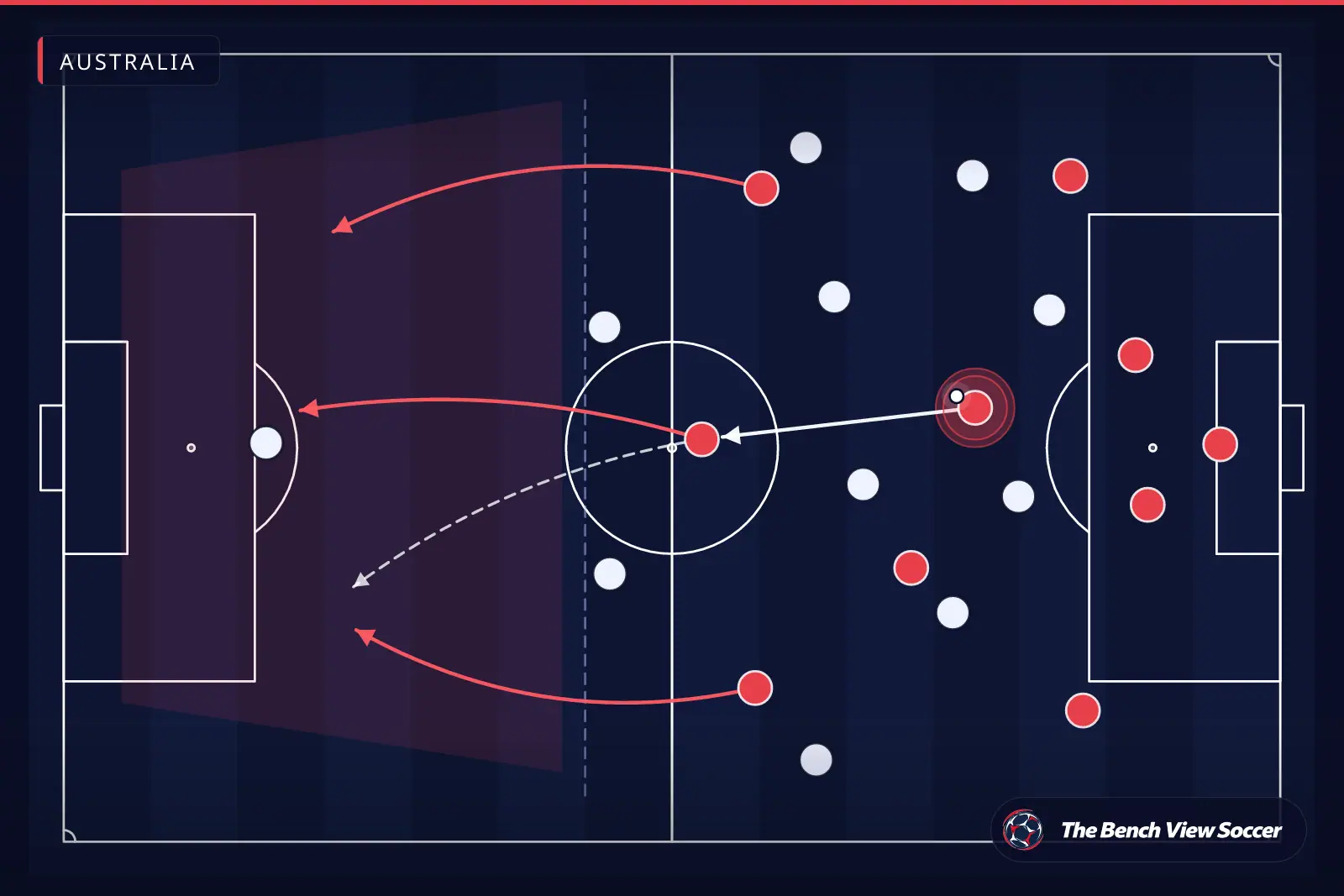
Australia’s counter-attack usually begins with how they defend. They often sit in a compact block, meaning the space between defenders and midfielders stays small. This forces opponents to play into crowded areas, where a tackle or interception is likely. The moment the ball is won, Australia’s first action is to play forward, not sideways. The key is the “first pass”: a sharp vertical ball into a striker’s feet, a wide runner’s path, or the space behind the opponent’s full-backs. This direct pass “breaks lines” because it bypasses the opposition midfielders who are positioned to press. Australia also uses width aggressively. Wingers and full-backs start deeper when defending, so when the ball is recovered they have momentum to run forward into open grass. The central striker (often a physical reference point like Mitchell Duke or a mobile forward like Mathew Leckie in different cycles) either pins centre-backs or drops to link play. Midfielders then arrive as the second wave, aiming for cutbacks at the edge of the box rather than slow circulation. A simple way to read their counter is: win it, find the outlet, attack the far post and the cutback zone, and shoot before the opponent regains compactness.
Match Examples
A clear reference point is Australia’s FIFA World Cup 2022 campaign in Qatar. Against Tunisia in the group stage (2022 World Cup, matchday 2), the decisive moment reflects classic Australian transition thinking: they compete hard for second balls, then attack quickly with direct delivery into the box, trusting timing and aggression. Even when the final action is a cross rather than a through ball, the idea is the same—reach the danger area before Tunisia’s defensive line is settled. Another useful example is the AFC Asian Cup 2015 run on home soil under Ange Postecoglou. In the semi-final versus the UAE (2015 Asian Cup), Australia’s attacking bursts often come after regains where the first look is forward; runners go beyond the ball while the pass is played early to break pressure. You can also study Australia vs Denmark at the 2022 World Cup (group stage, matchday 3). Australia defends compactly, then counter-attacks into the wide channels when Denmark’s full-backs are high. The most educational detail for viewers is how quickly Australia decides: two or three passes are enough to reach the final third, and the rest of the team sprints to support so the attack does not become an isolated dribble.
Related Concepts & Skills
Training Implications
To train an Australia-style counter-attack, start with habits that make the first 5 seconds after winning the ball automatic. (1) First-pass drill: set up a 6v6 in a 40x30m area with two mini-goals. When a team wins possession, they must attempt a forward pass within 2 seconds. Score double if the pass breaks a marked “midfield line” zone. Coach the receiver’s body shape: they open up to face forward, not back toward their own goal. (2) Wide channel transition game: mark two wide corridors. If the countering team plays into a wide corridor, a winger can carry the ball without pressure for three touches—this encourages immediate use of width like Australia does when opponents’ full-backs are high. (3) Second-wave finishing: run a 5v4 counter from halfway, but goals only count if a late-arriving midfielder reaches the cutback zone (top of the box) before the shot. This builds the timing Australia needs so counters do not die with the first runner. (4) Video checklist for players: after each scrimmage, review three clips and ask: Did we play forward first? Did we sprint to support? Did we protect ourselves with at least two players behind the ball (rest defence) in case we lose it? These are simple, repeatable rules that translate directly to match performance.
The Bench View app
Don’t just read football — train it
Everything you read here, turned into training you can follow step by step.
Physical training at home
AI daily sessions adapted to your level and position. No equipment needed.
Tactical training courses
Step-by-step courses on positioning, pressing, build-up and decision making.
- 7 days free
- No commitment
- Cancel anytime
Free account: 2 physical sessions + the first tactical course. PRO: 7-day free trial — cancel before day 8 and you pay nothing.